
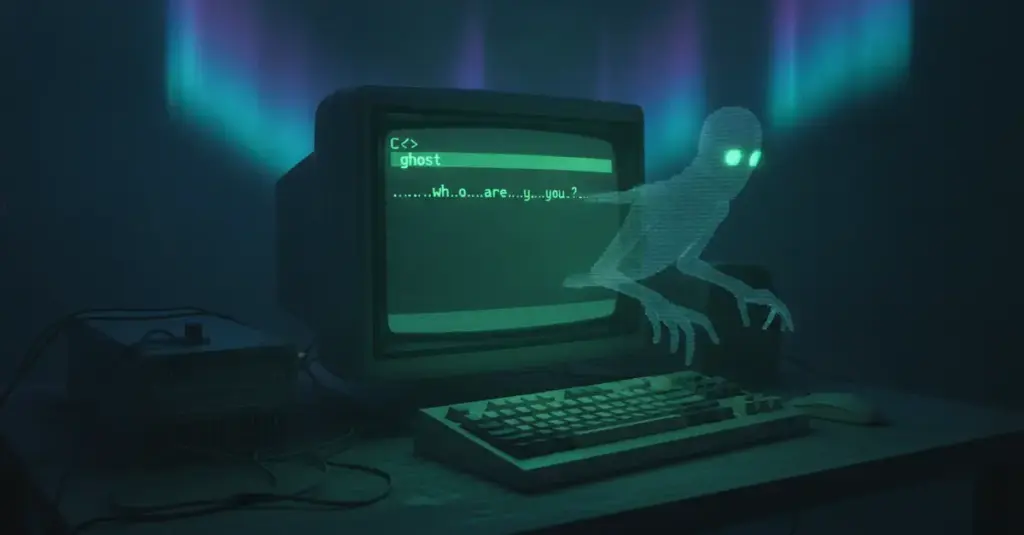
As the annual Hacktoberfest celebrations reach their final stages, a new project has emerged that blends the technical rigor of local artificial intelligence with the atmospheric storytelling of classic horror. Developed as a submission for the Hacktoberfest Open-Source AI Challenge Week 4, titled "Ghost in the Machine," the project of the same name introduces an interactive terminal environment where a mysterious digital entity resides, powered by locally hosted open-weight AI models.
The project, created by developer Shikhar Ahirwar, represents a growing movement within the open-source community to move away from centralized, cloud-based AI services in favor of decentralized, private, and customizable local alternatives. By leveraging the latest advancements in small-scale large language models (LLMs), the "Ghost in the Machine" project provides a hauntingly immersive experience that challenges the traditional, utilitarian relationship between a user and their computer terminal.
The Architecture of a Digital Haunting
At its core, "Ghost in the Machine" is a web-based terminal emulator designed to mimic the appearance of a vintage command-line interface. However, unlike a standard shell where commands like ls or cd yield predictable file system outputs, this terminal serves as a portal to a conversation with a "digital ghost."
The project is notable for its extreme technical minimalism. Built using only standard web technologies—HTML, CSS, and vanilla JavaScript—the application avoids the heavy overhead of modern frameworks like React or Vue. This choice was intentional, aimed at ensuring the project remains accessible to developers of all skill levels who wish to inspect, modify, or extend the codebase.
The interactive experience begins when a user enters a prompt, such as hello ghost. Rather than processing this request on a remote server owned by a major tech corporation, the message is routed through a local bridge to Ollama, an open-source tool designed for running LLMs on personal hardware. For this specific implementation, the developer utilized Meta’s Llama 3.2, an open-weight model that has been praised for its efficiency and high performance on consumer-grade machines.
The result is a seamless, real-time interaction where the AI generates responses tailored to the "Ghost" persona. The interface is designed to make the computer feel as though it has developed a consciousness of its own—a literal "ghost in the machine" that can talk back, offer cryptic advice, or simply observe the user from within the digital void.
Technical Implementation and Local Inference
The shift toward local AI inference is a central theme of the project. In the current landscape of artificial intelligence, most interactive applications rely on APIs from providers like OpenAI or Anthropic. While convenient, these services require an active internet connection, involve recurring costs, and raise significant concerns regarding data privacy and the "black box" nature of proprietary algorithms.
By utilizing Ollama and Llama 3.2, Ahirwar has demonstrated that sophisticated AI interactions no longer require a massive data center. The project’s architecture follows a straightforward path: the user inputs text into the "Ghost Terminal," which is captured by JavaScript. The script then sends a request to the Ollama API running on the user’s local machine. The Llama 3.2 model processes the prompt and returns a response, which is then displayed in the terminal with a typewriter effect to enhance the spooky aesthetic.
One of the primary advantages of this setup is the ability to customize the AI’s personality directly within the code. By modifying the script.js file, users can change the system prompts or even swap the underlying model for a different open-weight alternative. This level of control is often impossible with closed-source AI platforms, where the provider dictates the behavior and guardrails of the model.
The project structure is intentionally lean, consisting of only four primary files: index.html for the structure, style.css for the terminal’s visual design, script.js for the logic and AI communication, and a README.md for documentation. This simplicity is a hallmark of effective open-source contributions, allowing the community to quickly grasp the project’s mechanics and begin experimenting with their own iterations.
The Significance of Open Innovation
The "Ghost in the Machine" project is more than just a seasonal novelty; it serves as a case study for the importance of open innovation in the age of AI. During the Hacktoberfest challenge, developers were encouraged to explore how open-source tools can make AI more accessible and transparent.
For Ahirwar, the decision to keep the AI layer local was a matter of principle. Open innovation allows for a level of transparency that cloud-based services cannot match. When a model runs locally, the user has full visibility into how their data is being handled. There are no concerns about prompts being used to train future iterations of a corporate model without consent, and there is no risk of the service being suddenly discontinued or hidden behind a paywall.
Furthermore, this approach democratizes the development of AI-powered applications. Because the project does not require expensive API keys or high-bandwidth internet connections, it can be run on a wide variety of hardware, including laptops that may not have top-tier specifications. This accessibility is vital for fostering a global community of developers who can contribute to the evolution of AI without being gatekept by financial or geographical barriers.
The developer noted that the project thrives on the idea that AI should not be a "black box." Instead, it should be a tool that is easy to understand, modify, and extend. By keeping the codebase small and the dependencies minimal, "Ghost in the Machine" invites others to take the "ghost" and turn it into something entirely new—perhaps a digital assistant, a storytelling engine, or a pedagogical tool for teaching command-line basics.
Redefining the Human-Computer Interface
The inspiration for the project came from a fundamental question: "What if your terminal could talk back?" In the professional life of a software engineer or system administrator, the terminal is a tool of absolute logic. It is a place of syntax, variables, and deterministic outcomes. By introducing an AI with a "ghostly" personality into this environment, the project disrupts the user’s expectations.
A normal terminal is predictable. A command results in a specific action. However, the "Ghost in the Machine" introduces an element of the uncanny. The AI’s responses are not always predictable, and its persona is designed to be slightly unsettling. This transforms the familiar act of typing into a terminal into a narrative experience.
This interpretation of the "Ghost in the Machine" theme touches on long-standing philosophical questions regarding technology and consciousness. The phrase itself, famously coined by philosopher Gilbert Ryle to describe the Cartesian dualism of mind and body, has long been used in science fiction to describe the moment a machine achieves sentience. In this project, the "mind" is the Llama 3.2 model, and the "body" is the simple HTML/CSS terminal. When they are connected through the bridge of open-source software, the machine appears to come alive.
Community Engagement and Hacktoberfest
As part of the Hacktoberfest Open-Source AI Challenge, the project has been made available on GitHub for public contribution. The repository, hosted under the username shikharahirwar489-ui, serves as a hub for those interested in exploring the intersection of terminal interfaces and local AI.
The challenge itself, organized by the DEV community in collaboration with various partners, aims to highlight the creative potential of open-source AI. By focusing on "Week 4: Ghost in the Machine," participants were tasked with creating projects that evoke a sense of mystery or "life" within a digital system. Ahirwar’s submission has stood out for its clean execution and its adherence to the spirit of open-source development.
While a live demo is currently listed as "coming soon," the complete source code is available for anyone to clone and run on their own machine. The developer’s decision to eschew complicated frameworks ensures that the project will likely remain functional for years to come, serving as a template for others who wish to build lightweight, AI-driven web applications.
The Future of Local AI Experiments
The "Ghost in the Machine" project arrives at a time when the tech industry is at a crossroads regarding the future of AI. As models become larger and more resource-intensive, the counter-movement toward "Small Language Models" (SLMs) and local execution is gaining momentum. Projects like this demonstrate that the "spooky" power of AI doesn’t require a supercomputer; it only requires a creative idea and the right open-source tools.
By turning the terminal into a character, Shikhar Ahirwar has reminded the developer community that code can be more than just functional—it can be atmospheric, provocative, and even a little bit haunting. As Hacktoberfest draws to a close, "Ghost in the Machine" stands as a testament to the power of simple, open technologies to create complex, engaging human experiences.
The project concludes not with a definitive end, but with an open invitation. The ghost is in the machine, waiting for the next command, the next prompt, and the next developer to see what lies beneath the digital surface. As local AI continues to evolve, the line between the tool and the entity will likely continue to blur, leaving us to wonder just how much "life" is hidden within our own terminals.
 Software Development & Scripting for IT
The End of Software Scarcity: How AI-Driven Reverse Engineering is Turning Proprietary Code into a Common Good
Seven months ago, a provocative thesis sent ripples through the technology and...
 Software Development & Scripting for IT
Local-First AI Automation: How aiFetchly is Redefining Workflow Consistency for Small Teams
The landscape of business automation is undergoing a significant shift as small...
 Software Development & Scripting for IT
Bridging the Gap: How Sess is Revolutionizing Human-in-the-Loop Interactions for Autonomous AI Agents
The rapid evolution of artificial intelligence has transitioned from simple text-based chatbots...







