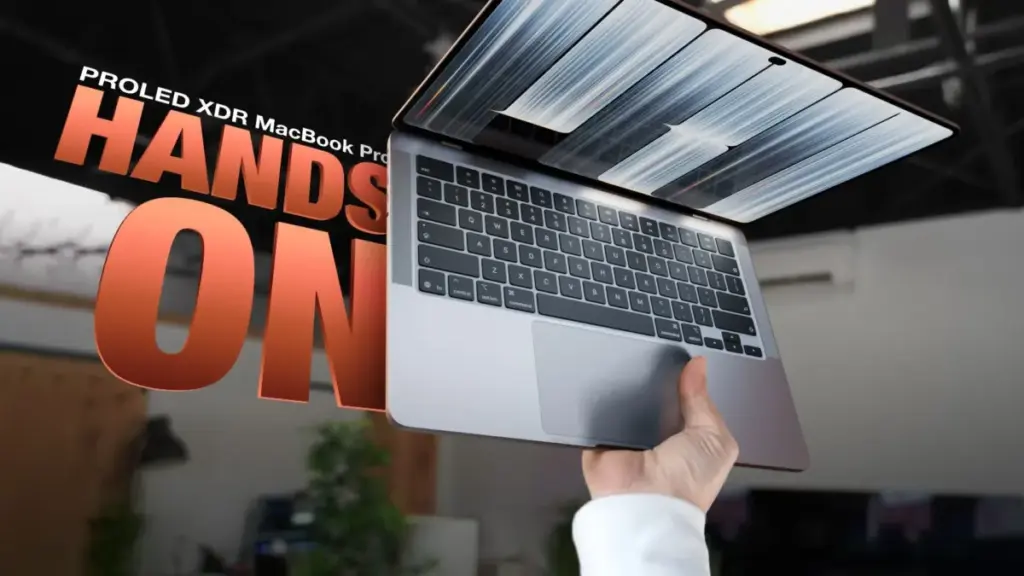
It has been half a decade since Apple last delivered a ground-up redesign of the MacBook Pro form factor, making this hardware generation a long-anticipated update for professional users. While the overall aesthetic of the PROLED MacBook Pro maintains a strong family resemblance to the preceding mini-LED generation, the physical refinements are immediately noticeable in the hand. Apple has focused heavily on reducing both the thickness and the mass of the laptop, resulting in a device that feels significantly lighter from the moment it is removed from its packaging.
For the 14-inch configuration, Apple managed to shave off approximately half a millimeter in thickness while cutting nearly half a pound from its overall weight. The result is a 14-inch machine that weighs just over three pounds, making it noticeably more portable for on-the-go workflows. The larger 16-inch model sees an even more pronounced physical transformation, trimming almost a full millimeter from its profile and dropping roughly 0.7 pounds to bring its total weight down to four pounds. Although sub-pound weight reductions might appear modest on paper, the practical impact on ergonomics and daily carry is substantial, providing a distinctly lighter feel when carrying the laptop or pulling it from a bag.
Alongside the thinner profile and reduced weight, Apple has brought back a classic aesthetic element: the glowing rear Apple logo. Reintroduced specifically for the PROLED MacBook Pro models, the illuminated emblem stands out on the display enclosure, distinguishing the new OLED-equipped hardware from previous generations and letting everyone in the room know that this is the latest high-end machine.
The centerpiece of the update, however, is the new PROLED display, which marks Apple’s transition to OLED technology for its flagship notebook line. Available in a lineup starting at $2,899, the new panel delivers the visual performance expectations associated with high-end OLED hardware. Because each individual pixel in an OLED panel self-illuminates and can be turned off completely, the screen achieves true, pitch-black levels. This fundamentally changes the viewing experience compared to previous mini-LED models. On mini-LED screens, high-contrast scenes featuring bright elements on dark backgrounds often suffer from "blooming" or haloing around lit zones. On the PROLED panel, blooming is completely eliminated, allowing sharp contrast edges with zero light bleed.
Peak brightness performance on the PROLED display is equally robust, pairing deep black levels with high luminance to elevate High Dynamic Range content. While OLED technology has historically faced scrutiny regarding its capability to perform under intense ambient lighting or direct sunlight, the PROLED panel overcomes these traditional limitations. High-brightness output ensures that the screen remains clear and readable even when used outdoors, maintaining image vibrancy and visual detail under daylight conditions.
Apple has also refined the screen real estate by narrowing the borders surrounding the panel. The reduced bezels allow for a slight expansion in actual viewable area on the larger configuration, stretching the display of the 16-inch model from its previous 16.2-inch measurement up to a true 16.3-inch diagonal display.
Another visible change to the display hardware is the replacement of the familiar camera notch with an iPhone-inspired Dynamic Island. Positioned at the top of the display, the Dynamic Island serves as a central hub for system interactions, accommodating Apple’s Siri AI features, Live Activities, and context-sensitive notifications.
The inclusion of the Dynamic Island aligns with the introduction of touch-screen functionality to the MacBook Pro line. The new display supports direct multi-touch gestures, bringing interactions familiar to iPhone and iPad users directly to the Mac desktop experience. Users can interact with the screen by tapping buttons, swiping through long webpages, dragging and dropping files across the desktop, and using multi-finger pinches to zoom into photos or documents.
To accommodate touch input without alienating traditional desktop users, Apple has introduced specific software adaptations within macOS. The operating system dynamically responds to touch inputs by enlarging target areas; for instance, drop-down menu options expand slightly when touched rather than clicked, and tiny window-resizing controls enlarge on screen to make precise finger input easier and less prone to accidental taps.
To support physical interactions with the display, Apple engineered a reinforced, sturdier hinge mechanism for the PROLED MacBook Pro. The updated hardware is designed to stabilize the panel and resist force when users press against the glass. In practical use, the sturdier hinge mitigates display movement, though it does not eliminate it entirely. Depending on where and how firmly the panel is tapped, some slight jiggling still occurs during screen interactions.
Despite these software and hardware adjustments, touch input is designed to act as an additive convenience rather than a primary navigation method. It is not intended to displace the precision of the built-in Force Touch trackpad or the physical keyboard, but rather to offer an alternate input method for quick tasks. While touch capability adds flexibility in specific scenarios, early testing suggests it serves as a secondary feature rather than a revolutionary shift in how most professionals interact with macOS.
Under the hood, the internal silicon strategy for the PROLED MacBook Pro presents a notable point of continuity. Next-generation processor chips were not ready in time for the release of these PROLED machines. As a result, Apple has outfitted the new models with the same M5 Pro and M5 Max chips that power the existing mini-LED versions. For a laptop family that commands a starting price near $3,000, the reliance on current-generation processing hardware represents a potential drawback for users seeking generation-over-generation performance leaps in compute power.
Because Apple continues to keep the mini-LED MacBook Pro models in its active retail lineup, buyers face a clear pricing divide. The new PROLED MacBook Pro carries a premium of approximately $400 over the equivalent mini-LED models. The entry-level 14-inch PROLED configuration starts at $2,899, while the 16-inch model begins at $3,399. Customers choosing to pay the $400 price difference are primarily paying for the upgraded OLED display panel, the lighter and thinner chassis design, the returning illuminated logo, the Dynamic Island, and the multi-touch display integration.
The arrival of the PROLED MacBook Pro resolves weeks of industry speculation regarding Apple’s branding and launch strategy. Ahead of the official announcement, hardware rumors suggested that Apple might introduce these touch-enabled OLED models under a brand-new "MacBook Ultra" moniker. However, invitations issued for Apple’s launch event in Los Angeles on October 28 featured the tagline "Pro and tell," signaling that the company intended to maintain its established MacBook Pro naming convention. This outcome mirrors Apple’s recent branding decisions across other product categories, such as when early speculation regarding an "iPhone Ultra" ultimately culminated in the release of the iPhone Duo.
The PROLED MacBook Pro release also fits into a broader rollout of OLED screen updates across Apple’s hardware portfolio late this fall. Alongside the MacBook Pro announcement, Apple expanded OLED technology to its compact tablet line with a redesigned iPad mini featuring an 8.5-inch OLED display. That device similarly received an overhaul, incorporating an A20 Pro chip, a nano-texture display option, a thinner and lighter body, an IP67 rating for water and dust resistance, a landscape front camera, an Acoustic Display audio system that removes traditional speaker holes, and Apple’s custom N1 wireless chip supporting Wi-Fi 7 and Bluetooth 6.
For potential MacBook Pro buyers, the choice between the existing mini-LED hardware and the new PROLED generation comes down to hardware priorities. While the internal processing capabilities remain identical due to the shared M5 Pro and M5 Max silicon, the physical refinements of the PROLED models—most notably the lighter chassis and superior OLED display quality—deliver tangible benefits for users who prioritize portability and color accuracy, with touch input serving as an added extra.
 macOS & Apple IT Support
Early Black Friday 2026 Apple Deals Arrive: Record Discounts Hit Mac, Apple Watch, iPad, and iPhone Lineups
With Black Friday scheduled for November 27, 2026, the annual holiday shopping...
 macOS & Apple IT Support
Apple Shell Company Filings Point to ‘HomeView’ and ‘homeOS’ Ahead of October ‘Welcome Home’ Launch
As Apple prepares for an upcoming hardware launch event, recent trademark discoveries...
 macOS & Apple IT Support
Early Black Friday 2026 Deals Deliver Record-Low Prices on Apple Watch Ultra, M5 MacBook Air, and iPhone 18 Pro Lineup
With Black Friday set for Friday, November 27, 2026, the holiday shopping...