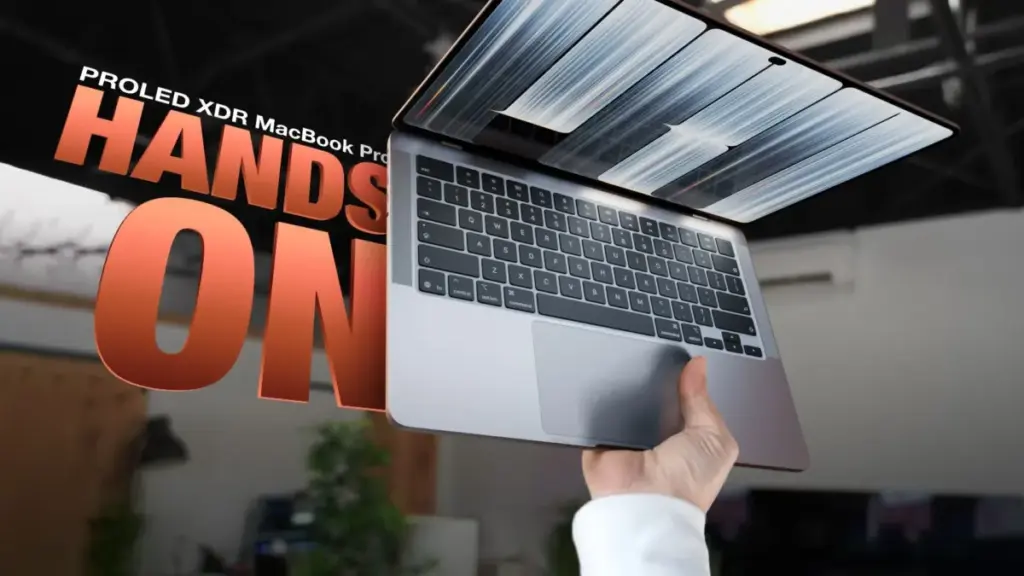
It has been half a decade since Apple last delivered a ground-up redesign of the MacBook Pro form factor, making this hardware generation a long-anticipated update for professional users. While the overall aesthetic of the PROLED MacBook Pro maintains a strong family resemblance to the preceding mini-LED generation, the physical refinements are immediately noticeable in the hand. Apple has focused heavily on reducing both the thickness and the mass of the laptop, resulting in a device that feels significantly lighter from the moment it is removed from its packaging.
For the 14-inch configuration, Apple managed to shave off approximately half a millimeter in thickness while cutting nearly half a pound from its overall weight. The result is a 14-inch machine that weighs just over three pounds, making it noticeably more portable for on-the-go workflows. The larger 16-inch model sees an even more pronounced physical transformation, trimming almost a full millimeter from its profile and dropping roughly 0.7 pounds to bring its total weight down to four pounds. Although sub-pound weight reductions might appear modest on paper, the practical impact on ergonomics and daily carry is substantial, providing a distinctly lighter feel when carrying the laptop or pulling it from a bag.
Alongside the thinner profile and reduced weight, Apple has brought back a classic aesthetic element: the glowing rear Apple logo. Reintroduced specifically for the PROLED MacBook Pro models, the illuminated emblem stands out on the display enclosure, distinguishing the new OLED-equipped hardware from previous generations and letting everyone in the room know that this is the latest high-end machine.
The centerpiece of the update, however, is the new PROLED display, which marks Apple’s transition to OLED technology for its flagship notebook line. Available in a lineup starting at $2,899, the new panel delivers the visual performance expectations associated with high-end OLED hardware. Because each individual pixel in an OLED panel self-illuminates and can be turned off completely, the screen achieves true, pitch-black levels. This fundamentally changes the viewing experience compared to previous mini-LED models. On mini-LED screens, high-contrast scenes featuring bright elements on dark backgrounds often suffer from "blooming" or haloing around lit zones. On the PROLED panel, blooming is completely eliminated, allowing sharp contrast edges with zero light bleed.
Peak brightness performance on the PROLED display is equally robust, pairing deep black levels with high luminance to elevate High Dynamic Range content. While OLED technology has historically faced scrutiny regarding its capability to perform under intense ambient lighting or direct sunlight, the PROLED panel overcomes these traditional limitations. High-brightness output ensures that the screen remains clear and readable even when used outdoors, maintaining image vibrancy and visual detail under daylight conditions.
Apple has also refined the screen real estate by narrowing the borders surrounding the panel. The reduced bezels allow for a slight expansion in actual viewable area on the larger configuration, stretching the display of the 16-inch model from its previous 16.2-inch measurement up to a true 16.3-inch diagonal display.
 macOS & Apple IT Support
Apple Prepares Comprehensive iPad Overhaul for First Half of 2027 Featuring OLED iPad Air, Vapor-Cooled M6 iPad Pro, and Upgraded Entry-Level Model
Following the recent announcement of a redesigned iPad mini equipped with an...
 macOS & Apple IT Support
Apple Engineering Leadership Restructure Triggers Executive Transitions, Layoffs, and Display Team Shift
In a major organizational shift across Apple’s hardware and software engineering divisions,...
 macOS & Apple IT Support
Apple HomeView Delivery Estimates Push Into December as Initial Pre-Order Stock Tightens Across Select Configurations
Apple’s newly unveiled HomeView smart home hub is experiencing expanding delivery wait...