In the rapidly evolving landscape of live-service gaming, information is the most valuable currency for players. Whether navigating the sprawling landscapes of Teyvat in Genshin Impact or the post-apocalyptic reaches of Solaris-3 in Wuthering Waves, players are constantly seeking answers to a specific set of high-stakes questions: Who is on the current banner? Which character is coming next? Exactly when does the current phase end?
However, for the developers and journalists who maintain the guides and trackers that answer these questions, these queries represent a significant data problem. The most frequently searched information is often the most volatile. A confirmed character lineup can be upended by a last-minute developer announcement, and community speculation often becomes indistinguishable from official data in the eyes of search engine algorithms. The traditional model of digital publishing—treating information as a chronological stream of blog posts—is increasingly proving inadequate for the demands of the modern "forever game."
A new approach to this challenge treats the game guide not as a series of articles, but as a state-modeling problem. By prioritizing the structural integrity of data over the mere frequency of updates, developers are finding ways to provide more accurate, reliable, and user-friendly tools for the gaming community. This methodology shifts the focus from "what is being said" to "what is known," creating a framework that can handle the inherent uncertainty of live-service roadmaps.
The Architecture of Explicit Evidence States
The core of the issue lies in how information is categorized before it ever reaches the user’s screen. In a standard content management system, a record for a "character banner"—the limited-time events where players spend currency to acquire new heroes—is typically either published or unpublished. This binary state fails to capture the nuance of the information lifecycle in gaming.
To combat this, the state-modeling approach introduces explicit "evidence states." Under this system, a banner record is never simply "missing" or "live." Instead, it exists within a spectrum of verification. The "confirmed" state is reserved strictly for data supported by official developer notices or direct in-game data. This ensures that when a player sees a countdown timer or a character list, they are looking at information that has been vetted by the primary source.
The "watchlist" state serves as a crucial middle ground. It acknowledges that while a version number might have been mentioned or a community signal has emerged, the specific lineup remains unofficial. By categorizing information this way, developers can prevent a generic mention of a future update from silently morphing into a factual banner page. It allows the platform to remain honest with the user; the page can explicitly state that the next official update is pending rather than inventing characters or dates to fill an empty UI card.
Finally, the "historical" state ensures that once a phase is completed, its data is not discarded but transitioned into a permanent archive. This is essential for players performing "rerun research"—the practice of tracking how long it has been since a specific character was last available—which is a vital component of long-term resource planning in games with "gacha" mechanics.
Separating the Live Snapshot from Global History
One of the most common technical failures in game tracking is the accidental corruption of historical data during a live update. When a site uses a single database entry that is constantly overwritten with the "current" information, the nuanced details of past events—such as specific end times or secondary featured items—can be lost or skewed.
The solution to this is a rigorous separation of the "live snapshot" from the "append-only" history. In this model, the homepage of a tracker does not query a massive, complex database of every event in the game’s history. Instead, it reads from a small, lightweight "current-state" object. This object contains only the essentials: the current version number, the active phase, the featured characters, the expiration timestamp, and a "snapshot date" indicating exactly when the data was last verified.
This separation serves two purposes. First, it makes the platform more resilient. An update script intended to refresh the current banner is physically isolated from the historical archives, making it nearly impossible to accidentally overwrite the rerun evidence that players rely on for future planning. Second, it allows the user interface to answer two fundamentally different types of questions with equal clarity. The "Live Snapshot" answers "What can I play right now?" while the "History" collection answers "How long has it been since this character appeared?" By decoupling these data points, the developer ensures that the answer to one does not compromise the accuracy of the other.
Making Uncertainty a Visible Feature of the Interface
Data modeling is only effective if its logic is communicated clearly to the end-user. In many traditional guides, a lack of information is often hidden behind vague language or, worse, speculative filler. The state-modeling philosophy argues that uncertainty should be treated as a data point in its own right and exposed through the user interface.
When a "next-banner" card is displayed, its appearance should change based on its evidence state. If the data is "confirmed," the UI can confidently display a high-resolution countdown timer and a verified character lineup. However, if the data is in the "watchlist" state, the interface should pivot. Instead of showing a countdown to a guessed date, it might display a "pending official reveal" status.
This approach transforms a moment of "missing information" into a useful routing decision. Instead of leaving the user to wonder if the site is simply out of date, the UI provides a clear signal of the current state of official knowledge. This builds a deeper level of trust with the community. Players learn that if the site doesn’t show a date, it’s because the developer hasn’t announced one yet—not because the site is lagging behind the rumors. It moves the platform away from the "rumor mill" and toward becoming a definitive record of truth.
Rebuilding the Single Source of Truth
The final pillar of this approach involves how the information is delivered to the user’s browser. In an era of heavy, JavaScript-dependent web applications, there is a significant benefit to returning to static page generation, provided it is powered by a dynamic data model.
A static tracker can still handle the frequent changes inherent in live-service games. In this workflow, a build script reads the current snapshot and the historical data, generates the necessary HTML pages, and writes the snapshot date directly into the visible text of the page. Because the important content remains in the original HTML, search engines can easily index the most current answers, and readers do not need to wait for complex client-side scripts to load before they can see the banner dates.
This "static-first" approach also allows for a cleaner handling of personal user data. Many players use trackers to maintain "pity notes" (tracking how many pulls they have made toward a guaranteed reward) or to plan their future spending. By keeping the official banner facts as a deterministic, static source of truth, the browser can handle a player’s personal state separately in local storage. This allows for a personalized experience that doesn’t require the user to sync with a third-party server or risk their game account’s security.
Case Study: The WuWa Banners Tracker
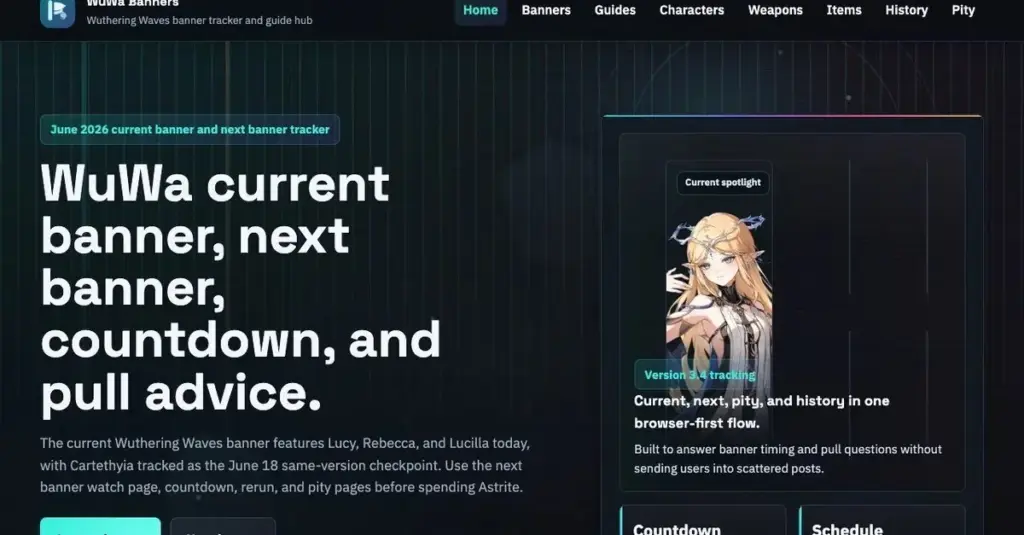
The practical application of these principles can be seen in the development of independent tools like "WuWa Banners," a tracker dedicated to the game Wuthering Waves. As a relatively new entry in the high-fidelity gacha market, Wuthering Waves has a community that is particularly hungry for reliable data amidst a sea of early-access rumors and rapid-fire updates.
By implementing the state-modeling approach, the tracker provides a comprehensive suite of features: current and next status, precise countdowns, historical context, and rerun tracking. But more importantly, it provides a sense of stability. When a new version is announced, the site doesn’t just update a blog post; it rebuilds its entire state based on the new "confirmed" evidence.
The broader lesson for the digital publishing and gaming industries is clear: as information moves faster, the structures we use to hold that information must become more robust. Modeling uncertainty as data, rather than ignoring it, allows for a more honest and effective relationship between content creators and their audiences. In the world of live-service games, where the only constant is change, the most successful guides will be those that treat "not knowing" with as much technical rigor as "knowing." By separating live state from history and requiring high thresholds of evidence, developers can create tools that are not just trackers, but definitive archives for the modern gaming era.
 Software Development & Scripting for IT
Streamlining Web-to-PDF Workflows: The Shift Toward Dependency-Free Headless Chrome Integration
In the modern landscape of web development, the demand for high-fidelity document...
 Software Development & Scripting for IT
AI-Driven Development Reaches New Milestone as Formal Verification and Statecharts Detect Elusive Edge Cases
In the rapidly evolving landscape of software engineering, the integration of artificial...
 Software Development & Scripting for IT
Commerce Sites Face High Barriers for AI Buying Agents as New Industry Index Reveals Median Score of Just 11
As the e-commerce landscape shifts toward an era defined by "agentic commerce,"...