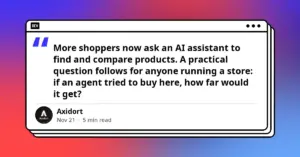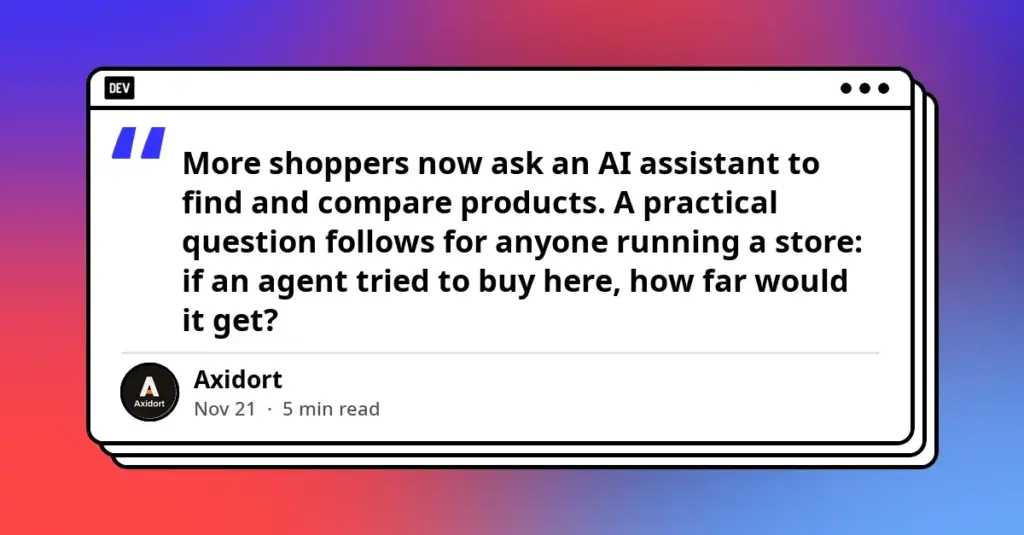
As the e-commerce landscape shifts toward an era defined by "agentic commerce," a new study has revealed that the vast majority of major retail and business-to-business sites remain largely inaccessible to the next generation of shoppers: AI autonomous agents. According to the recently released Axidort Index, a comprehensive scan of 50 prominent commerce platforms, the median score for AI agent accessibility stands at a remarkably low 11 out of 100.
The data, originally published by ByteSprint and derived from a public scan conducted on October 1, 2026, suggests a significant friction point between current web security protocols and the emerging trend of AI-assisted purchasing. While consumers are increasingly turning to AI assistants to navigate the complexities of product comparison and procurement, the infrastructure supporting modern e-commerce appears to be inadvertently locking these digital representatives out of the transaction journey.
The findings highlight a growing challenge for store owners. As AI agents move beyond simple search queries and begin attempting to execute the full purchase lifecycle—from identifying stock levels to navigating the checkout—they are encountering a digital "brick wall" that often stops them before they can even view a product price.
The Methodology of the Axidort Index
To understand the current state of AI readiness in the commerce sector, the Axidort Index utilized a dual-agent scanning approach. On October 1, 2026, the study targeted 50 well-known commerce sites, split evenly between 25 business-to-business (B2B) and 25 business-to-consumer (B2C) platforms.
The primary tool used was a declared AI browser agent identifying itself as "AxidortAgentCheck." This agent was programmed to simulate a standard consumer journey: it attempted to search for a specific product, open the product detail page, read the current price and stock status, and move toward the checkout stage. To maintain ethical standards and data integrity, the agent was strictly prohibited from placing orders, submitting payment information, logging into user accounts, or filling out forms.
Complementing this browser-based agent was a second, "no-browser" reader agent. This secondary tool focused on the underlying data structures of the pages, checking what information could be extracted directly from the page text and metadata without the need for complex browser interactions.
The resulting scores, ranging from 0 to 100, were calculated based on seven distinct components. Per the published methodology, the behavior of the agent—its ability to actually navigate the site and perform tasks—accounted for 90% of the total score. The remaining 10% was determined by the presence and quality of technical standards and files, such as structured data and Schema.org markup, which are designed to help machines understand web content.
The Headline Numbers: A Disparity in Performance
The headline figure from the report—a median score of 11—paints a picture of an industry that is currently ill-equipped for automated buyers. However, the data also reveals a wide variance in performance across different sectors and individual sites.
 Software Development & Scripting for IT
Re-evaluating the Enterprise Test Automation Stack: Why Past Decisions Require New Scrutiny in the Age of AI
In the fast-moving world of enterprise software, a test automation tool that...
 Software Development & Scripting for IT
The High Stakes of Autonomy: Navigating the Promise and Peril of AI in Security Operations
The modern Security Operations Center (SOC) is currently undergoing a radical transformation....
 Software Development & Scripting for IT
Bridging the Gap Between Code and Clarity: Building a Comprehensive Expo Developer Guide with Thally
In the modern software development landscape, the distance between successfully launching an...