
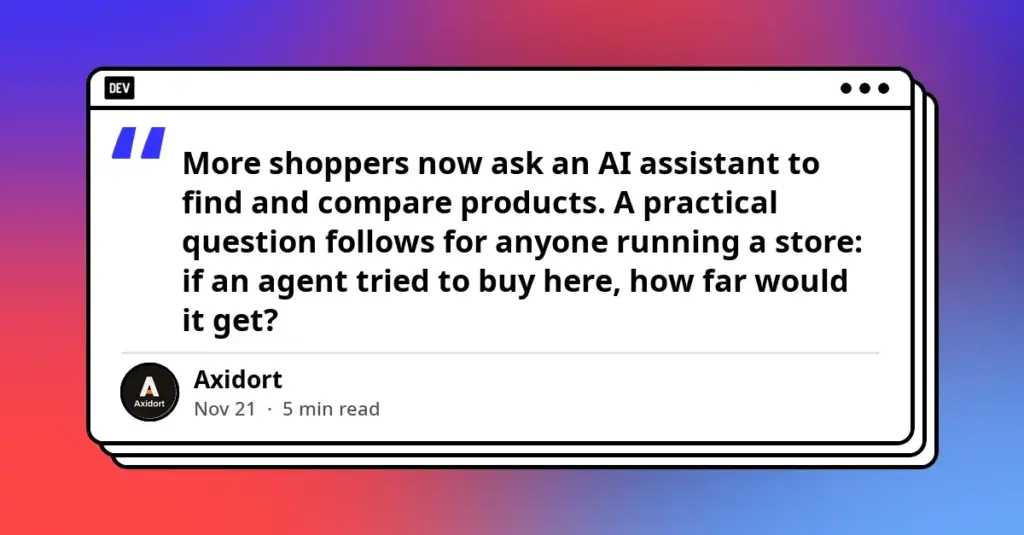
As the e-commerce landscape shifts toward an era defined by "agentic commerce," a new study has revealed that the vast majority of major retail and business-to-business sites remain largely inaccessible to the next generation of shoppers: AI autonomous agents. According to the recently released Axidort Index, a comprehensive scan of 50 prominent commerce platforms, the median score for AI agent accessibility stands at a remarkably low 11 out of 100.
The data, originally published by ByteSprint and derived from a public scan conducted on October 1, 2026, suggests a significant friction point between current web security protocols and the emerging trend of AI-assisted purchasing. While consumers are increasingly turning to AI assistants to navigate the complexities of product comparison and procurement, the infrastructure supporting modern e-commerce appears to be inadvertently locking these digital representatives out of the transaction journey.
The findings highlight a growing challenge for store owners. As AI agents move beyond simple search queries and begin attempting to execute the full purchase lifecycle—from identifying stock levels to navigating the checkout—they are encountering a digital "brick wall" that often stops them before they can even view a product price.
The Methodology of the Axidort Index
To understand the current state of AI readiness in the commerce sector, the Axidort Index utilized a dual-agent scanning approach. On October 1, 2026, the study targeted 50 well-known commerce sites, split evenly between 25 business-to-business (B2B) and 25 business-to-consumer (B2C) platforms.
The primary tool used was a declared AI browser agent identifying itself as "AxidortAgentCheck." This agent was programmed to simulate a standard consumer journey: it attempted to search for a specific product, open the product detail page, read the current price and stock status, and move toward the checkout stage. To maintain ethical standards and data integrity, the agent was strictly prohibited from placing orders, submitting payment information, logging into user accounts, or filling out forms.
Complementing this browser-based agent was a second, "no-browser" reader agent. This secondary tool focused on the underlying data structures of the pages, checking what information could be extracted directly from the page text and metadata without the need for complex browser interactions.
The resulting scores, ranging from 0 to 100, were calculated based on seven distinct components. Per the published methodology, the behavior of the agent—its ability to actually navigate the site and perform tasks—accounted for 90% of the total score. The remaining 10% was determined by the presence and quality of technical standards and files, such as structured data and Schema.org markup, which are designed to help machines understand web content.
The Headline Numbers: A Disparity in Performance
The headline figure from the report—a median score of 11—paints a picture of an industry that is currently ill-equipped for automated buyers. However, the data also reveals a wide variance in performance across different sectors and individual sites.
While the median was low, the highest-performing site in the scan achieved a score of 97, proving that it is technically possible for a modern commerce site to be fully accessible to AI agents while maintaining its standard operations. This high score, however, was an outlier. The low median suggests that for every site that has optimized its path for bots, many more are effectively closed to them.
The disparity between B2B and B2C sectors was also notable. B2C sites outperformed their B2B counterparts, with an average score of 34 compared to the B2B average of just 20. Analysts suggest this may be due to the more open nature of retail sites, which often prioritize search engine optimization (SEO) and public product visibility. In contrast, B2B sites often feature complex pricing structures, gated content, or legacy technical architectures that pose greater challenges for automated browsers.
What Actually Stopped the Agent
The Index provides a narrow but revealing look at the specific barriers preventing AI agents from completing their tasks. A low score generally indicates that the agent met a definitive barrier early in its journey. The two most common examples cited were bot challenges and rejected "add-to-cart" actions.
A bot challenge, such as a CAPTCHA or a hidden script that detects automated behavior, is perhaps the most significant hurdle. Because these challenges often sit at the very front of the user journey, they can stop an agent before it even reaches a product page. In these cases, the AI agent is unable to gather even basic information like price or availability, leading to a near-zero score.
The rejection of "add-to-cart" actions represents a different kind of failure. Even if an agent can read the product data, many commerce platforms are configured to block automated scripts from interacting with the shopping cart functionality. This prevents the agent from verifying the final steps of the purchase journey, which is a critical requirement for any AI assistant tasked with more than just basic research.
The Conflict Between Security and Accessibility
The prevalence of bot challenges highlights a fundamental tension in modern web management. Bot protection is a vital component of e-commerce security, protecting businesses from malicious activities such as data scraping, credential stuffing, and card testing. These security measures are designed to be robust and are often provided by third-party vendors who specialize in identifying and blocking non-human traffic.
However, the side effect of these protections is that a declared, well-behaved AI agent—one that identifies itself and follows ethical scraping guidelines—can look identical to a malicious bot to an automated security system. While some security vendors allow site owners to "allowlist" or verify known, helpful bots, this requires an intentional configuration by the site’s technical team.
For many store owners, the question of whether their site is accessible to AI is not a matter of policy, but a matter of default security settings. If a store uses a major security provider but has not specifically configured it to recognize AI buying agents, those agents will likely be blocked by default.
Interpreting the Data Fairly
The creators of the Axidort Index emphasize that these findings should be viewed as a snapshot in time rather than a final verdict on any specific business. Several factors can influence a site’s score on a given day.
First, the scan was conducted from a single geographical location. Because many commerce sites use Content Delivery Networks (CDNs) or localized security rules, an agent might be blocked in one region while being allowed in another. Second, the scores reflect the experience of one specific agent: AxidortAgentCheck. A different AI agent with a different digital signature or identification string might have achieved a different result.
Furthermore, a low score does not necessarily mean a business is failing or doing something wrong. It simply indicates that, on the day of the scan, a specific type of automated visitor was unable to complete a purchase journey. For many businesses, the security benefits of blocking all bots may currently outweigh the perceived benefits of allowing AI buying agents.
The Path Forward for Store Owners
As AI buying agents become more common, the Axidort Index suggests that store owners should begin evaluating their "agentic readiness." This does not necessarily require expensive new software or a complete overhaul of the site. Instead, it begins with a few fundamental checks.
The first step is often reviewing the site’s robots.txt file. This file acts as the "front door" for bots, telling them which parts of the site they are allowed to visit. If this file is overly restrictive, it may be preventing well-behaved AI agents from even beginning their search.
Secondly, the use of structured data, such as Schema.org markup, is critical. This code helps machines understand exactly what a number on a page represents—whether it is a price, a stock level, or a shipping weight. Even if an agent can access a page, it may struggle to "read" it if the data is not clearly labeled in the underlying code.
Finally, checking bot logs and security configurations is essential. By reviewing which bots are being blocked and why, technical teams can determine if they are inadvertently turning away legitimate AI assistants that could be bringing them customers.
The Axidort Index serves as a starting point for a broader conversation between commerce leaders and their development teams. As the median score of 11 demonstrates, the industry is currently in the very early stages of adapting to a world where the shopper may not always be a human. Whether that score rises in the coming years will likely depend on how businesses balance the competing needs of ironclad security and AI-driven accessibility.
 Software Development & Scripting for IT
The Efficiency Era: Compressed Models Dominate as VIDraft and LG Lead the 2026 Korean AI Download Charts
As the global landscape for artificial intelligence continues to shift toward practical...
 Software Development & Scripting for IT
The Hidden Risks of DNS Drift: Why Engineering Teams are Prioritizing Reconciliation Safety over Speed
In the modern landscape of cloud-native logistics and software-as-a-service platforms, the reliability...
 Software Development & Scripting for IT
The Token Tax: Why Large Language Models Charge Bengali Speakers Six Times More for the Same Words
In the rapidly advancing world of artificial intelligence, a hidden economic and...







