Separating the Live Snapshot from Global History
One of the most common technical failures in game tracking is the accidental corruption of historical data during a live update. When a site uses a single database entry that is constantly overwritten with the "current" information, the nuanced details of past events—such as specific end times or secondary featured items—can be lost or skewed.
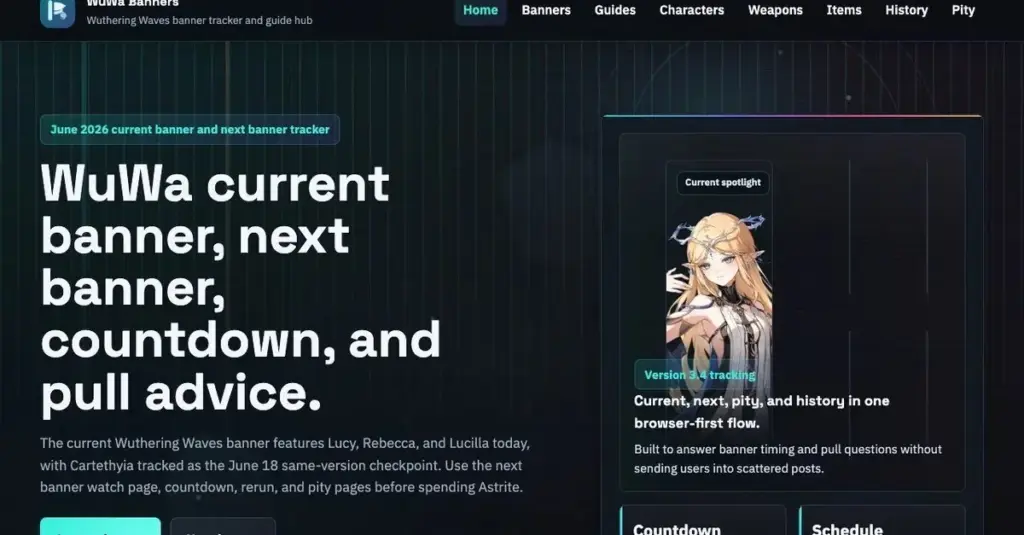
The solution to this is a rigorous separation of the "live snapshot" from the "append-only" history. In this model, the homepage of a tracker does not query a massive, complex database of every event in the game’s history. Instead, it reads from a small, lightweight "current-state" object. This object contains only the essentials: the current version number, the active phase, the featured characters, the expiration timestamp, and a "snapshot date" indicating exactly when the data was last verified.
This separation serves two purposes. First, it makes the platform more resilient. An update script intended to refresh the current banner is physically isolated from the historical archives, making it nearly impossible to accidentally overwrite the rerun evidence that players rely on for future planning. Second, it allows the user interface to answer two fundamentally different types of questions with equal clarity. The "Live Snapshot" answers "What can I play right now?" while the "History" collection answers "How long has it been since this character appeared?" By decoupling these data points, the developer ensures that the answer to one does not compromise the accuracy of the other.
Making Uncertainty a Visible Feature of the Interface
Data modeling is only effective if its logic is communicated clearly to the end-user. In many traditional guides, a lack of information is often hidden behind vague language or, worse, speculative filler. The state-modeling philosophy argues that uncertainty should be treated as a data point in its own right and exposed through the user interface.
When a "next-banner" card is displayed, its appearance should change based on its evidence state. If the data is "confirmed," the UI can confidently display a high-resolution countdown timer and a verified character lineup. However, if the data is in the "watchlist" state, the interface should pivot. Instead of showing a countdown to a guessed date, it might display a "pending official reveal" status.
This approach transforms a moment of "missing information" into a useful routing decision. Instead of leaving the user to wonder if the site is simply out of date, the UI provides a clear signal of the current state of official knowledge. This builds a deeper level of trust with the community. Players learn that if the site doesn’t show a date, it’s because the developer hasn’t announced one yet—not because the site is lagging behind the rumors. It moves the platform away from the "rumor mill" and toward becoming a definitive record of truth.
 Software Development & Scripting for IT
Bridging the Context Gap: TokenCap Introduces Schema Intelligence to Eliminate AI Coding Errors
In the rapidly evolving landscape of software development, the integration of Artificial...
 Software Development & Scripting for IT
The Performance Paradox: Why Cross-Origin Isolation Remains a Strategic Trade-off for In-Browser Machine Learning
In the rapidly evolving landscape of web development, the push to move...
 Software Development & Scripting for IT
"Outside in 20" Redefines Digital Wellness with Local AI-Driven Outdoor Encouragement
In an era where digital connectivity often feels inescapable, a new open-source...