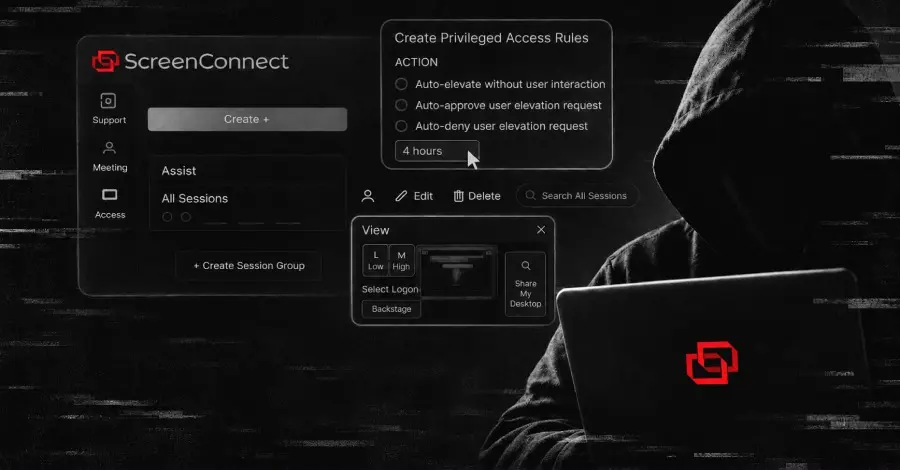
Cybersecurity researchers have uncovered a wave of active exploitation targeting a critical security flaw in the ConnectWise ScreenConnect remote desktop software. The vulnerability, which carries a near-maximum severity rating, is being leveraged by threat actors to compromise the workstations of Managed Service Provider (MSP) technicians. By gaining control over these high-value machines, attackers effectively secure a foothold into the broader networks of the MSPs’ numerous clients, creating a significant risk of large-scale supply chain compromises.
The activity centers on a flaw identified as CVE-2026-84869, which boasts a CVSS score of 9.9 out of 10. This critical vulnerability resides within the ScreenConnect client and allows an unauthorized "guest" in a remote session to transfer and execute malicious payloads directly onto the host machine of the connecting technician. In a typical support scenario, the technician—the host—retains control over file transfers and execution. However, this flaw upends that security model, granting the guest the ability to initiate actions on the technician’s system without their knowledge or consent.
According to technical analysis from Huntress, a leading cybersecurity firm monitoring the situation, the exploitation is not merely theoretical but is being carried out with remarkable speed and efficiency. On November 12, 2026, researchers observed a specific instance where an MSP technician’s workstation was compromised in a matter of seconds. The attacker utilized the flaw to push a batch file to the host, which then executed a series of commands that registered the infection via a Telegram bot and installed a rogue ScreenConnect client. The entire process, from the initial exploitation to the establishment of persistent remote access for the attacker, was completed in approximately nine seconds.
The Anatomy of the 9-Second Attack
The speed of these incursions highlights the sophisticated nature of the scripts being employed by threat actors. In the incident documented by Huntress, the primary vehicle for the attack was a batch script titled "update_224ac089.bat." Once executed on the technician’s machine, the script performed several automated tasks designed to evade detection and establish command-and-control (C2) communications.
First, the script was designed to decode a Base64-encoded string containing a Telegram bot token and a specific chat ID. By using Telegram—a legitimate and widely used messaging platform—as a communication channel, the attackers can often bypass traditional network monitoring tools that might flag traffic to known malicious domains. The script used this token to "check in" with the attacker, notifying them that a new infection had been successful and providing details about the compromised host.
Following the initial check-in, the script reached out to a remote server—specifically masterdarky[.]com—to download a secondary payload. This payload was an MSI installer masquerading as a routine system update, named "WindowsUpdate.msi." Far from being a security patch, this installer deployed a rogue ScreenConnect client configured to point toward the attacker’s own relay server. This maneuver allowed the threat actor to gain full, persistent remote access to the technician’s workstation, effectively turning the MSP’s own tools against them.
John Hammond, a principal security researcher at Huntress, emphasized the danger of this "guest-to-host" execution. "An MSP technician’s workstation typically holds RMM consoles, saved credentials, and access to every customer, making it an exceptionally attractive target," Hammond noted. He explained that while the technician usually decides what files move and run during a session, CVE-2026-84869 allows a malicious guest to bypass this gatekeeping entirely. "From the technician’s view, no prompt appears. They only have to join the session, whether from an attacker-controlled machine or a real customer’s support session that the attacker has slipped into as an extra guest."

Widespread Spraying and Canary Tactics
The exploitation of CVE-2026-84869 appears to be part of a broader, more aggressive campaign. Between October 20 and November 16, 2026, researchers observed what they described as a "spraying" campaign, where attackers blindly targeted ScreenConnect servers with thousands of requests. Huntress reported seeing at least 688,000 guest "run file" requests hitting 42 different ScreenConnect servers. These requests originated from 29 distinct IP addresses and specifically sought to execute files with names like update.bat or variations containing hexadecimal strings, such as update_<8 hex characters>.bat.
In many of these cases, the attackers appeared to be using automated scripts to probe for vulnerable systems. The guest sessions often had blank session names or used default Windows hostnames, suggesting a lack of specific targeting in the initial phase. However, more nuanced tactics have also been observed. In one instance, a guest machine located at the IP address 91.224.92[.]167 pushed a harmless text file named "marker.txt" to a technician’s machine just two seconds after the technician joined the session.
Security analysts believe this "marker.txt" file serves as a canary. By successfully pushing and potentially verifying the existence of this file, the attacker can confirm that the exploit works against a specific target before deploying a more malicious payload. This allows the threat actor to avoid wasting their more sophisticated tools on systems that may already be patched or otherwise protected.
Targeted Infiltration of Real Sessions
While much of the activity has been automated, researchers have also documented more surgical, targeted attacks. In October 2026, an attacker was observed joining three legitimate support sessions that a technician had created for real clients. By slipping into these active sessions as an additional guest, the attacker was able to exploit the vulnerability in a live environment.
During these sessions, the attacker attempted to run a file designed to drop a batch script named "Sync.bat" into the technician’s Windows Startup folder. Placing a script in the Startup folder is a classic persistence mechanism; it ensures that the malicious code executes every time the technician logs into their computer, even if the initial ScreenConnect session has ended. This specific case illustrates the danger of "session hijacking," where an attacker doesn’t just lure a technician to a fake session but actively infiltrates the day-to-day operations of the MSP.
A Complex Threat Landscape: SCKit and Crypto-Bots
The exploitation of CVE-2026-84869 is occurring alongside other distinct but related threats targeting ScreenConnect users. One such threat involves a recently disclosed attack wave where unknown actors gained unauthorized access to ScreenConnect environments by exploiting an authentication flaw in a third-party extension.
Once access was gained through the extension, the attackers deployed a malware toolkit known as "SCKit." This toolkit then leveraged the ScreenConnect infrastructure to propagate malware to technician workstations. While the end goal—compromising the technician—is similar to the exploitation of CVE-2026-84869, the entry point via third-party extensions represents a different vector that MSPs must account for in their security posture.
Additionally, researchers have identified a curious cluster of activity involving thousands of unauthorized ScreenConnect guest sessions originating from machines with names themed after cryptocurrency exchanges. These sessions used names like BITMEX-BOT, KUCOIN-SRV, LAPTOP-BINANCE, and BITFINEX-PRO. The prevailing theory is that these names are intended to trick technicians into connecting to the sessions, perhaps under the guise of providing support for a crypto-related issue.

While Huntress noted that no immediate malicious activity—such as file transfers or command execution—has been observed from these specific crypto-themed sessions, the scale of the operation is significant. As of mid-November 2026, over 2,400 unauthorized sessions of this type were enrolled across 118 self-hosted ScreenConnect servers.
Investigations revealed that the actors behind these sessions were obtaining publicly downloadable ScreenConnect Access installers to extract the relay addresses needed to register a guest client with a target server. They then used scripted emulators to impersonate Windows ScreenConnect clients and create fake sessions that appeared to be online. Interestingly, nearly all of these crypto-themed connections originated from a single IP address hosted by IONOS: 74.208.158[.]106.
Mitigation and Defensive Recommendations
The critical nature of CVE-2026-84869 and the active exploitation of MSP environments have prompted urgent calls for remediation. Security experts advise that the most effective defense is to ensure that all ScreenConnect host clients are updated to version 26.6.5 or later, which contains the necessary patches to close the vulnerability.
For organizations that cannot apply patches immediately, ConnectWise has recommended a temporary workaround: removing the "TransferFiles" permission from all roles and session groups. This effectively disables the mechanism that attackers are using to push their malicious payloads, though it may also limit the legitimate functionality of the software for technicians.
In addition to patching, Huntress recommends that MSPs take the following proactive steps:
- Hunt for Signs of Exposure: Review ScreenConnect logs for unauthorized guest joins, especially those with default hostnames or suspicious file transfer requests (e.g.,
update.bat,marker.txt). - Isolate Affected Workstations: If there is any evidence that a technician’s machine has been targeted or compromised, it should be immediately isolated from the network to prevent lateral movement.
- Rotate Credentials: Because technician workstations often store credentials for various client systems and RMM tools, all passwords and secrets reachable from a potentially compromised machine should be rotated immediately.
The targeting of MSPs remains a top priority for modern threat actors due to the "multiplier effect" it offers. By compromising a single service provider, an attacker can potentially gain access to hundreds of downstream businesses. As the exploitation of CVE-2026-84869 demonstrates, maintaining the security of the tools used to manage these environments is not just a matter of internal hygiene, but a critical component of global supply chain security.
 Cybersecurity Basics & Security News
Critical Check Point Flaw Grants Unauthenticated Root Access to Management Servers
A severe security vulnerability has been identified within Check Point’s Security Management...
 Cybersecurity Basics & Security News
ShinyHunters Suspect Rey Reportedly Detained in Jordan, Helping FBI Identify Group Members
Khader, who also operated under the moniker ReyXBF, is far from an...
 Cybersecurity Basics & Security News
Russia-Aligned Cyber Espionage Group UAC-0099 Deploys New ASHVEIN Malware in Sophisticated Campaign Against Ukraine
The landscape of cyber warfare in Eastern Europe continues to shift as...