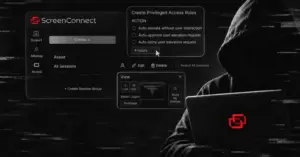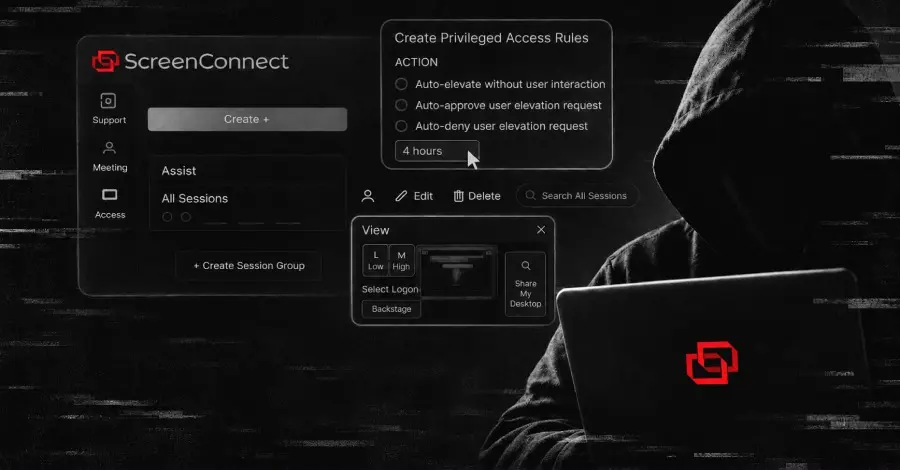
Cybersecurity researchers have uncovered a wave of active exploitation targeting a critical security flaw in the ConnectWise ScreenConnect remote desktop software. The vulnerability, which carries a near-maximum severity rating, is being leveraged by threat actors to compromise the workstations of Managed Service Provider (MSP) technicians. By gaining control over these high-value machines, attackers effectively secure a foothold into the broader networks of the MSPs’ numerous clients, creating a significant risk of large-scale supply chain compromises.
The activity centers on a flaw identified as CVE-2026-84869, which boasts a CVSS score of 9.9 out of 10. This critical vulnerability resides within the ScreenConnect client and allows an unauthorized "guest" in a remote session to transfer and execute malicious payloads directly onto the host machine of the connecting technician. In a typical support scenario, the technician—the host—retains control over file transfers and execution. However, this flaw upends that security model, granting the guest the ability to initiate actions on the technician’s system without their knowledge or consent.
According to technical analysis from Huntress, a leading cybersecurity firm monitoring the situation, the exploitation is not merely theoretical but is being carried out with remarkable speed and efficiency. On November 12, 2026, researchers observed a specific instance where an MSP technician’s workstation was compromised in a matter of seconds. The attacker utilized the flaw to push a batch file to the host, which then executed a series of commands that registered the infection via a Telegram bot and installed a rogue ScreenConnect client. The entire process, from the initial exploitation to the establishment of persistent remote access for the attacker, was completed in approximately nine seconds.
The Anatomy of the 9-Second Attack
The speed of these incursions highlights the sophisticated nature of the scripts being employed by threat actors. In the incident documented by Huntress, the primary vehicle for the attack was a batch script titled "update_224ac089.bat." Once executed on the technician’s machine, the script performed several automated tasks designed to evade detection and establish command-and-control (C2) communications.
First, the script was designed to decode a Base64-encoded string containing a Telegram bot token and a specific chat ID. By using Telegram—a legitimate and widely used messaging platform—as a communication channel, the attackers can often bypass traditional network monitoring tools that might flag traffic to known malicious domains. The script used this token to "check in" with the attacker, notifying them that a new infection had been successful and providing details about the compromised host.
Following the initial check-in, the script reached out to a remote server—specifically masterdarky[.]com—to download a secondary payload. This payload was an MSI installer masquerading as a routine system update, named "WindowsUpdate.msi." Far from being a security patch, this installer deployed a rogue ScreenConnect client configured to point toward the attacker’s own relay server. This maneuver allowed the threat actor to gain full, persistent remote access to the technician’s workstation, effectively turning the MSP’s own tools against them.
John Hammond, a principal security researcher at Huntress, emphasized the danger of this "guest-to-host" execution. "An MSP technician’s workstation typically holds RMM consoles, saved credentials, and access to every customer, making it an exceptionally attractive target," Hammond noted. He explained that while the technician usually decides what files move and run during a session, CVE-2026-84869 allows a malicious guest to bypass this gatekeeping entirely. "From the technician’s view, no prompt appears. They only have to join the session, whether from an attacker-controlled machine or a real customer’s support session that the attacker has slipped into as an extra guest."
 Cybersecurity Basics & Security News
Italy’s Privacy Regulator Fines Meta €805 Million Over Facebook’s Unauthorized Access to User Photo Galleries
In a landmark decision that highlights the tightening grip of European regulators...
 Cybersecurity Basics & Security News
Advanced Wazza Phishing Kit Leverages Multi-Stage Routing and Device Code Tactics to Target Critical Global Sectors
The landscape of email-based threats is undergoing a fundamental transformation. Phishing kits,...
 Cybersecurity Basics & Security News
Critical Remote Code Execution Vulnerability Discovered in GitLab AI Gateway
GitLab has issued an urgent security advisory regarding a critical vulnerability discovered...