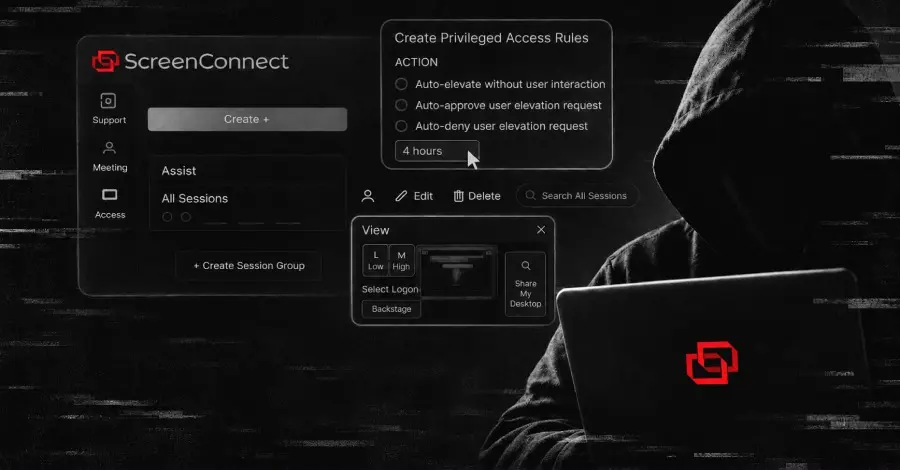
Additionally, researchers have identified a curious cluster of activity involving thousands of unauthorized ScreenConnect guest sessions originating from machines with names themed after cryptocurrency exchanges. These sessions used names like BITMEX-BOT, KUCOIN-SRV, LAPTOP-BINANCE, and BITFINEX-PRO. The prevailing theory is that these names are intended to trick technicians into connecting to the sessions, perhaps under the guise of providing support for a crypto-related issue.

While Huntress noted that no immediate malicious activity—such as file transfers or command execution—has been observed from these specific crypto-themed sessions, the scale of the operation is significant. As of mid-November 2026, over 2,400 unauthorized sessions of this type were enrolled across 118 self-hosted ScreenConnect servers.
Investigations revealed that the actors behind these sessions were obtaining publicly downloadable ScreenConnect Access installers to extract the relay addresses needed to register a guest client with a target server. They then used scripted emulators to impersonate Windows ScreenConnect clients and create fake sessions that appeared to be online. Interestingly, nearly all of these crypto-themed connections originated from a single IP address hosted by IONOS: 74.208.158[.]106.
Mitigation and Defensive Recommendations
The critical nature of CVE-2026-84869 and the active exploitation of MSP environments have prompted urgent calls for remediation. Security experts advise that the most effective defense is to ensure that all ScreenConnect host clients are updated to version 26.6.5 or later, which contains the necessary patches to close the vulnerability.
For organizations that cannot apply patches immediately, ConnectWise has recommended a temporary workaround: removing the "TransferFiles" permission from all roles and session groups. This effectively disables the mechanism that attackers are using to push their malicious payloads, though it may also limit the legitimate functionality of the software for technicians.
In addition to patching, Huntress recommends that MSPs take the following proactive steps:
- Hunt for Signs of Exposure: Review ScreenConnect logs for unauthorized guest joins, especially those with default hostnames or suspicious file transfer requests (e.g.,
update.bat,marker.txt). - Isolate Affected Workstations: If there is any evidence that a technician’s machine has been targeted or compromised, it should be immediately isolated from the network to prevent lateral movement.
- Rotate Credentials: Because technician workstations often store credentials for various client systems and RMM tools, all passwords and secrets reachable from a potentially compromised machine should be rotated immediately.
The targeting of MSPs remains a top priority for modern threat actors due to the "multiplier effect" it offers. By compromising a single service provider, an attacker can potentially gain access to hundreds of downstream businesses. As the exploitation of CVE-2026-84869 demonstrates, maintaining the security of the tools used to manage these environments is not just a matter of internal hygiene, but a critical component of global supply chain security.
 Cybersecurity Basics & Security News
The Evolution of the Digital Frontier: How AI and Cloud Expansion are Redefining Modern Cybersecurity Strategy
The global cybersecurity landscape is currently undergoing a fundamental transformation, driven by...
 Cybersecurity Basics & Security News
ShinyHunters Suspect Rey Reportedly Detained in Jordan, Helping FBI Identify Group Members
Khader, who also operated under the moniker ReyXBF, is far from an...
 Cybersecurity Basics & Security News
Unmasking Lunex: The Rapid Expansion of a Sophisticated Malware-as-a-Service Platform Targeting Ukraine
The cybersecurity landscape is witnessing the emergence of a highly sophisticated Malware-as-a-Service...