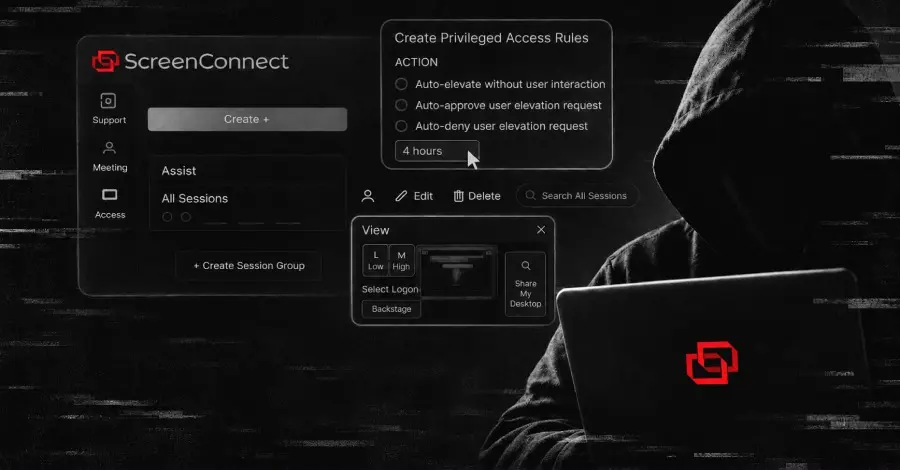

Widespread Spraying and Canary Tactics
The exploitation of CVE-2026-84869 appears to be part of a broader, more aggressive campaign. Between October 20 and November 16, 2026, researchers observed what they described as a "spraying" campaign, where attackers blindly targeted ScreenConnect servers with thousands of requests. Huntress reported seeing at least 688,000 guest "run file" requests hitting 42 different ScreenConnect servers. These requests originated from 29 distinct IP addresses and specifically sought to execute files with names like update.bat or variations containing hexadecimal strings, such as update_<8 hex characters>.bat.
In many of these cases, the attackers appeared to be using automated scripts to probe for vulnerable systems. The guest sessions often had blank session names or used default Windows hostnames, suggesting a lack of specific targeting in the initial phase. However, more nuanced tactics have also been observed. In one instance, a guest machine located at the IP address 91.224.92[.]167 pushed a harmless text file named "marker.txt" to a technician’s machine just two seconds after the technician joined the session.
Security analysts believe this "marker.txt" file serves as a canary. By successfully pushing and potentially verifying the existence of this file, the attacker can confirm that the exploit works against a specific target before deploying a more malicious payload. This allows the threat actor to avoid wasting their more sophisticated tools on systems that may already be patched or otherwise protected.
Targeted Infiltration of Real Sessions
While much of the activity has been automated, researchers have also documented more surgical, targeted attacks. In October 2026, an attacker was observed joining three legitimate support sessions that a technician had created for real clients. By slipping into these active sessions as an additional guest, the attacker was able to exploit the vulnerability in a live environment.
During these sessions, the attacker attempted to run a file designed to drop a batch script named "Sync.bat" into the technician’s Windows Startup folder. Placing a script in the Startup folder is a classic persistence mechanism; it ensures that the malicious code executes every time the technician logs into their computer, even if the initial ScreenConnect session has ended. This specific case illustrates the danger of "session hijacking," where an attacker doesn’t just lure a technician to a fake session but actively infiltrates the day-to-day operations of the MSP.
A Complex Threat Landscape: SCKit and Crypto-Bots
The exploitation of CVE-2026-84869 is occurring alongside other distinct but related threats targeting ScreenConnect users. One such threat involves a recently disclosed attack wave where unknown actors gained unauthorized access to ScreenConnect environments by exploiting an authentication flaw in a third-party extension.
Once access was gained through the extension, the attackers deployed a malware toolkit known as "SCKit." This toolkit then leveraged the ScreenConnect infrastructure to propagate malware to technician workstations. While the end goal—compromising the technician—is similar to the exploitation of CVE-2026-84869, the entry point via third-party extensions represents a different vector that MSPs must account for in their security posture.
 Cybersecurity Basics & Security News
Google Intelligence Report Warns of Paradigm Shift as Threat Actors Deploy Autonomous Agentic AI Frameworks
In a comprehensive assessment that underscores a fundamental transformation in the digital...
 Cybersecurity Basics & Security News
OpenSSH "SSHole" Vulnerability and the Persistence of Simple Misconfigurations Lead Weekly Cybersecurity Briefing
The cybersecurity landscape in late 2026 continues to demonstrate a paradoxical truth:...
 Cybersecurity Basics & Security News
CISA Expands Known Exploited Vulnerabilities Catalog with Critical Flaws in Cisco BroadWorks and Openwave Messaging
The U.S. Cybersecurity and Infrastructure Security Agency (CISA) has issued a fresh...