

In the modern cybersecurity landscape, the act of identifying a vulnerability is often the simplest part of the process. Automated scanners and threat intelligence feeds provide a constant stream of alerts, flagging missing patches and configuration errors across sprawling digital estates. However, the true challenge—and where the most significant risks reside—lies in what happens after the scan is complete. Closing a vulnerability safely, confirming the fix is effective, and ensuring that the same weakness does not resurface requires more than just a security tool; it demands a rigorous operational discipline rooted in IT service management.
A vulnerability scanner is designed to identify technical weaknesses, such as a missing security update on a server. However, that scanner is typically blind to the operational context surrounding that server. It cannot identify which team is responsible for the hardware, which critical business services rely on its uptime, or when the next viable maintenance window is scheduled. Furthermore, a scanner cannot predict which interconnected systems might fail if a server requires a reboot after a patch. These operational questions transform vulnerability management from a simple security workflow into a complex exercise in service coordination.
This shift in perspective is the central theme of a new series on cyber resilience in service management. By examining the practices that support security work in live environments—ranging from asset context and service ownership to change control and recovery planning—organizations can begin to move past the "find and fix" mentality toward a more sustainable model of continuous improvement.
The Critical Distinction Between Discovery and Remediation
It is a common misconception in IT circles that a vulnerability assessment is synonymous with vulnerability management. In reality, an assessment is merely a snapshot in time, identifying weaknesses as they exist at a specific moment. Vulnerability management, by contrast, is an ongoing lifecycle that encompasses the identification, prioritization, treatment, validation, and monitoring of those weaknesses. The distinction is vital because a scan result, on its own, resolves nothing.
Consider a typical scenario in a high-pressure production environment. A security scanner flags a critical vulnerability on a core system. The security team, fulfilling its mandate, generates a ticket and sends it to the operations department. At this point, the technical discovery is over, but the actual work of risk reduction is only beginning. The operations team must then determine if the asset is still active, who has the authority to take it offline, and what the potential "blast radius" of a failed patch might be.
This operational reality is reflected in recent guidance from the Cybersecurity and Infrastructure Security Agency (CISA) and the National Institute of Standards and Technology (NIST). CISA’s recommendations on asset inventory emphasize the need to maintain accurate data throughout the entire lifecycle of an asset. By connecting inventory context with vulnerability data, organizations can more effectively prioritize risk. Similarly, the NIST Cybersecurity Framework 2.0 bridges the gap between asset management and broader risk management, highlighting that incident response and recovery are inextricably linked to how well an organization understands its own infrastructure.

The Necessity of Decision-Ready Asset Data
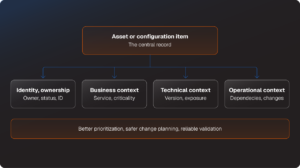
Effective remediation cannot be built on a foundation of hostnames and serial numbers alone. To move the needle on security, teams require "decision-ready" asset data. This involves enriching basic technical records with the context necessary to make informed choices under pressure. IT Asset Management (ITAM) plays a crucial role here, tracking hardware, software, and cloud resources from procurement to retirement.
A remediation-ready asset record should provide answers to several pivotal questions. For instance, knowing the environment—whether a system is in production, development, or a testing lab—immediately dictates the urgency and the protocol for a patch. Technical details confirm if a vulnerability is even applicable to the specific configuration in use, while status records help teams filter out "ghost" assets or stale records that no longer pose a threat.
Furthermore, understanding the business criticality and the related services an asset supports allows security teams to look beyond a raw severity score. A "medium" vulnerability on a revenue-generating database may actually pose a higher risk to the organization than a "critical" vulnerability on an isolated, non-essential test server. By integrating this context, organizations can ensure that their limited resources are focused on the areas of greatest impact.
The Interplay of ITAM and CMDB in Security
While ITAM focuses on the lifecycle and financial aspects of assets, the Configuration Management Database (CMDB) serves a different but equally vital purpose during remediation. The CMDB documents configuration items and, more importantly, the relationships between hardware, software, and business services.
These relationships are the backbone of change-impact analysis. When a critical vulnerability is found on a web server, the CMDB can reveal that the server relies on a shared identity service or supports a specific customer-facing application. This knowledge allows the team to develop a remediation plan that includes targeted application testing and a documented rollback strategy. Without this visibility, a security fix intended to protect the company could inadvertently cause a major service outage, creating a different kind of business crisis.
Tools like SolarWinds Service Desk are designed to bridge these silos, connecting asset discovery with configuration items, incidents, and changes. This integration allows a team to transition from simply knowing a vulnerable device exists to having a clear path toward closure, backed by an accountable owner and a documented implementation plan.
Closing the Ownership Gap
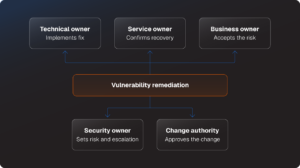
When remediation efforts stall, the problem is rarely a lack of technical skill. More often, the delay is caused by a gap in ownership. A security team may be aware of a risk but lack the authority to approve downtime. Conversely, a technical owner may understand the system but may not feel empowered to prioritize security work over their existing operational backlog.
To clear these hurdles, a practical remediation workflow must establish clear roles. This includes a security owner to define the risk, a technical owner to implement the fix, and a service owner who understands the business impact and can authorize the necessary changes. Additionally, a change approver ensures that the work is balanced against other organizational priorities.
The goal of establishing these roles is not to create a bureaucratic bottleneck. In fact, unnecessary approvals can be just as damaging as a lack of oversight. Instead, the objective is to match the level of governance to the risk and complexity of the work. For routine patches, automated workflows and pre-authorized "standard changes" can keep work moving quickly. For high-impact systems, a more formal review ensures that the cure isn’t worse than the disease.
Treating Remediation as Managed Work
The most successful vulnerability management programs treat remediation as a repeatable, managed process with defined stages. This begins with intake and triage, where findings are documented and owners are identified. It then moves into a prioritization phase that weighs technical severity against exploitability and business exposure.
Once the work is assigned, the planning phase becomes critical. This is where teams document their implementation approach, including testing and rollback procedures. The actual remediation—whether it involves a patch, a configuration change, or an upgrade—is only one part of the sequence. Following the fix, validation is required to confirm that the vulnerability is gone and the service is still functional.
This structured approach provides a central system of record, offering a superior alternative to the fragmented email threads and chat messages that often characterize ad-hoc remediation. A centralized system preserves the history of the work, including escalation paths and exception approvals, which is essential for both operational efficiency and regulatory compliance.
Prioritizing Risk Over Ticket Age
A common pitfall in vulnerability management is the tendency to prioritize work based on how long a ticket has been open. However, a risk-based approach, as advocated by CISA, suggests a more nuanced strategy. CISA’s Known Exploited Vulnerabilities (KEV) Catalog is a vital tool in this regard, helping teams identify which weaknesses are currently being leveraged by attackers in the wild.
Prioritization should take into account the reachability of the asset, the sensitivity of the data it handles, and the existence of any compensating controls that might mitigate the risk. This framework allows organizations to make documented, risk-based decisions. It distinguishes between a ticket that is aging because it is a low priority and one that is aging because no one knows who is responsible for the asset.
Mature programs also look beyond simple averages when measuring success. While "average time to patch" is a common metric, it can often hide a "long tail" of neglected vulnerabilities on critical systems. Tracking the 90th percentile of remediation time provides a clearer picture of where the process is failing and which high-risk issues are lingering beyond their target dates.
The Role of Change Control in Rapid Remediation
Speed is essential in security, particularly when dealing with zero-day exploits. However, the urgency of a "patch immediately" order must be balanced against the stability of the production environment. IT change management provides the structure necessary to assess and implement these fixes without causing unintended outages.
Changes can generally be categorized into three types: standard, normal, and emergency. Standard changes are for low-risk, repetitive tasks that follow a pre-authorized procedure. Normal changes require a more detailed impact analysis and scheduling due to their complexity. Emergency changes are reserved for urgent risks that require immediate action. Even in an emergency, however, the process must be documented to capture what was changed, who authorized it, and how it was validated.
By standardizing routine work, teams can move faster on the majority of vulnerabilities, leaving them with more time to focus on the complex, high-impact changes that require careful coordination across multiple departments.
Validating Success and Addressing Root Causes
The remediation process is not complete until the fix has been validated. Closing a ticket based on the assumption that a patch was successful is a dangerous practice. Validation should involve rescanning the asset, checking version numbers, and performing application tests to ensure that the service is operating correctly.
In cases where remediation cannot happen immediately, organizations must manage exceptions through a formal, time-bound process. These exceptions should include a justification for the delay, a description of compensating controls, and a clear expiration date to prevent them from becoming permanent security holes.
Finally, recurring vulnerabilities should be treated as a systemic issue rather than a series of isolated incidents. Problem management practices can help teams investigate the root causes of these patterns. Whether the issue is an unsupported legacy system or a flawed deployment process, identifying and fixing the underlying cause is the only way to prevent the same risks from returning. By building this operational foundation, organizations can ensure that their security efforts are not just reactive, but are a core component of their overall cyber resilience.
 Helpdesk & IT Service Management (ITSM)
The Hidden Complexity of Efficiency: SolarWinds Report Reveals the Dual Nature of AI in the Modern Service Desk
The promise of artificial intelligence within Information Technology Service Management (ITSM) has...
 Helpdesk & IT Service Management (ITSM)
US Authorities Disrupt Major Chinese State-Sponsored Cyber Infrastructure Linked to Integrity Technology Group
In a significant blow to state-sponsored cyber espionage operations, the United States...
 Helpdesk & IT Service Management (ITSM)
Binance Confirms Record-Breaking $6.3 Billion Security Breach Attributed to North Korean Threat Actors
In what is being described as the most significant financial hit in...







