
The promise of artificial intelligence within Information Technology Service Management (ITSM) has long been centered on the concept of radical simplification. For years, the narrative has suggested that AI would act as a release valve for overextended IT departments, automating away the mundane and allowing human agents to focus on high-level strategy. However, the reality emerging on the ground is significantly more nuanced. While AI is undeniably accelerating specific tasks and delivering on return-on-investment (ROI) goals, it is simultaneously introducing new layers of management, oversight, and operational "taxes" that threaten to offset the very time savings it provides.
This complex landscape is the primary focus of the SolarWinds 2026 State of ITSM Report. Drawing on a comprehensive survey of 844 IT professionals across North America, Europe, the Middle East, Africa, and the Asia-Pacific region, the report offers a sobering yet optimistic look at the current state of AI adoption. The central takeaway is clear: the value of AI is not inherent in the technology itself, but rather in how it is applied, maintained, and measured by the people and data structures supporting it. Far from being a "set-and-forget" solution, AI is proving to be a sophisticated tool that requires a fundamental shift in how service desks operate.
The ROI Paradox: Practical Gains vs. Fundamental Breakthroughs
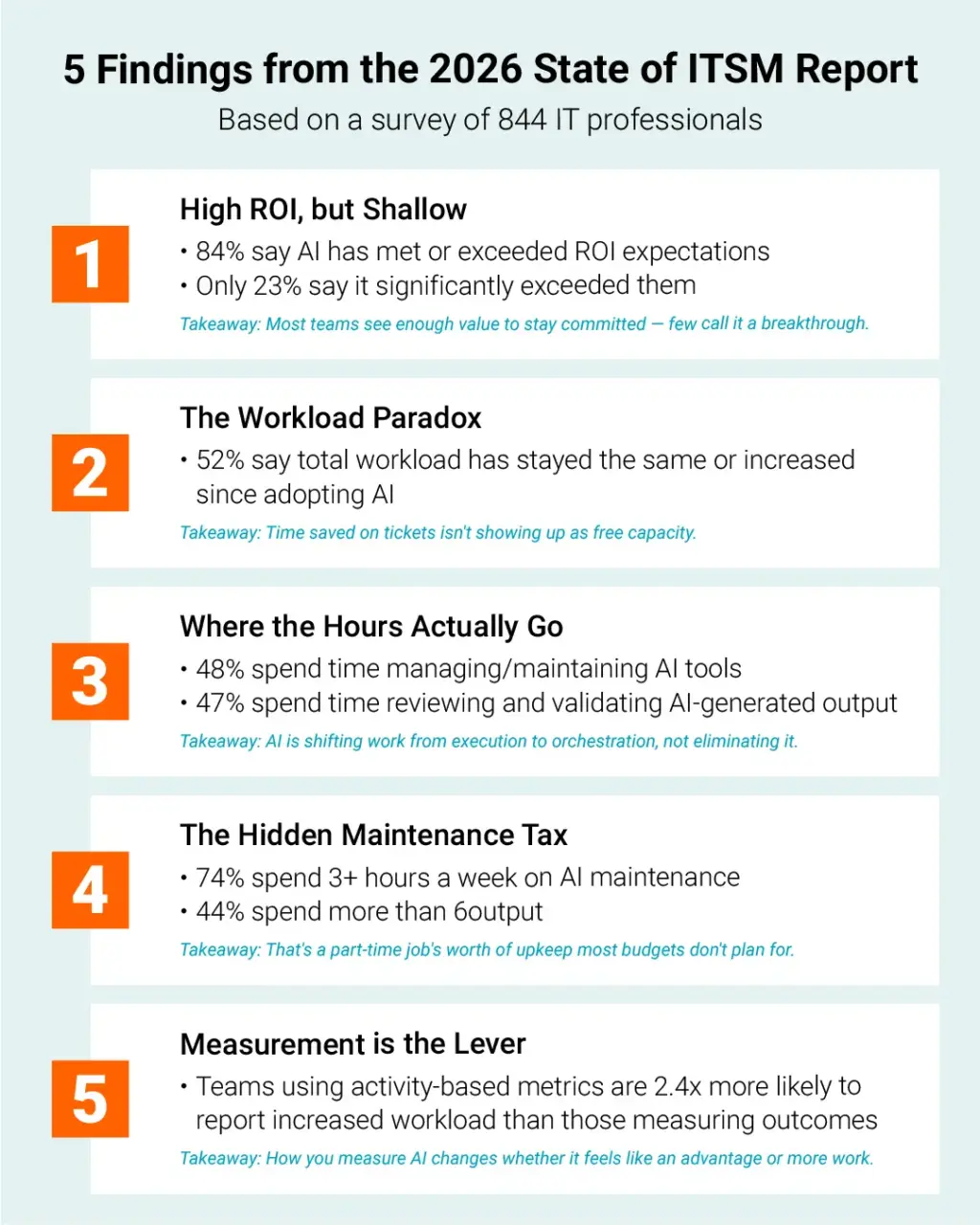
One of the most encouraging findings from the report is that AI is successfully meeting financial and operational expectations for the vast majority of organizations. According to the data, 84% of respondents say AI has either met or exceeded their ROI expectations. This is a significant milestone, particularly given the "hype cycle" that has surrounded generative AI over the last several years. It suggests that IT leaders have moved past the phase of idle experimentation and are now implementing AI in ways that produce tangible value.
However, the report also highlights a "breakthrough gap." While most see positive ROI, only 23% of respondents report that AI has significantly exceeded their expectations. This distinction is critical for understanding the current maturity level of AI in the service desk. Most organizations are seeing incremental improvements—practical gains in areas such as drafting initial ticket responses, summarizing complex incident histories, categorizing incoming requests, and surfacing relevant knowledge base articles for agents.
These are worthwhile improvements that reduce the friction of daily operations. Yet, as the report notes, these practical applications have not yet translated into the kind of outsized, transformative gains that fundamentally alter the economics or the end-user experience of service delivery. For the service desk of 2026, the challenge is no longer just adopting AI, but moving from these "headline metrics" of adoption toward specific service outcomes. The report suggests that instead of measuring how much AI is being used, leaders must focus on whether that usage leads to fewer escalations, stronger SLA compliance, and lower costs per ticket.
The Workload Contradiction: Saving Time While Increasing Effort
Perhaps the most surprising finding in the SolarWinds research is the disconnect between time saved on specific tasks and the overall workload of IT staff. On a task-by-task basis, AI is a proven time-saver. Respondents reported significant weekly gains across several core service desk functions. For instance, AI-driven issue detection and flagging saves an average of 3.3 hours per week. Responding to end-user requests is shortened by 3.0 hours, while triaging and categorizing tickets—a traditionally manual and tedious process—saves 2.9 hours.
Further efficiencies are found in the creation and uploading of knowledge base articles (2.9 hours), documenting and summarizing incidents (2.8 hours), and the actual resolution and remediation of issues (2.7 hours). These findings align with previous SolarWinds data. The 2024 State of ITSM Report noted that automation and self-service portals could reduce incident resolution times by several hours, while the 2025 analysis found that organizations using generative AI features saw average resolution times drop by nearly five hours—an 17.8% improvement.
 Helpdesk & IT Service Management (ITSM)
OpenSSF and Tech Giants Call for Sustainable Funding to Secure Global Software Supply Chain
The OpenSSF (Open Source Security Foundation) Governing Board has issued an urgent...
 Helpdesk & IT Service Management (ITSM)
Rethinking K-12 IT Staffing: Why Traditional Ratios Fail Modern School Districts
For years, school district administrators and school boards have searched for a...
 Helpdesk & IT Service Management (ITSM)
Softcat Announces Strategic Acquisition of GDT to Establish Premier Transatlantic IT Solutions Platform
In a move that signals a significant shift in its international growth...







