
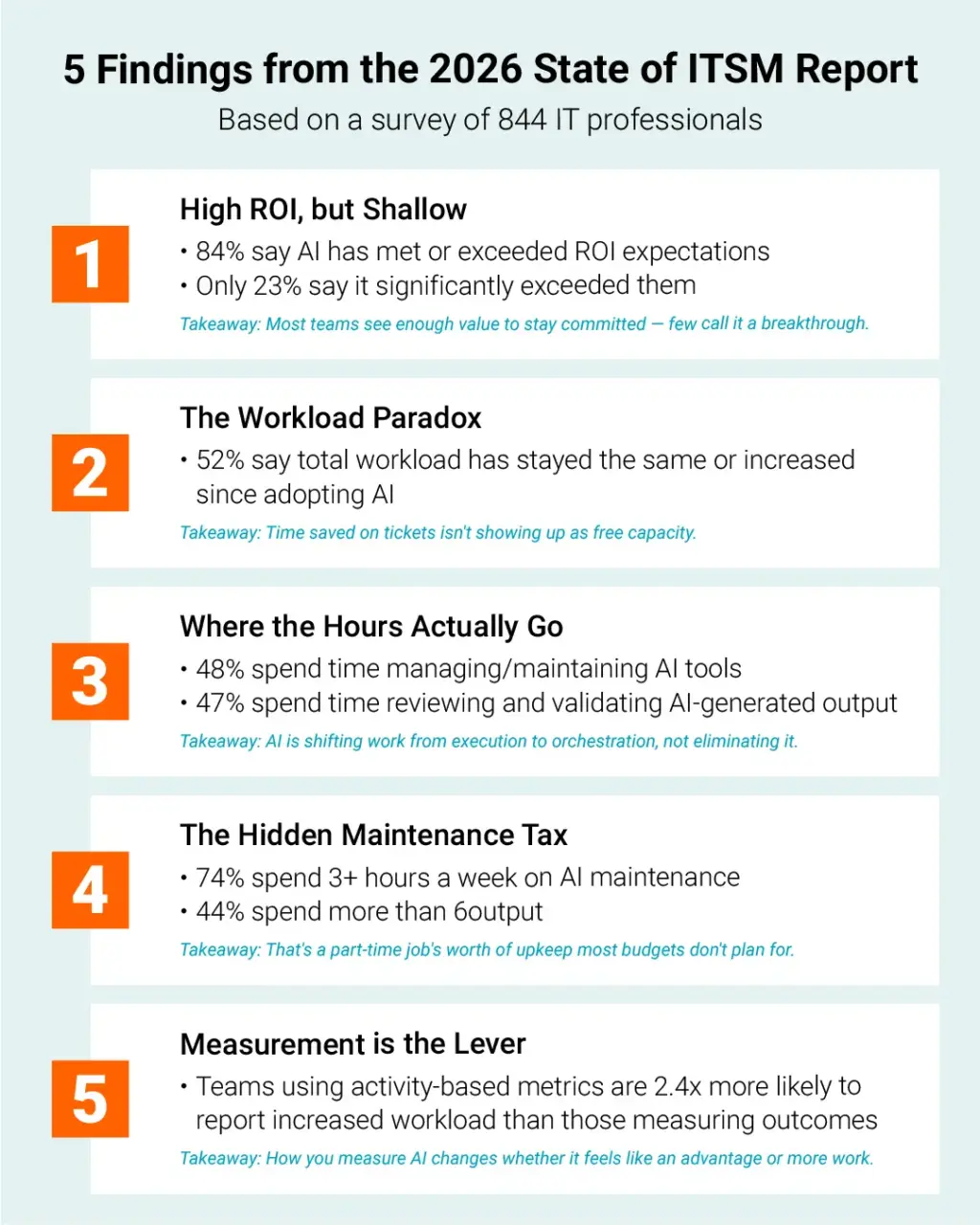
Despite these clear wins, the 2026 report reveals a startling reality: 52% of respondents say their overall workload has actually increased since adopting AI. Another 19% report that their workload has remained the same. Combined, this means that 71% of IT professionals have seen no net reduction in their daily work volume despite the introduction of labor-saving technology.
This paradox can be explained by how IT departments utilize reclaimed time. Rather than creating idle capacity or allowing for headcount reductions, the time saved by AI is almost immediately reinvested. Service desks are using those extra hours to process a higher volume of requests, improve the quality of their documentation, engage in proactive maintenance, and focus on strategic projects that were previously sidelined. While this represents progress and a more "proactive" IT stance, it requires leadership to have clear visibility into where this reclaimed time is going to avoid the perception that AI has failed to deliver efficiency.
The Human-in-the-Loop: Oversight as a New Workstream
The increase in workload is also driven by a new category of labor: AI oversight. The report clarifies that IT teams are not simply delegating work to AI and moving on to other tasks. Instead, they are taking on the role of supervisors for the technology. Forty-eight percent of respondents now spend significant time managing or maintaining AI tools, while 47% are tasked with reviewing and validating the output generated by AI.
In the context of a service desk, the stakes for accuracy are high. An AI-generated summary that misses a key technical detail or a categorization error that routes a critical server issue to the wrong department can actually slow down the resolution process rather than accelerate it. Consequently, human judgment remains a vital component of the workflow.
The report advises that service desks must intentionally design human review into their processes, particularly for workflows that carry high operational risk. The goal is to define exactly when AI can operate autonomously and when an agent’s approval is mandatory. This shift means that the role of the IT professional is evolving from "executor" to "auditor," requiring a different set of skills and a new allocation of time that must be accounted for in staffing models.
Budgeting for the "AI Maintenance Tax"
As AI becomes more integrated into the service desk, it is bringing with it a "maintenance tax" that many organizations failed to anticipate. The survey found that 83% of IT professionals spend at least three hours every week on AI maintenance, and nearly half—44%—spend six or more hours per week on these activities.
This maintenance work is multifaceted. It includes tuning prompts to ensure better accuracy, reviewing model outputs for bias or "hallucinations," coordinating with AI vendors on updates, and managing the integrations between AI tools and other ITSM systems. Furthermore, AI is only as good as the data it consumes. This means teams must spend time updating knowledge sources and addressing data gaps to ensure the AI remains reliable.
 Helpdesk & IT Service Management (ITSM)
The Shift Toward Pre-emptive Cybersecurity: Why "Detect and Respond" is No Longer Enough in the Age of AI
The cybersecurity landscape has long been characterized by a perpetual game of...
 Helpdesk & IT Service Management (ITSM)
Global Security Alert: North Korean Cybercriminals Target IT Freelancers in Multi-Million Dollar Fraud Campaign
International security agencies have issued a high-priority alert following the discovery of...
 Helpdesk & IT Service Management (ITSM)
IPhone 18 Pro Review: A Refined Powerhouse Redefining the Professional Flagship
While the tech industry’s collective gaze has recently been fixed on the...







