
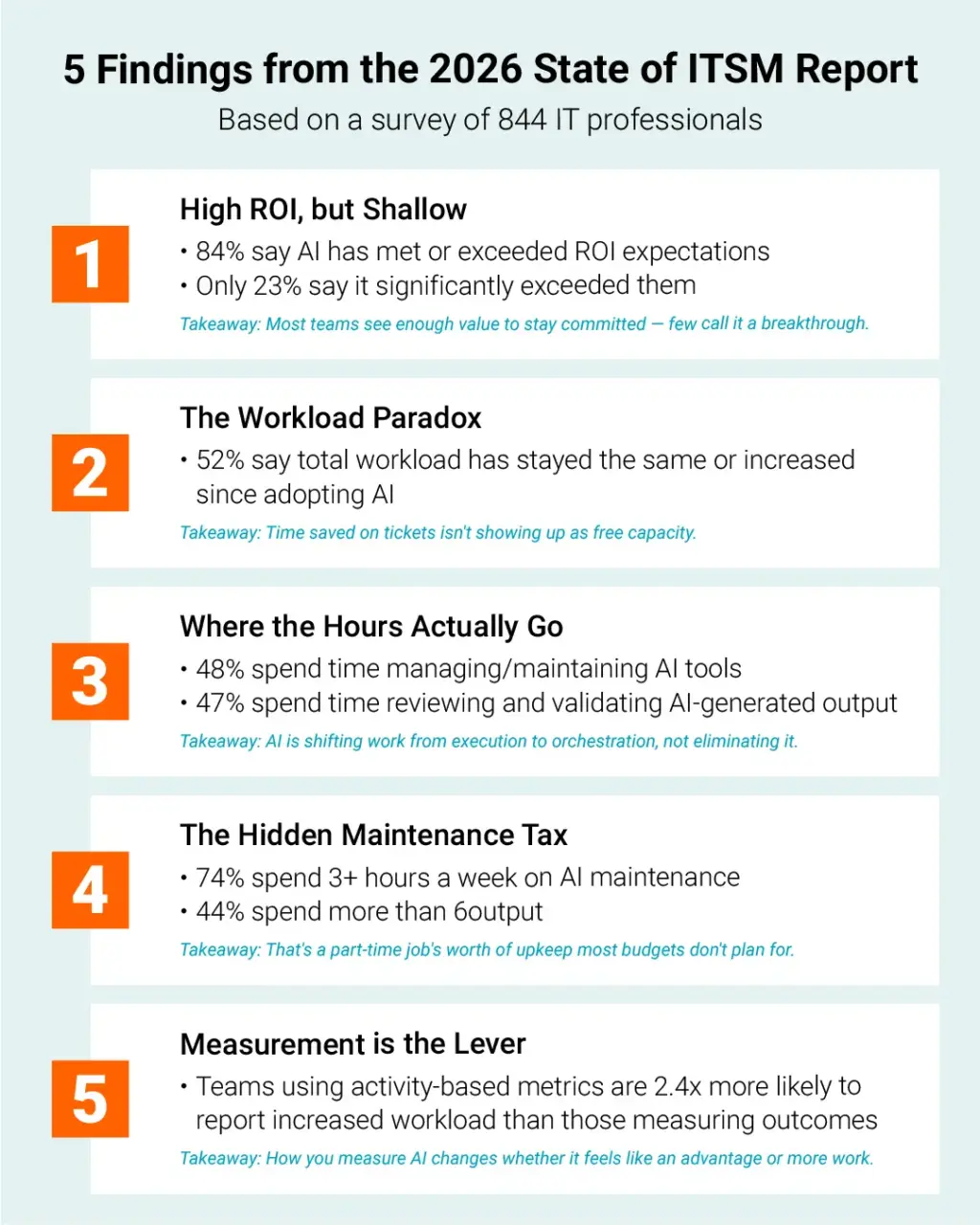
The report points out that while all service desk tools require maintenance—automation rules need periodic reviews and knowledge articles eventually go stale—the operating models for AI are still in their infancy. Many organizations have established processes for governing their self-service portals, but they have yet to build similar rigor around their AI deployments. To achieve sustainable value, the report suggests that AI maintenance must be a formal part of the IT roadmap, with assigned owners and defined review cycles.
Moving from Activity to Outcomes
The final key finding of the 2026 report highlights a correlation between how AI is measured and how the workload is perceived. Organizations that use an activity-oriented approach to measurement—counting things like the number of AI-generated summaries or the volume of automated categorizations—are 2.4 times more likely to report an increased workload compared to those using an outcome-oriented approach.
Activity metrics can be misleading. A service desk can process more tickets than ever before using AI, but if those tickets are not resolved effectively or if employee satisfaction is dropping, the "activity" does not represent true value. It merely represents a busier, more chaotic environment.
The report advocates for a shift toward outcome measures that reflect the actual experience of the end-user and the health of the business. These include metrics such as employee productivity, the number of prevented incidents, cost per ticket, and mean time to detect (MTTD). By focusing on these results, IT leaders can better evaluate whether AI is actually solving problems or just moving them around. For example, if AI is used for ticket triaging, the success should be measured by reassignment rates and time-to-assignment, rather than just the number of tickets triaged.
A Mature Era for AI in ITSM
The 2026 State of ITSM Report signals a transition into a more mature era of AI adoption. The initial excitement of "what AI can do" is being replaced by a pragmatic understanding of "what it takes to run AI." The trajectory of the last three years of SolarWinds research shows a clear evolution: the 2024 report established that automation and knowledge management provide the necessary foundation; the 2025 report proved that generative AI can significantly reduce resolution times; and now, the 2026 research clarifies that the next step is operational discipline.
Ultimately, the question for modern service desks is no longer whether AI has a place in ITSM. The question is whether the organization has the workflows, the data integrity, and the measurement frameworks to support it. As the report concludes, the most successful organizations will be those that manage the work around the AI as deliberately as they manage the technology itself. By recognizing the maintenance tax, planning for human oversight, and focusing on outcome-based metrics, IT leaders can ensure that AI serves as a true catalyst for efficiency rather than just another source of digital noise.
 Helpdesk & IT Service Management (ITSM)
Omdia Research Highlights Significant Cost Savings and Operational Gains for MSPs and IT Teams Adopting Unified Management Platforms
In an era defined by tightening budgets and an explosion of digital...
 Helpdesk & IT Service Management (ITSM)
IPhone 18 Pro Review: A Refined Powerhouse Redefining the Professional Flagship
While the tech industry’s collective gaze has recently been fixed on the...
 Helpdesk & IT Service Management (ITSM)
NetApp and Oracle Unveil Native Integration to Streamline Enterprise Cloud Migration and AI Workloads
LAS VEGAS — In a move designed to bridge the gap between...







