In a significant move to redefine the boundaries of digital productivity, Microsoft has unveiled a reimagined Copilot experience designed to integrate artificial intelligence more deeply into the "flow of human ambition." The tech giant is positioning this "new Copilot" not merely as a sidecar assistant, but as a centralized platform that connects the essential tools of the modern workplace with a sophisticated new generation of agentic capabilities. This evolution seeks to empower both individuals and large-scale organizations to build, customize, and scale AI solutions across their entire operational footprint.
The announcement, spearheaded by Jared Spataro, Microsoft’s lead for AI at Work, introduces a fundamental shift in how users interact with AI. By moving beyond simple chat interfaces, Microsoft is creating a multi-modal environment where users can toggle between instant conversation, delegated complex tasks, and custom software creation, all within a unified workspace.
A New Experience for Every Mode of Work
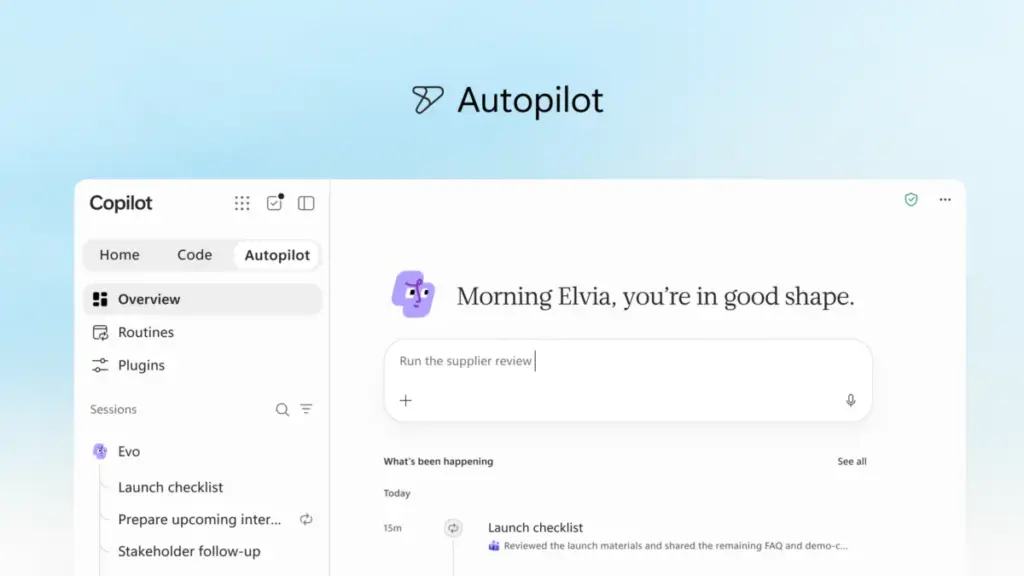
At the heart of this transformation is the revamped Copilot app, which introduces three primary pillars: Home, Code, and Autopilot. These features are designed to address the fragmented nature of modern work, where employees often find themselves caught in a constant shuffle between meetings, emails, and document editing.
Home: The Unified Starting Point
The new "Home" interface serves as the central nervous system for the user’s workday. It is designed to be the definitive starting point where two distinct modes of AI interaction—Chat and Cowork—converge. As digital work becomes increasingly decentralized, Home provides a grounding mechanism, allowing users to review recent activities, receive proactive suggestions on pending tasks, and resume projects exactly where they left off.
The distinction between Chat and Cowork is central to Microsoft’s vision. Chat remains the go-to for instantaneous, conversational needs—answering quick questions, drafting brief emails, or summarizing a recent thread. Cowork, however, represents a shift toward delegation. In this mode, users define a high-level objective, such as responding to a Request for Proposal (RFP) or closing a financial period, and the AI manages the end-to-end execution. This allows for complex, iterative work that results in a finished product rather than just a conversational response. Microsoft has indicated that soon, the system will automatically route requests to the appropriate mode—Chat, Cowork, or Code—based on the nature of the prompt.

Office in Copilot: Seamless Productivity
A major friction point in early AI adoption was the need to move context between an AI chat and a dedicated productivity application. Microsoft is addressing this by embedding the full power of Word, Excel, and PowerPoint directly into the Copilot experience through "Office in Copilot." This integration ensures that when a user asks Copilot to draft a brief or model a budget, it creates a live, editable document that maintains all formatting and context. This collaborative environment allows team members to be @mentioned directly within the interface, with edits syncing in real-time between the Copilot app and the traditional Office suite.
Furthermore, Microsoft has enhanced the specific "skills" within these apps. PowerPoint can now automatically ensure decks remain on-brand while offering fine-tuned image adjustments. Excel has been upgraded to provide transparency in data manipulation; when Copilot or a teammate makes a change, the system explains the "why" behind the edit and suggests the most effective visualizations for the data.
Code: Democratizing Solution Building
The introduction of "Code" marks a significant expansion of what Microsoft considers "knowledge work." While documents and spreadsheets remain vital, Microsoft is introducing a "fourth unit" of work: purpose-built, small-scale solutions. Powered by the same underlying technology as GitHub Copilot, "Code" allows non-developers to describe an app, automation, or dashboard in natural language. Copilot then builds the solution in a sandboxed, secure environment.
 Productivity Software & Office Suites
Microsoft Unveils the "New Copilot": A Reimagined AI Platform Featuring Autonomous Agents and Low-Code Solution Building
In a significant move to redefine the landscape of digital productivity, Microsoft...
 Productivity Software & Office Suites
Microsoft Unveils Natural Language App Creation in Copilot Studio, Bridging the Gap Between AI Innovation and Enterprise Governance
The landscape of software development is undergoing a fundamental transformation, driven by...
 Productivity Software & Office Suites
Microsoft Unveils Microsoft 365 G7: A New Frontier for AI-Driven Governance in the Public Sector
In a move designed to redefine how the public sector interacts with...