
In the rapidly evolving landscape of corporate technology, the conversation among C-suite executives has shifted from the novelty of generative AI to the practicalities of industrial-scale implementation. As businesses move past the initial excitement of large language models, a new set of challenges has emerged: How does a company transform from a collection of experimental pilots into a "Frontier Firm"—an organization where AI is not just a tool, but a self-reinforcing system of continuous learning?
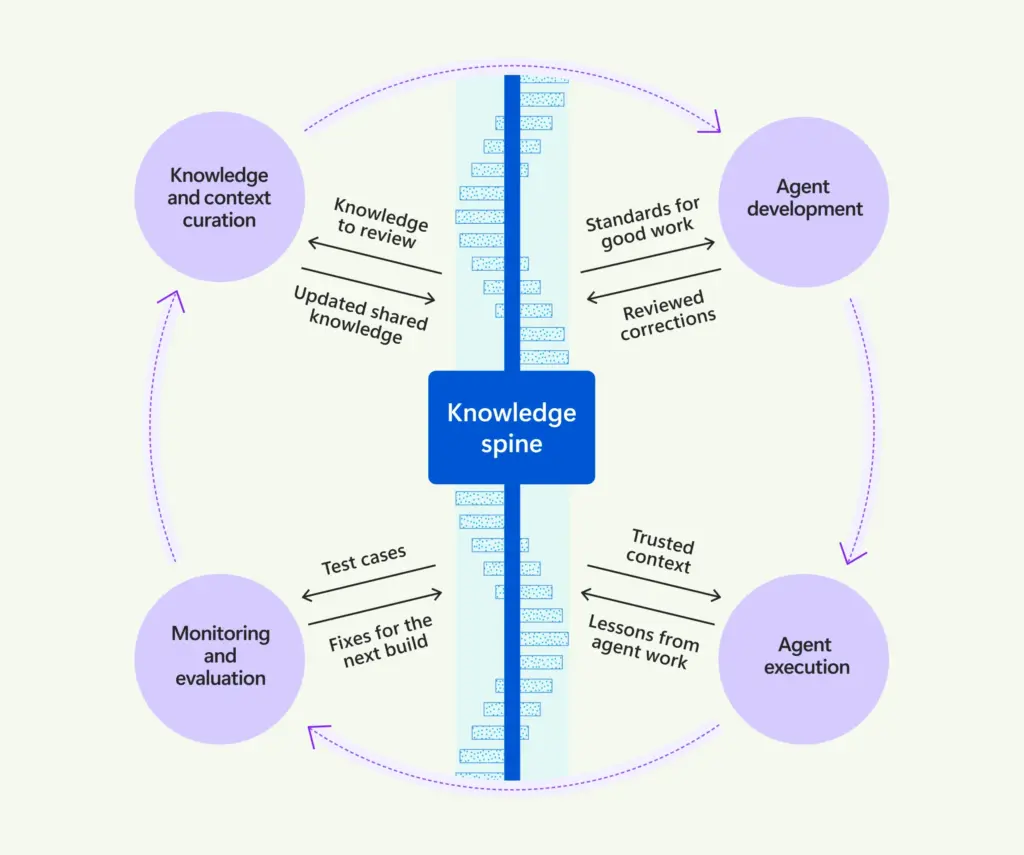
New research launched by Microsoft in collaboration with the global technology and advisory firm Keystone offers a data-driven look into this transformation. The study, which culminated in a Harvard Business School working paper titled “Organizing AI at Enterprise Scale: Agentic Operating Models and Firm Outcomes,” suggests that the most successful organizations are moving away from isolated AI applications. Instead, they are building what researchers call a "knowledge spine"—a centralized, shared infrastructure that allows AI agents to learn from one another and the business at large.
The findings come at a critical time. While thousands of companies have deployed basic AI chat functions, the research indicates that only a tiny fraction—roughly 3%—have successfully implemented the full architectural building blocks required for a truly agentic operating model. However, those who have made significant strides in this direction are already seeing measurable financial advantages.
The Rise of the Knowledge Spine
At the heart of the research is the concept of the "knowledge spine." In the early days of the AI boom, many firms deployed agents in silos—one for customer service, another for supply chain logistics, and perhaps a third for internal HR queries. While these agents may perform their specific tasks well, they often operate in isolation, meaning a lesson learned by one agent is lost to the rest of the organization.
The study defines the knowledge spine as a shared system that stores and updates the context these agents rely on. More importantly, it acts as a repository for the corrections, tests, and operational lessons derived from the agents’ daily work. When a human corrects an agent’s mistake, that "fix" is fed back into the spine, ensuring that every other agent in the system benefits from that single interaction.
This approach turns a company’s operational history into a proprietary asset. While the underlying AI models may be developed by third parties, the "knowledge spine" is built from the unique context of the company itself. Researchers found that companies implementing these practices saw significantly higher gains in operating margins and return on assets between 2022 and 2025. Specifically, companies in the top quartile of the study’s maturity scale improved their operating margins by over 5 percentage points more than those in the bottom quartile.
A Framework for Enterprise Transformation
To help leaders navigate this transition, the research team—which included scholars from Harvard and experts from Keystone—developed a four-stage maturity framework for AI transformation. This framework was built after an extensive period of investigation, including interviews with leaders at 29 organizations with advanced AI deployments and a detailed survey of more than 200 enterprises across sectors such as healthcare, finance, and manufacturing.

The first stage is characterized by a patchwork of AI pilot projects. In these organizations, AI efforts are often uncoordinated and limited to basic chat functions. Because these tools are not integrated into real business workflows, they show minimal impact on the bottom line.
 Productivity Software & Office Suites
The Rise of the Agentic Enterprise: New Research Identifies the ‘Knowledge Spine’ as the Key to AI Transformation
In the current corporate landscape, the conversation surrounding artificial intelligence has shifted...
 Productivity Software & Office Suites
Microsoft to Headline ESPC 2026 in Amsterdam as the European Tech Community Pivots Toward an Agentic AI Future
As the global landscape of work undergoes its most significant transformation since...
 Productivity Software & Office Suites
Microsoft Reimagines Copilot as a Centralized Engine for the Future of AI-Driven Work
In a major strategic shift aimed at redefining the intersection of human...







