
As the initial hype surrounding generative artificial intelligence matures into a demand for tangible business results, a new class of organizations is beginning to emerge. These "Frontier Firms" are moving beyond simple chatbots to build self-reinforcing systems of learning that integrate AI agents directly into the fabric of their operations. However, for many executives, the path to this transformation has remained obscured by a lack of clear, actionable data.
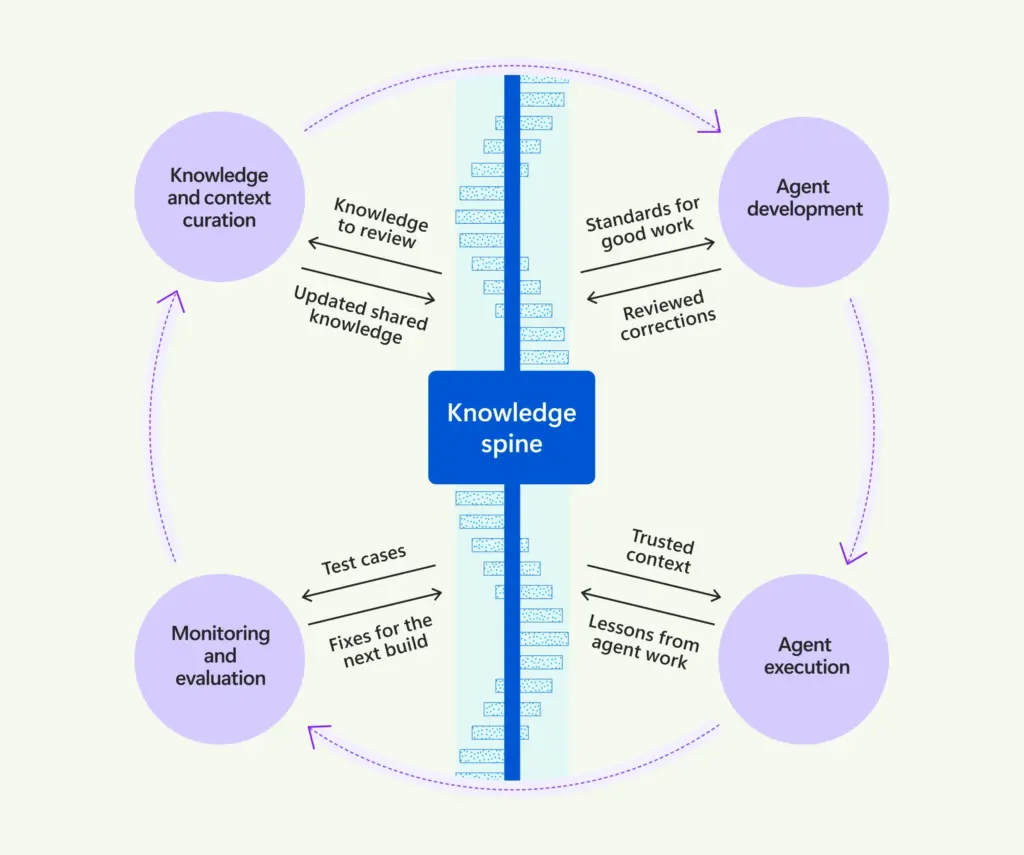
To bridge this gap, Microsoft recently unveiled a comprehensive research initiative conducted in collaboration with Keystone, a global technology and advisory firm. The study, which includes a Harvard Business School working paper titled “Organizing AI at Enterprise Scale: Agentic Operating Models and Firm Outcomes,” examines how major enterprises are navigating the transition from pilot projects to fully integrated AI systems. The findings suggest that a specific architectural approach—referred to as a "knowledge spine"—is becoming the differentiator between companies seeing massive financial gains and those stuck in the "patchwork" phase of adoption.
The research reveals a stark divide in performance. Companies that have successfully implemented the building blocks of a coordinated AI system saw significantly higher operating margins and returns on assets compared to their peers. Yet, despite the clear advantages, the study finds that only 3% of the enterprises surveyed have fully deployed the necessary components to support a robust knowledge spine.
A New Framework for Enterprise Transformation
The transition to an AI-driven organization is rarely a linear path. To help leaders understand their current position, the research team—led by scholars including Marco Iansiti of Harvard Business School—developed a four-stage maturity framework based on an assessment of over 200 enterprises. Each of these companies employs more than 1,000 people and spans diverse sectors, including financial services, manufacturing, healthcare, and retail.
In Stage One, companies are characterized by a "patchwork" of AI efforts. These organizations typically focus on isolated pilot projects, often limited to basic chat interfaces. These efforts generally lack central coordination and are not yet connected to core business workflows. Consequently, they show minimal business impact and fail to move the needle on financial performance.
Stage Two represents a significant step forward, as companies begin to deploy AI agents to tackle real-world business problems. At this level, agents are targeted at specific workflows across various functions. However, the limitation at this stage is the lack of automated orchestration. Instead, these firms rely on human-led committees and teams to prioritize investments and check the work of the agents. While this provides a necessary layer of governance, the study notes that human orchestration is notoriously difficult to scale, which can delay the realization of meaningful returns.
Stage Three is described by researchers as the "turning point." At this stage, companies begin to shift the burden of coordination from humans to systems. This is achieved through the use of shared knowledge bases and automated monitoring of agent activity. Rather than having a person manually review every output, the organization uses technological guardrails and business-outcome data to guide what work the agents take on. While this often starts within a single department or a specific set of workflows, it sets the foundation for enterprise-wide scaling.
Finally, Stage Four represents the arrival of the "Agentic Operating Model." Here, orchestration, governance, and a central knowledge spine are fully integrated. In these firms, the lessons learned from an agent’s work are automatically fed back into a shared system, allowing the entire organization to benefit from every individual interaction. This creates a single, cohesive operating model where systems take on the majority of the coordination and learning tasks.

The Financial Reality of AI Maturity
 Productivity Software & Office Suites
Microsoft Shifts Focus from AI Hype to Enterprise Utility as Jared Spataro Outlines New Strategic Roadmap
In a comprehensive message addressed to the global business community, Jared Spataro,...
 Productivity Software & Office Suites
Microsoft Unveils the Next Generation of Copilot: A Reimagined AI Platform for the Evolving Digital Workplace
In a significant move to redefine the intersection of artificial intelligence and...
 Productivity Software & Office Suites
Microsoft 365 Copilot Surpasses 30 Million Paid Seats as Enterprise AI Evolves from Assistant to Autonomous Agent
In a landmark update shared during its most recent earnings call, Microsoft...







