
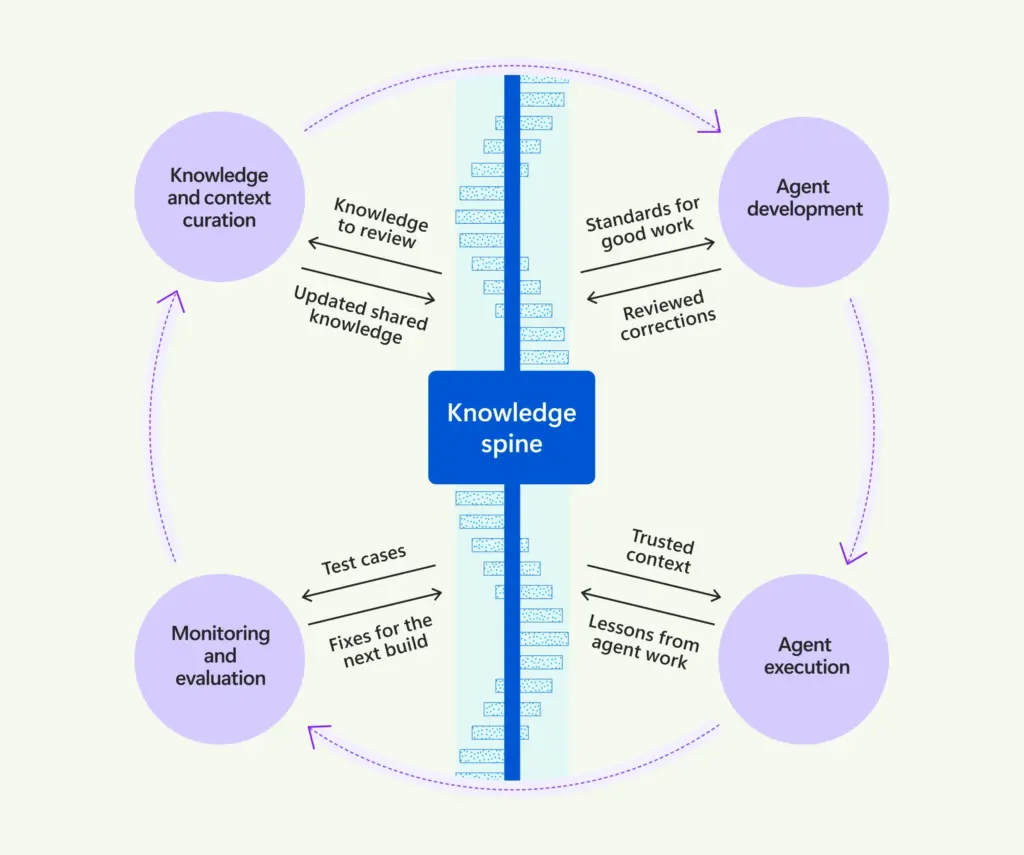
Finally, the knowledge spine requires clear ownership. A specific individual or team must be accountable for the integrity of the data sources the agents rely on, resolving conflicts when different sources provide contradictory information, and ensuring that outdated data is purged from the system.
Implementing a Culture of Observability
Underpinning these four practices is the principle of observability. The study found that 76% of companies in the top quartile of AI maturity maintained searchable records of agent activity, compared to just 8% of companies in the bottom quartile.
By capturing detailed operational telemetry on every action an agent attempts, these firms can identify exactly why a fix is needed and how to implement it. This level of transparency allows agents to "earn" their autonomy. When the data shows an agent is consistently performing well against a set of test cases, the company can widen its scope of authority. Conversely, if an agent struggles, it can be pulled back for further training and refinement.
Microsoft is already incorporating these principles into its own infrastructure through "Microsoft IQ," an enterprise intelligence layer designed to update shared knowledge in a single location for use by all agents. The goal is to allow companies to stop worrying about the underlying models and focus instead on the proprietary lessons, tests, and corrections that make their business unique.
The Practical Path Forward
For business leaders looking to replicate the success of these Frontier Firms, the advice from researchers is to start small but think systematically. Building an enterprise-wide knowledge spine is a massive undertaking that few companies can achieve in one move. Instead, the study suggests implementing these practices within a single team or a handful of connected workflows.
Once the system is proven to work in a localized environment, it can be extended across the organization. Leaders are encouraged to ask three critical questions to gauge their current standing: When an agent is corrected, does that lesson reach other agents? Is there a shared standard for "good work" that improves every time a mistake is made? And finally, is there a clear owner for the knowledge the agents rely on?
The broad shift in enterprise AI is moving away from a focus on individual models and toward a focus on integrated systems. While AI models will continue to evolve and be replaced, the infrastructure of a knowledge spine—and the proprietary lessons stored within it—remains a permanent asset. As the research concludes, the advantage in the AI era will not go to those who have the best models, but to those who have built the best systems for their agents to learn, coordinate, and grow.
 Productivity Software & Office Suites
Microsoft Reimagines the Future of Productivity with the Launch of the New Copilot
In a significant evolution of its artificial intelligence strategy, Microsoft has unveiled...
 Productivity Software & Office Suites
Microsoft Unveils ‘Autopilots’ and Scout: A New Frontier for Autonomous AI Agents in the Enterprise
The nature of professional productivity is undergoing a fundamental shift, moving away...
 Productivity Software & Office Suites
Microsoft Announces Global Launch of Copilot Cowork, Introducing Agentic AI to the Modern Enterprise
In a move that signals a significant shift in the landscape of...







