
The research provides compelling evidence that AI maturity is closely linked to financial performance. The team analyzed financial data from 2022 to 2025 for over 100 public companies in the study, comparing those in the top quartiles of AI practice scores against those in the bottom quartiles.
The results were striking: companies in the top quartile improved their operating margins by more than 5 percentage points more than those in the bottom quartile. Additionally, these leaders saw a return on assets (ROA) that was approximately 2 percentage points higher. While the researchers noted that the study shows correlation rather than direct causation—given that the financial gains often preceded the full deployment of agentic systems—the data suggests that the highest-performing companies were already fundamentally restructuring their operations to accommodate digital and AI-driven scale.
Interestingly, the study observed that margins for companies in the bottom two quartiles remained largely stagnant. Researchers pointed to an economic concept known as the "J-curve" to explain this phenomenon. When a transformative technology is first introduced, productivity and payoffs often dip or plateau while the organization undergoes the painful and costly process of reorganizing work around the new tools. The lag in returns for these companies may stem from deploying AI tools faster than they can build the infrastructure to manage them.
The Core of the Transformation: The Knowledge Spine
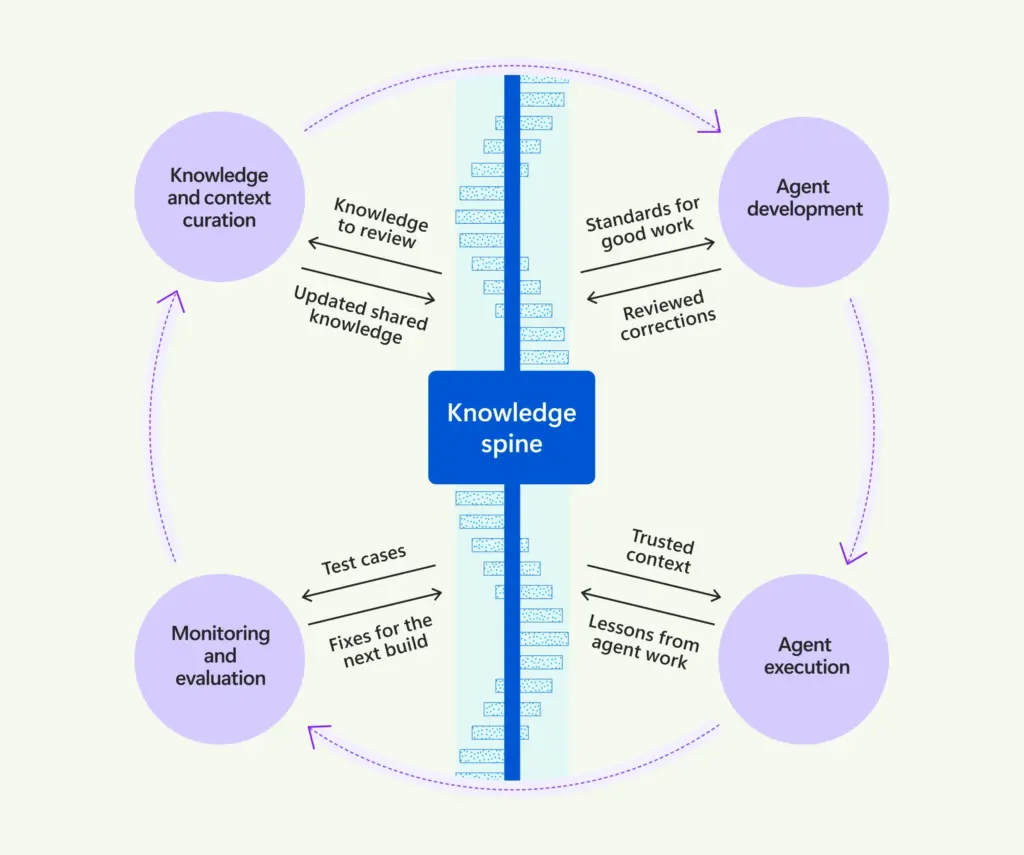
Central to the success of Stage Four companies is the "knowledge spine." Microsoft describes this as a shared system that stores and updates the context that AI agents rely on, alongside the corrections, tests, and lessons derived from the agents’ daily operations.
In a traditional setup, if an AI agent makes an error, a human might correct it, but that lesson remains isolated. With a knowledge spine, that correction becomes part of the enterprise’s collective intelligence. Every other agent in the system can then draw on that updated context, ensuring that the same mistake is not repeated elsewhere. This turns a company’s proprietary data and operational experiences into a unique competitive advantage that belongs to the firm alone.
To build an effective knowledge spine, the research identifies four essential practices:
First, organizations must collect context from diverse sources. This includes chat applications, systems of record, and internal documentation. This data must be stored centrally so that agents are always pulling from the most current information.
Second, firms must treat fixes as valuable information. When a human intervenes to correct an agent’s output, that failure should be transformed into a test case for the next version of the agent. This creates a "golden dataset" that can be used to measure progress and maintain quality standards.

Third, the system must combine this information to proactively shape agent actions. The goal is not just to fix a single wrong answer, but to fundamentally change how the agent handles that specific category of work in the future.
 Productivity Software & Office Suites
Microsoft Expands Copilot Ecosystem with Natural Language App Building to Democratize Enterprise Software Development
The landscape of software development is undergoing a fundamental transformation, driven by...
 Productivity Software & Office Suites
Microsoft Reports 30 Million Copilot Seats as Enterprise AI Shifts from Assistance to Autonomous Agents
In its most recent earnings report, Microsoft announced a significant milestone in...
 Productivity Software & Office Suites
Microsoft Unveils Microsoft 365 G7: A New "Frontier Suite" Aimed at Transforming AI Adoption for Government Agencies
In an era where public sector leaders are increasingly pressured to modernize...







