
As the initial hype surrounding generative artificial intelligence matures into a demand for tangible business results, a new class of organizations is beginning to emerge. These "Frontier Firms" are moving beyond simple chatbots to build self-reinforcing systems of learning that integrate AI agents directly into the fabric of their operations. However, for many executives, the path to this transformation has remained obscured by a lack of clear, actionable data.
To bridge this gap, Microsoft recently unveiled a comprehensive research initiative conducted in collaboration with Keystone, a global technology and advisory firm. The study, which includes a Harvard Business School working paper titled “Organizing AI at Enterprise Scale: Agentic Operating Models and Firm Outcomes,” examines how major enterprises are navigating the transition from pilot projects to fully integrated AI systems. The findings suggest that a specific architectural approach—referred to as a "knowledge spine"—is becoming the differentiator between companies seeing massive financial gains and those stuck in the "patchwork" phase of adoption.
The research reveals a stark divide in performance. Companies that have successfully implemented the building blocks of a coordinated AI system saw significantly higher operating margins and returns on assets compared to their peers. Yet, despite the clear advantages, the study finds that only 3% of the enterprises surveyed have fully deployed the necessary components to support a robust knowledge spine.
A New Framework for Enterprise Transformation
The transition to an AI-driven organization is rarely a linear path. To help leaders understand their current position, the research team—led by scholars including Marco Iansiti of Harvard Business School—developed a four-stage maturity framework based on an assessment of over 200 enterprises. Each of these companies employs more than 1,000 people and spans diverse sectors, including financial services, manufacturing, healthcare, and retail.
In Stage One, companies are characterized by a "patchwork" of AI efforts. These organizations typically focus on isolated pilot projects, often limited to basic chat interfaces. These efforts generally lack central coordination and are not yet connected to core business workflows. Consequently, they show minimal business impact and fail to move the needle on financial performance.
Stage Two represents a significant step forward, as companies begin to deploy AI agents to tackle real-world business problems. At this level, agents are targeted at specific workflows across various functions. However, the limitation at this stage is the lack of automated orchestration. Instead, these firms rely on human-led committees and teams to prioritize investments and check the work of the agents. While this provides a necessary layer of governance, the study notes that human orchestration is notoriously difficult to scale, which can delay the realization of meaningful returns.
Stage Three is described by researchers as the "turning point." At this stage, companies begin to shift the burden of coordination from humans to systems. This is achieved through the use of shared knowledge bases and automated monitoring of agent activity. Rather than having a person manually review every output, the organization uses technological guardrails and business-outcome data to guide what work the agents take on. While this often starts within a single department or a specific set of workflows, it sets the foundation for enterprise-wide scaling.
Finally, Stage Four represents the arrival of the "Agentic Operating Model." Here, orchestration, governance, and a central knowledge spine are fully integrated. In these firms, the lessons learned from an agent’s work are automatically fed back into a shared system, allowing the entire organization to benefit from every individual interaction. This creates a single, cohesive operating model where systems take on the majority of the coordination and learning tasks.

The Financial Reality of AI Maturity
The research provides compelling evidence that AI maturity is closely linked to financial performance. The team analyzed financial data from 2022 to 2025 for over 100 public companies in the study, comparing those in the top quartiles of AI practice scores against those in the bottom quartiles.
The results were striking: companies in the top quartile improved their operating margins by more than 5 percentage points more than those in the bottom quartile. Additionally, these leaders saw a return on assets (ROA) that was approximately 2 percentage points higher. While the researchers noted that the study shows correlation rather than direct causation—given that the financial gains often preceded the full deployment of agentic systems—the data suggests that the highest-performing companies were already fundamentally restructuring their operations to accommodate digital and AI-driven scale.
Interestingly, the study observed that margins for companies in the bottom two quartiles remained largely stagnant. Researchers pointed to an economic concept known as the "J-curve" to explain this phenomenon. When a transformative technology is first introduced, productivity and payoffs often dip or plateau while the organization undergoes the painful and costly process of reorganizing work around the new tools. The lag in returns for these companies may stem from deploying AI tools faster than they can build the infrastructure to manage them.
The Core of the Transformation: The Knowledge Spine
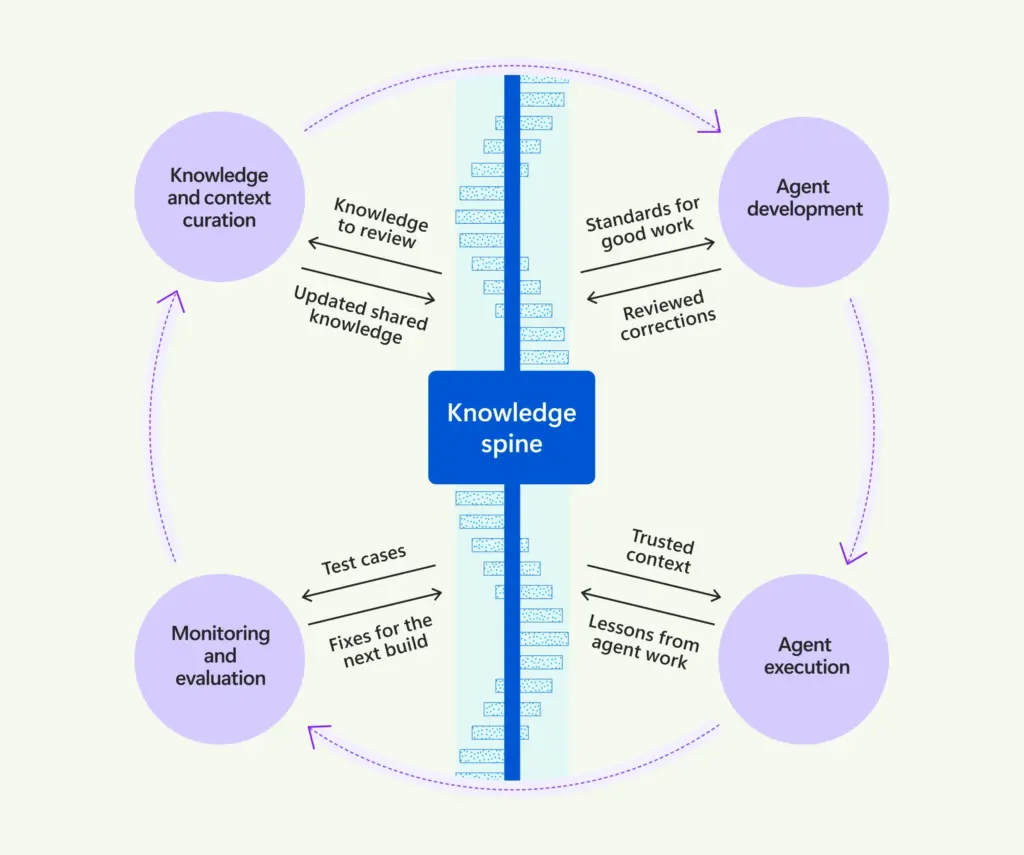
Central to the success of Stage Four companies is the "knowledge spine." Microsoft describes this as a shared system that stores and updates the context that AI agents rely on, alongside the corrections, tests, and lessons derived from the agents’ daily operations.
In a traditional setup, if an AI agent makes an error, a human might correct it, but that lesson remains isolated. With a knowledge spine, that correction becomes part of the enterprise’s collective intelligence. Every other agent in the system can then draw on that updated context, ensuring that the same mistake is not repeated elsewhere. This turns a company’s proprietary data and operational experiences into a unique competitive advantage that belongs to the firm alone.
To build an effective knowledge spine, the research identifies four essential practices:
First, organizations must collect context from diverse sources. This includes chat applications, systems of record, and internal documentation. This data must be stored centrally so that agents are always pulling from the most current information.
Second, firms must treat fixes as valuable information. When a human intervenes to correct an agent’s output, that failure should be transformed into a test case for the next version of the agent. This creates a "golden dataset" that can be used to measure progress and maintain quality standards.

Third, the system must combine this information to proactively shape agent actions. The goal is not just to fix a single wrong answer, but to fundamentally change how the agent handles that specific category of work in the future.
Finally, the knowledge spine requires clear ownership. A specific individual or team must be accountable for the integrity of the data sources the agents rely on, resolving conflicts when different sources provide contradictory information, and ensuring that outdated data is purged from the system.
Implementing a Culture of Observability
Underpinning these four practices is the principle of observability. The study found that 76% of companies in the top quartile of AI maturity maintained searchable records of agent activity, compared to just 8% of companies in the bottom quartile.
By capturing detailed operational telemetry on every action an agent attempts, these firms can identify exactly why a fix is needed and how to implement it. This level of transparency allows agents to "earn" their autonomy. When the data shows an agent is consistently performing well against a set of test cases, the company can widen its scope of authority. Conversely, if an agent struggles, it can be pulled back for further training and refinement.
Microsoft is already incorporating these principles into its own infrastructure through "Microsoft IQ," an enterprise intelligence layer designed to update shared knowledge in a single location for use by all agents. The goal is to allow companies to stop worrying about the underlying models and focus instead on the proprietary lessons, tests, and corrections that make their business unique.
The Practical Path Forward
For business leaders looking to replicate the success of these Frontier Firms, the advice from researchers is to start small but think systematically. Building an enterprise-wide knowledge spine is a massive undertaking that few companies can achieve in one move. Instead, the study suggests implementing these practices within a single team or a handful of connected workflows.
Once the system is proven to work in a localized environment, it can be extended across the organization. Leaders are encouraged to ask three critical questions to gauge their current standing: When an agent is corrected, does that lesson reach other agents? Is there a shared standard for "good work" that improves every time a mistake is made? And finally, is there a clear owner for the knowledge the agents rely on?
The broad shift in enterprise AI is moving away from a focus on individual models and toward a focus on integrated systems. While AI models will continue to evolve and be replaced, the infrastructure of a knowledge spine—and the proprietary lessons stored within it—remains a permanent asset. As the research concludes, the advantage in the AI era will not go to those who have the best models, but to those who have built the best systems for their agents to learn, coordinate, and grow.
 Productivity Software & Office Suites
Microsoft Announces General Availability of Work IQ APIs, Ushering in the Era of Agentic Software
REDMOND, Wash. — In a move that signals a fundamental transformation in...
 Productivity Software & Office Suites
Microsoft Shifts AI Strategy Toward Enterprise Utility and "Agentic" Workflows
In an era defined by a relentless cadence of technical breakthroughs and...
 Productivity Software & Office Suites
Microsoft Unveils Microsoft 365 G7: A New Era of AI-Driven Productivity and Governance for Government Agencies
In a significant move to modernize the digital infrastructure of the U.S....







