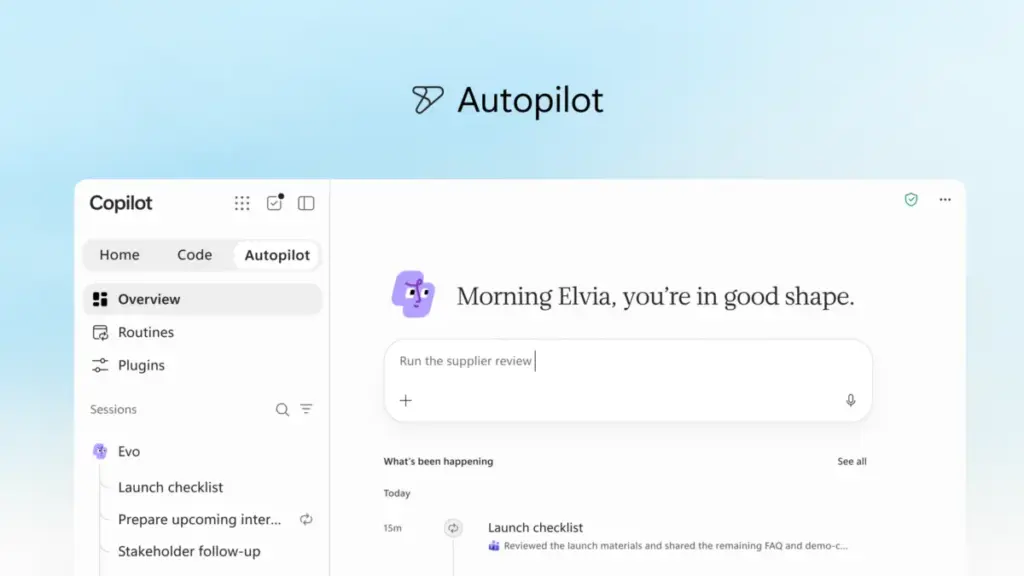
In a significant move to redefine the intersection of artificial intelligence and professional productivity, Microsoft has announced a comprehensive reimagining of its Copilot ecosystem. The tech giant is transitioning Copilot from a series of disparate assistive features into a unified, agentic platform designed to integrate seamlessly into the flow of human ambition. This evolution aims to empower both individuals and large-scale organizations to build, customize, and scale AI capabilities across their entire operational landscape.
Jared Spataro, who leads Microsoft’s AI at Work initiatives, framed the announcement as a response to the rapidly changing nature of work. The "new Copilot" is not merely an incremental update but a structural overhaul of how AI interacts with the tools millions of professionals rely on daily. By introducing three primary pillars—Home, Code, and Autopilot—Microsoft is signaling a shift toward more proactive, autonomous, and specialized AI interactions.
A New Experience for Every Mode of Work
At the center of this transformation is the new "Home" experience within the Copilot app. Microsoft describes Home as the primary starting point for users, serving as a centralized hub where "Chat" and "Cowork" converge. As modern workflows increasingly involve shifting between disparate platforms—such as video meetings, email threads, and collaborative documents—Home is designed to provide users with a grounded sense of their current priorities.
The Home interface allows users to review recent activities, receive AI-driven suggestions on immediate tasks, and resume work exactly where it was left off. Microsoft distinguishes between two primary modes of interaction within this space: Chat and Cowork. While Chat remains the familiar, conversational interface for quick inquiries, data lookups, and draft creation, Cowork represents a more advanced tier of delegation. In Cowork, users define complex tasks—such as generating a Request for Proposal (RFP) response, a marketing launch kit, or a financial close package—and the AI executes the project from start to finish, allowing for iterative refinements along the way.
Crucially, Microsoft is introducing a routing intelligence that eliminates the need for users to manually select a mode. In the near future, the platform will be capable of analyzing a user’s request and automatically routing it to Chat, Cowork, or Code, depending on which capability is best suited for the specific objective.

A major component of this streamlined experience is the introduction of "Office in Copilot." This integration brings the native power of Word, Excel, and PowerPoint directly into the Copilot environment. This move addresses a common friction point in AI productivity: the need to copy and paste content between an AI chat and a document. Now, users can draft briefs or model budgets within Copilot, and the platform creates real, editable Office files that maintain consistent formatting and version control. These documents are live and collaborative, meaning @mentions and edits made by teammates in the standalone Office apps sync perfectly with the Copilot interface.
Furthermore, Microsoft has enhanced the specific "Skills" within these apps. PowerPoint can now automatically ensure decks remain on-brand while allowing for fine-tuned slide adjustments. Excel has been updated to provide clear explanations of edits made by AI or collaborators, and it now offers intelligent recommendations for data visualization. These role-specific workflows, such as legal-focused skills in Word or financial analysis in Excel, are intended to help organizations scale best practices across their entire workforce.
Democratizing Solution Building Through Code
Perhaps the most technical shift in the new Copilot is the introduction of "Code." Historically, the primary units of knowledge work have been files—documents, spreadsheets, and presentations. Microsoft is now introducing a fourth unit: small, purpose-built digital solutions.
 Productivity Software & Office Suites
Microsoft Reimagines the Future of Productivity with the Launch of the "New Copilot" and Autonomous AI Agents
In a significant shift toward the next generation of digital labor, Microsoft...
 Productivity Software & Office Suites
Microsoft Reimagines Copilot as a Centralized Hub for Agentic Work and Enterprise Automation
In a significant evolution of its artificial intelligence strategy, Microsoft has unveiled...
 Productivity Software & Office Suites
Microsoft Democratizes Software Development with Natural Language App Building in Copilot Studio
The landscape of software development is undergoing a fundamental transformation as artificial...