
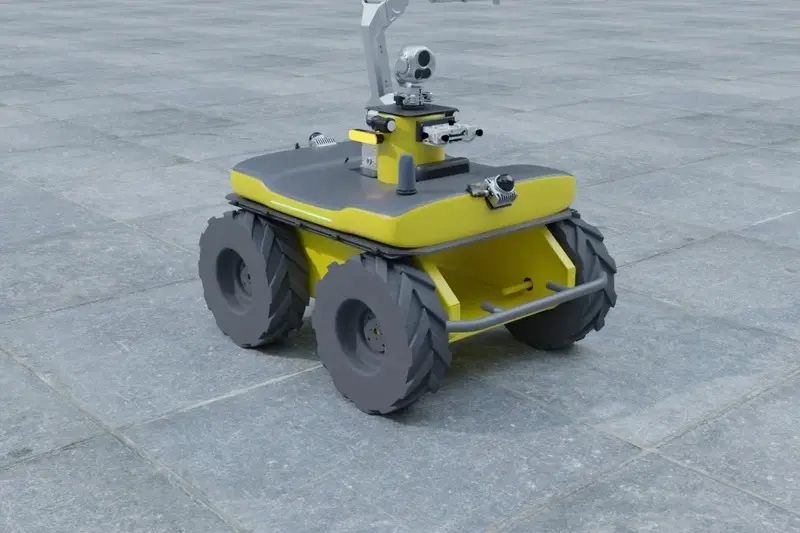
In the rapidly evolving landscape of industrial automation, the deployment of autonomous robots for routine inspections has transitioned from a futuristic concept to a standard operational requirement. However, as facilities move toward unattended rounds, a fundamental engineering dilemma persists: should the sensor payload be carried by a wheeled or tracked Unmanned Ground Vehicle (UGV), or does the environment demand the agility of a legged quadruped?
The engineering team at YUANZHI ROBOTICS, a firm specializing in the design and construction of sensor payloads for robot dogs, UGVs, and drones, recently addressed this pivotal question. Drawing from extensive field experience and a platform-agnostic perspective, the team has outlined the critical factors that determine the success of a robotic inspection project. According to their analysis, the decision rarely rests on a preference for one technology over another, but rather on a cold assessment of the site’s physical constraints and the mission’s specific requirements.
The Route as the Primary Decision Matrix
The selection process for any robotic platform begins long before a single bolt is tightened. It starts with a literal walkthrough of the intended inspection route. Engineers emphasize that the physical layout of a facility is the single most significant factor in narrowing down the choice.
When evaluating a site, engineers look for "showstoppers" for wheeled vehicles. These include traditional stairs, steep steps at doorways, bulkheads, high kerbs, and floor obstructions such as exposed pipes or cable trays. In many legacy industrial environments, the presence of even a single flight of stairs that the robot must traverse to complete its round immediately settles the debate in favor of a quadruped. While tracks can handle shallow steps or kerbs, and custom ramps can be installed for minor elevation changes, a standard staircase remains the exclusive domain of legged systems.
Conversely, if the route is characterized by continuous, flat surfaces—such as the paved walkways of an outdoor substation, the expansive rows of a solar plant, or the paved roads of a tank farm—the UGV becomes the primary contender. In many large-scale operations, such as production halls or perimeter fences, the UGV often emerges as the superior choice due to its stability and efficiency on flat ground. It is not uncommon for complex sites to employ a hybrid fleet: a UGV for yard patrols and a quadruped for indoor switchgear rounds where space is tight and floors are uneven.

Navigating Terrain, Obstacles, and the Risk of Recovery
The mechanical differences between quadrupeds and UGVs dictate how they interact with their environment and, perhaps more importantly, what happens when things go wrong. A quadruped offers unparalleled mobility; it can navigate gravel, slopes, and gaps in floor grating with ease. Its ability to turn in place within a narrow passage and crouch under low-hanging equipment makes it ideal for dense industrial environments.
However, this mobility comes with the inherent risk of instability. On surfaces like wet steel, ice, or loose cables, a quadruped may lose its footing. While modern industrial quadrupeds are increasingly capable of self-righting after a fall, the impact poses a significant threat to the sensitive sensor payloads they carry. To mitigate this, engineers at YUANZHI ROBOTICS design specialized protection for these platforms, often incorporating roll cages or recessed sensor heads to ensure that a slip does not result in a total loss of the vision or gas-sensing equipment.
 Software Development & Scripting for IT
The Technical Divide: How Design Control and Risk Management Distinguish ISO 13485 from ISO 9001 in Medical Manufacturing
In the complex world of medical device procurement and engineering, the presentation...
 Software Development & Scripting for IT
Architecting Complexity: How a Structured Multi-Prompt Strategy Enabled an AI Agent to Build a Multi-Platform Messenger
In the rapidly evolving landscape of artificial intelligence, the narrative has shifted...
 Software Development & Scripting for IT
Navigating the "Lakh and Crore" Divide: New AI Benchmark Exposes Significant Errors in Indian Real Estate Mathematics
The dream of homeownership in India is often a complex journey through...







