
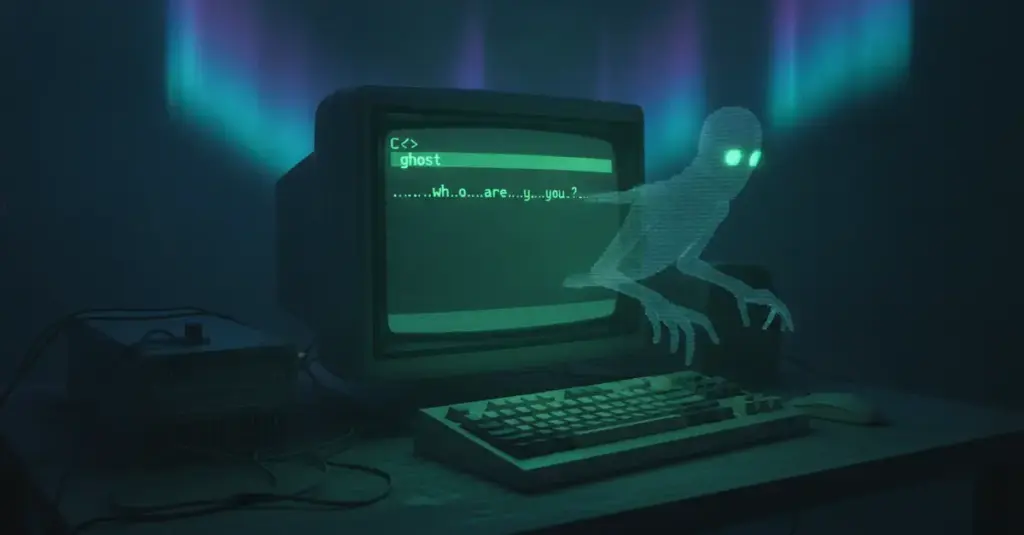
As the annual Hacktoberfest celebrations reach their final stages, a new project has emerged that blends the technical rigor of local artificial intelligence with the atmospheric storytelling of classic horror. Developed as a submission for the Hacktoberfest Open-Source AI Challenge Week 4, titled "Ghost in the Machine," the project of the same name introduces an interactive terminal environment where a mysterious digital entity resides, powered by locally hosted open-weight AI models.
The project, created by developer Shikhar Ahirwar, represents a growing movement within the open-source community to move away from centralized, cloud-based AI services in favor of decentralized, private, and customizable local alternatives. By leveraging the latest advancements in small-scale large language models (LLMs), the "Ghost in the Machine" project provides a hauntingly immersive experience that challenges the traditional, utilitarian relationship between a user and their computer terminal.
The Architecture of a Digital Haunting
At its core, "Ghost in the Machine" is a web-based terminal emulator designed to mimic the appearance of a vintage command-line interface. However, unlike a standard shell where commands like ls or cd yield predictable file system outputs, this terminal serves as a portal to a conversation with a "digital ghost."
The project is notable for its extreme technical minimalism. Built using only standard web technologies—HTML, CSS, and vanilla JavaScript—the application avoids the heavy overhead of modern frameworks like React or Vue. This choice was intentional, aimed at ensuring the project remains accessible to developers of all skill levels who wish to inspect, modify, or extend the codebase.
The interactive experience begins when a user enters a prompt, such as hello ghost. Rather than processing this request on a remote server owned by a major tech corporation, the message is routed through a local bridge to Ollama, an open-source tool designed for running LLMs on personal hardware. For this specific implementation, the developer utilized Meta’s Llama 3.2, an open-weight model that has been praised for its efficiency and high performance on consumer-grade machines.
The result is a seamless, real-time interaction where the AI generates responses tailored to the "Ghost" persona. The interface is designed to make the computer feel as though it has developed a consciousness of its own—a literal "ghost in the machine" that can talk back, offer cryptic advice, or simply observe the user from within the digital void.
Technical Implementation and Local Inference
The shift toward local AI inference is a central theme of the project. In the current landscape of artificial intelligence, most interactive applications rely on APIs from providers like OpenAI or Anthropic. While convenient, these services require an active internet connection, involve recurring costs, and raise significant concerns regarding data privacy and the "black box" nature of proprietary algorithms.
By utilizing Ollama and Llama 3.2, Ahirwar has demonstrated that sophisticated AI interactions no longer require a massive data center. The project’s architecture follows a straightforward path: the user inputs text into the "Ghost Terminal," which is captured by JavaScript. The script then sends a request to the Ollama API running on the user’s local machine. The Llama 3.2 model processes the prompt and returns a response, which is then displayed in the terminal with a typewriter effect to enhance the spooky aesthetic.
 Software Development & Scripting for IT
Bridging the Gap: How Sess is Revolutionizing Human-in-the-Loop Interactions for Autonomous AI Agents
The rapid evolution of artificial intelligence has transitioned from simple text-based chatbots...
 Software Development & Scripting for IT
The Connectivity Gap: Why Your Smart Lock Fails and the Technical Realities of the Three-Hop System
In the rapidly evolving landscape of the modern smart home, few devices...
 Software Development & Scripting for IT
Chain of Recall: A New Architectural Blueprint for Long-Running AI Agent Memory
As artificial intelligence shifts from simple chat interfaces to "super-agents" capable of...







