The achievement is not merely a personal victory for Luumi but a significant milestone for the vintage hardware community. By achieving a multicore score of 10.8 cb in the Cinebench R11.5 benchmark, Luumi has effectively dethroned a record holder who had occupied the top spot for an astonishing 12 years. In the world of technology, where records are often broken within weeks or even days of a product’s launch, a decade-long reign is almost unheard of. Toppling such a long-standing figure requires more than just a lucky piece of silicon; it requires a deep understanding of legacy architectures, specialized cooling techniques, and the patience to fine-tune a system that was designed during a completely different era of computing.
The heart of this record-breaking system is the Intel Core i5-4670K, a processor belonging to the Haswell family, which represented Intel’s fourth generation of Core architecture. Launched in the summer of 2013, the i5-4670K was built on Intel’s then-cutting-edge 22nm process. It was a time when the "Tick-Tock" manufacturing model was still in full swing, and Haswell represented a "Tock"—a new microarchitecture on a proven process node. For many PC enthusiasts of that era, the i5-4670K was the "sweet spot" for gaming and general performance. It offered four physical cores and four threads, lacking the Hyper-Threading technology found in its more expensive sibling, the Core i7-4770K. With a base clock of 3.4 GHz and a boost clock of 3.8 GHz, it was a formidable performer, though its 84W thermal design power (TDP) and 6MB of L3 cache seem modest by today’s standards.
What made the "K" series of these chips special, however, was the unlocked multiplier. This feature was the gateway for enthusiasts to push the silicon beyond its factory-rated speeds. During the Haswell era, overclocking was undergoing a significant transition. Intel had introduced the Fully Integrated Voltage Regulator (FIVR) inside the CPU package, a move designed to simplify motherboard power delivery but one that also concentrated heat directly within the processor. This made high-end cooling essential for anyone looking to reach the upper echelons of performance. For Luumi’s world-record attempt, standard air or water cooling was never going to be enough. To reach the stability required for a 10.8 cb score in Cinebench R11.5, the processor had to be subjected to the extreme sub-zero temperatures of liquid nitrogen (LN2).
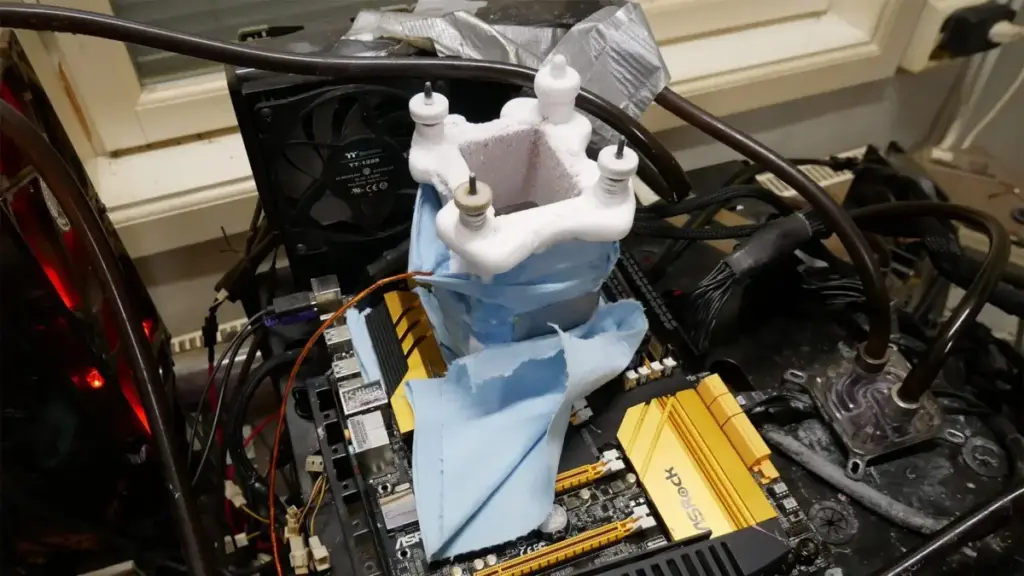
The use of liquid nitrogen is the hallmark of professional competitive overclocking. It involves pouring the substance, which sits at roughly -196 degrees Celsius (-321 degrees Fahrenheit), into a specialized copper "pot" mounted directly onto the CPU. This allows the overclocker to apply massive amounts of voltage to the chip—levels that would instantly incinerate the silicon under normal conditions—while keeping the core temperatures low enough to prevent physical destruction. However, extreme cooling brings its own set of challenges. At these temperatures, materials become brittle, and moisture in the air instantly condenses into frost and ice. Overclockers like Luumi must meticulously insulate the motherboard using materials like kneaded eraser, shop towels, and specialized coatings to prevent a single drop of water from short-circuiting the delicate electronics.
 Hardware Reviews & PC Building
Microsoft brings Snapdragon X2 Plus to 13-inch Surface Laptop, 12-inch Surface Pro — low-end systems finally get…
The introduction of the Snapdragon X2 Plus represents a substantial leap over...
 Hardware Reviews & PC Building
GlobalFoundries to produce silicon interposers for TSMC’s CoWoS in the US — Five-year agreement valued at $2…
The deal establishes a robust, U.S.-based manufacturing source for essential advanced packaging...
 Hardware Reviews & PC Building
Digital Fly Brain Achieves 20 Percent Win Rate in Balatro Following Breakthrough Google Neural Mapping
In the rapidly evolving landscape of artificial intelligence and computational neuroscience, the...