The achievement is not merely a personal victory for Luumi but a significant milestone for the vintage hardware community. By achieving a multicore score of 10.8 cb in the Cinebench R11.5 benchmark, Luumi has effectively dethroned a record holder who had occupied the top spot for an astonishing 12 years. In the world of technology, where records are often broken within weeks or even days of a product’s launch, a decade-long reign is almost unheard of. Toppling such a long-standing figure requires more than just a lucky piece of silicon; it requires a deep understanding of legacy architectures, specialized cooling techniques, and the patience to fine-tune a system that was designed during a completely different era of computing.
The heart of this record-breaking system is the Intel Core i5-4670K, a processor belonging to the Haswell family, which represented Intel’s fourth generation of Core architecture. Launched in the summer of 2013, the i5-4670K was built on Intel’s then-cutting-edge 22nm process. It was a time when the "Tick-Tock" manufacturing model was still in full swing, and Haswell represented a "Tock"—a new microarchitecture on a proven process node. For many PC enthusiasts of that era, the i5-4670K was the "sweet spot" for gaming and general performance. It offered four physical cores and four threads, lacking the Hyper-Threading technology found in its more expensive sibling, the Core i7-4770K. With a base clock of 3.4 GHz and a boost clock of 3.8 GHz, it was a formidable performer, though its 84W thermal design power (TDP) and 6MB of L3 cache seem modest by today’s standards.
What made the "K" series of these chips special, however, was the unlocked multiplier. This feature was the gateway for enthusiasts to push the silicon beyond its factory-rated speeds. During the Haswell era, overclocking was undergoing a significant transition. Intel had introduced the Fully Integrated Voltage Regulator (FIVR) inside the CPU package, a move designed to simplify motherboard power delivery but one that also concentrated heat directly within the processor. This made high-end cooling essential for anyone looking to reach the upper echelons of performance. For Luumi’s world-record attempt, standard air or water cooling was never going to be enough. To reach the stability required for a 10.8 cb score in Cinebench R11.5, the processor had to be subjected to the extreme sub-zero temperatures of liquid nitrogen (LN2).
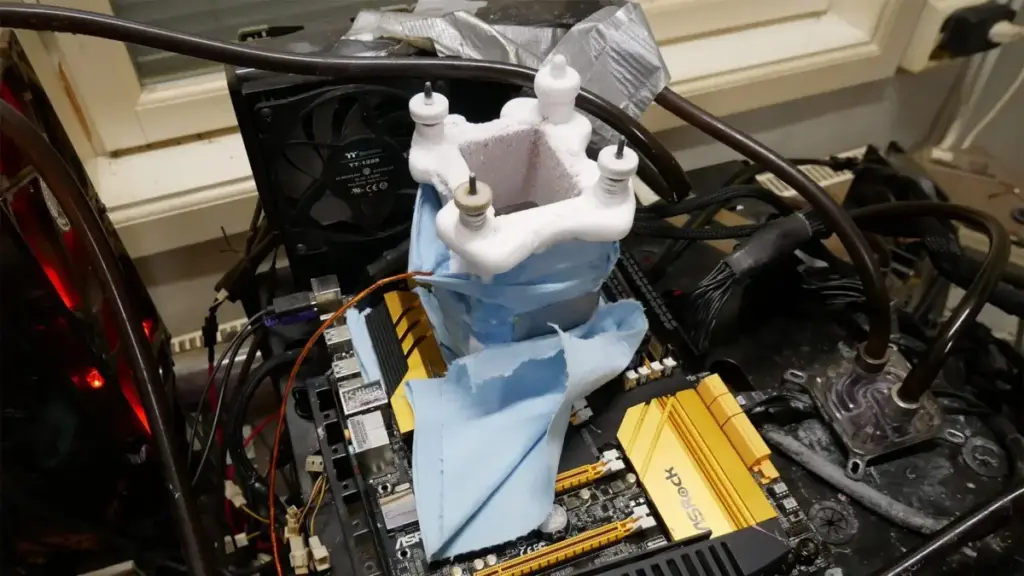
The use of liquid nitrogen is the hallmark of professional competitive overclocking. It involves pouring the substance, which sits at roughly -196 degrees Celsius (-321 degrees Fahrenheit), into a specialized copper "pot" mounted directly onto the CPU. This allows the overclocker to apply massive amounts of voltage to the chip—levels that would instantly incinerate the silicon under normal conditions—while keeping the core temperatures low enough to prevent physical destruction. However, extreme cooling brings its own set of challenges. At these temperatures, materials become brittle, and moisture in the air instantly condenses into frost and ice. Overclockers like Luumi must meticulously insulate the motherboard using materials like kneaded eraser, shop towels, and specialized coatings to prevent a single drop of water from short-circuiting the delicate electronics.
The benchmark chosen for this record, Cinebench R11.5, is itself a piece of computing history. Based on Maxon’s Cinema 4D software, R11.5 was for years the primary metric by which CPU rendering performance was measured. While it has since been superseded by versions like R15, R20, R23, and the most recent Cinebench 2024, the "legacy" benchmarks remain highly competitive on HWBot. These platforms allow overclockers to compete on a level playing field with specific hardware generations, ensuring that a chip from 2013 isn’t being unfairly compared to a 2024 flagship. Luumi’s score of 10.8 cb is a testament to the raw IPC (instructions per clock) improvements Intel made with Haswell, as well as the sheer clock speed Luumi was able to maintain across all four cores during the multi-threaded test.
Achieving such a score on a 4-core, 4-thread part is particularly impressive because there is no Hyper-Threading to fall back on. In multi-threaded benchmarks, Hyper-Threading usually provides a significant boost by allowing each core to handle two tasks simultaneously. Without it, the i5-4670K must rely entirely on the strength of its physical cores. Every fraction of a point in the final score represents hundreds of megahertz in clock speed and hours of stability testing. To edge out a 12-year-old record by even a small margin requires finding a "golden" chip—one that was manufactured with fewer defects and can handle higher voltages and lower temperatures than the average unit.
The supporting hardware for Luumi’s run was equally period-appropriate. The system utilized a modest amount of DDR3 memory, the standard of the time before the industry transitioned to DDR4 and eventually DDR5. Overclocking memory on these older platforms is often as much of an art as overclocking the CPU itself. Tightening timings and increasing the memory frequency can provide the necessary bandwidth to ensure the CPU isn’t "starved" for data during the benchmark run, which can be the difference between a world record and a second-place finish.
The broader context of this achievement highlights a growing trend in the hardware community: the "retro" or "legacy" overclocking movement. As modern CPUs become increasingly locked down or reach their limits out of the box thanks to sophisticated factory boosting algorithms, many enthusiasts are looking back to the "Golden Age" of overclocking. The period between 2010 and 2015 is often cited as a favorite, as it featured chips like the Sandy Bridge i7-2600K and the Haswell i5-4670K, which offered massive overclocking headroom for those willing to take the risk. Luumi’s success serves as a reminder that these components, while no longer suitable for modern AAA gaming or high-end video production, still possess an inherent value as tools for competition and technical exploration.
For those who followed the PC market a decade ago, the news of an i5-4670K breaking a record brings a wave of nostalgia. It was an era of intense competition and rapid iteration. Haswell was the bridge to the modern era, introducing features that would become staples of Intel’s lineup for years to come. It was also the era of the "silicon lottery," where enthusiasts would buy multiple copies of the same processor in hopes of finding the one that could hit the elusive 5.0 GHz mark on water cooling. By taking that same silicon and pushing it to the absolute limit with LN2, Luumi has completed a journey that began when the chip first rolled off the assembly line in 2013.
The HWBot community, which serves as the official registry for these records, has officially crowned Luumi’s system as the new king of the i5-4670K category. The 10.8 cb multicore score now sits at the top of the mountain, a target for future overclockers to aim for. Whether this new record will stand for another 12 years remains to be seen, but the difficulty of the feat suggests it won’t be topped anytime soon. It requires the perfect alignment of a high-quality chip, expert-level cooling management, and the right motherboard and memory configuration to survive the rigors of extreme voltage.
Ultimately, Luumi’s achievement underscores a fundamental truth about the hobby of PC building and overclocking: the fun isn’t always found in the newest hardware. Sometimes, the most rewarding experiences come from revisiting the past, taking a piece of "ancient" silicon, and showing the world that it still has some fight left in it. By breathing new life into a Haswell-era i5, Luumi has not only set a new world record but has also celebrated the enduring legacy of one of Intel’s most iconic processor families. As the hardware world continues to march toward smaller nodes and higher core counts, the achievements of overclockers like Luumi ensure that the history of the industry is never forgotten, but rather, continually pushed to its absolute limit.
 Hardware Reviews & PC Building
GlobalFoundries to produce silicon interposers for TSMC’s CoWoS in the US — Five-year agreement valued at $2…
The deal establishes a robust, U.S.-based manufacturing source for essential advanced packaging...
 Hardware Reviews & PC Building
Tom’s Hardware Expands Digital Reach with Launch of Official Mobile Application for Android and iOS
The landscape of technology journalism has undergone a profound transformation over the...
 Hardware Reviews & PC Building
Russian Military Targets Ukrainian Data Centers in Widening Campaign Against Digital Infrastructure
The Russian military has initiated a series of targeted strikes against critical...