
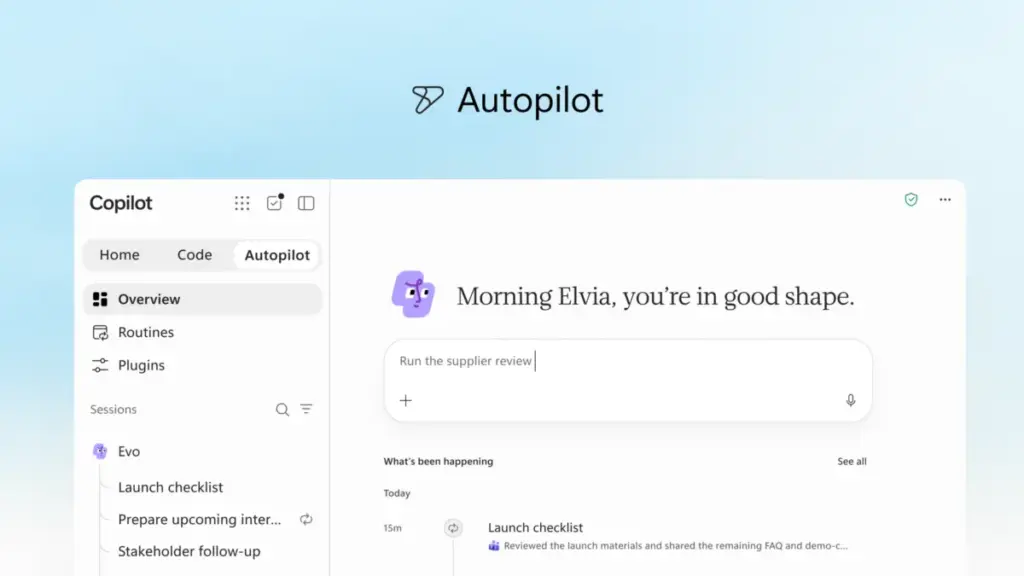
Microsoft has announced a significant evolution of its AI strategy, unveiling what it describes as the "new Copilot." This overhaul moves the technology beyond a simple sidebar assistant, transforming it into a comprehensive orchestration layer designed to integrate seamlessly into the flow of professional productivity. By introducing new capabilities such as a centralized "Home" interface, autonomous "Autopilot" agents, and a natural-language "Code" environment, Microsoft aims to redefine how individuals and organizations interact with artificial intelligence to manage complex workflows and scale their operations.
The shift reflects a broader trend in the technology industry toward "agentic AI"—systems that do not merely respond to prompts but can proactively manage tasks, follow up on threads, and execute multi-step processes with minimal human intervention. Jared Spataro, who leads Microsoft’s AI at Work efforts, emphasized that this reimagining is intended to help organizations solve unique business problems and drive value creation as the nature of work continues to evolve.
A Unified Experience for Every Mode of Work
At the heart of this transformation is the new "Home" experience, designed to serve as the primary starting point for the modern worker. As professional life increasingly fragments across various meetings, chat threads, documents, and specialized applications, Microsoft’s new interface acts as a grounding mechanism. It is here that two distinct modes of AI interaction—Chat and Cowork—converge.
Chat remains the familiar, conversational interface optimized for instant queries, quick lookups, and the drafting of simple communications. However, it is the introduction of "Cowork" that signals a shift in capability. Cowork is designed for delegated tasks that require an end-to-end completion of complex projects. Instead of a back-and-forth dialogue, a user defines a high-level objective—such as generating a formal RFP response, a product launch kit, or a financial close package—and the system iterates on the task until a finished result is delivered.
To simplify the user experience, Microsoft plans to remove the need for manual mode selection in the near future. Users will eventually be able to state their objective in natural language, and Copilot will automatically route the request to Chat, Cowork, or the new Code environment, depending on which capability is best suited for the specific requirements of the job.

The integration deepens with "Office in Copilot," which embeds the full functionality of Word, Excel, and PowerPoint directly into the Copilot experience. This move addresses a common friction point in AI productivity: the need to copy and paste content between a chat window and a document. Within the new interface, users can ask Copilot to draft briefs or model budgets, and the system creates or updates live, editable files that are synced across the Microsoft 365 ecosystem. This ensures that formatting remains intact and that all team members can collaborate on the AI-generated content in real-time, using familiar features like @mentions to loop in human colleagues.
Democratizing Solution Building with Natural Language
One of the most ambitious additions to the suite is "Code," a feature that seeks to move software and solution building out of the exclusive domain of developers. Microsoft posits that while the traditional units of knowledge work—the document, the spreadsheet, and the slide deck—remain vital, a fourth unit is emerging: the purpose-built digital solution.
The Code feature allows non-technical users to describe an application, an automation workflow, or a data dashboard in natural language. Powered by the same underlying technology as GitHub Copilot, the system then architects and builds the solution. These can range from persistent desktop widgets for quick data reference to cloud-hosted internal applications shared across a department.
 Productivity Software & Office Suites
Microsoft to Headline ESPC 2026 in Amsterdam as the European Tech Community Pivots Toward an Agentic AI Future
As the global landscape of work undergoes its most significant transformation since...
 Productivity Software & Office Suites
Microsoft Shifts Focus to Enterprise AI Utility: A New Strategic Framework for Agents, Economics, and Partnership
In an era defined by a relentless cycle of artificial intelligence breakthroughs,...
 Productivity Software & Office Suites
Microsoft Reports 30 Million Copilot Seats as Enterprise AI Shifts from Assistance to Autonomous Agents
In its most recent earnings report, Microsoft announced a significant milestone in...







