
To ensure these user-generated solutions meet enterprise security standards, Microsoft is introducing the "Microsoft Copilot Managed Runtime." This hosting infrastructure allows the generated code to run safely within the organization’s existing Microsoft 365 environment. It provides IT departments with the necessary governance and oversight while giving employees the freedom to connect their custom apps to live data. This managed runtime is also being opened to third-party and professional developers, creating a unified foundation for apps built in Cowork, Code, and Copilot Studio.
The Rise of Autonomous Agents: From Scout to Autopilot
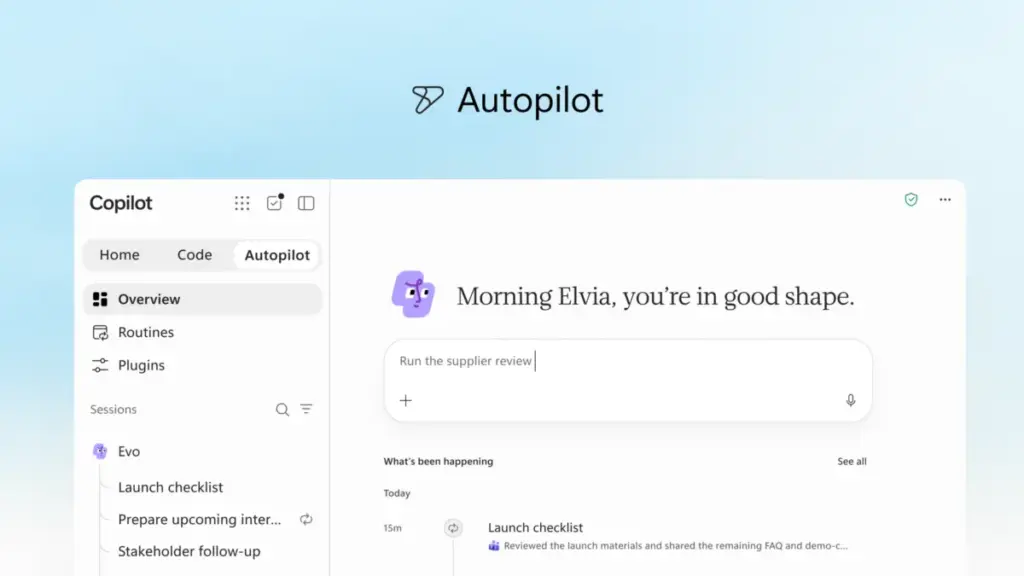
Perhaps the most significant leap toward autonomous AI is "Autopilot," the feature formerly known as Scout. Unlike traditional AI assistants that wait for a user to initiate contact, Autopilot is designed to be a proactive digital teammate. It operates with its own identity, memory, and workspace within a company’s digital environment.
Users can assign Autopilot a specific name, role, and goal. Once activated, the agent can monitor communication channels, follow up on email threads, and manage recurring administrative processes without being prompted. For example, in a supply chain context, Autopilot could manage a full supplier review process—building a schedule, handling preparatory meetings, and reaching out to various stakeholders for updates—while the human user focuses on higher-level strategy.

Because Autopilot is cloud-hosted and integrated into Microsoft IQ—the company’s unified intelligence platform—it maintains continuity. It continues to work while the user is offline, ensuring that projects do not stall during the "white space" between active working hours. It is accessible through Teams, Outlook, and other Microsoft 365 apps, allowing team members to interact with it as they would a human colleague.
Grounding AI in Deep Business Context
For AI to be effective in a corporate setting, it must be grounded in the specific data and workflows of the organization. Microsoft is expanding this context through "Fabric IQ," which brings more than 20 million semantic models from Power BI into the Copilot environment. This allows the AI to provide insights based on trusted, real-time data from across the enterprise.
Furthermore, Copilot is now gaining deeper integration with Dynamics 365 and the Power Platform. This means that a sales professional drafting a proposal can have Copilot automatically pull in deal histories, customer support tickets, and pricing data without having to switch between different enterprise resource planning (ERP) or customer relationship management (CRM) tools.
To manage the growing ecosystem of AI capabilities, Microsoft is launching a new unified plugin registry. This catalog brings together first-party, partner-built, and custom plugins into a single location. It allows IT administrators to approve and govern the tools available to their workforce, while developers can publish a single plugin that extends Copilot’s functionality across multiple Microsoft interfaces.
 Productivity Software & Office Suites
Microsoft Shifts Focus to Enterprise AI Utility: A New Strategic Framework for Agents, Economics, and Partnership
In an era defined by a relentless cycle of artificial intelligence breakthroughs,...
 Productivity Software & Office Suites
Microsoft Announces Microsoft 365 G7 and Agent 365 to Accelerate AI Adoption and Governance Across U.S. Government Agencies
In an era where the public sector faces the dual challenge of...
 Productivity Software & Office Suites
Microsoft Unveils Strategic Roadmap for Enterprise AI, Prioritizing Agentic Workflows and Flexible Economic Models
In an era defined by rapid-fire technological breakthroughs and a relentless cycle...







