
The Economics of AI: Managing Spend and Value
As AI usage scales, organizations are increasingly concerned with the associated costs. Microsoft is addressing this through a dual-pronged pricing strategy and the introduction of "FinOps for AI" capabilities.
For everyday productivity tasks like drafting and summarization, Microsoft utilizes a User Subscription License (USL), providing high-quality AI at a fixed cost. Within this model, a feature called "Auto" intelligently routes requests to the most appropriate model based on the complexity of the task, balancing speed, accuracy, and cost.

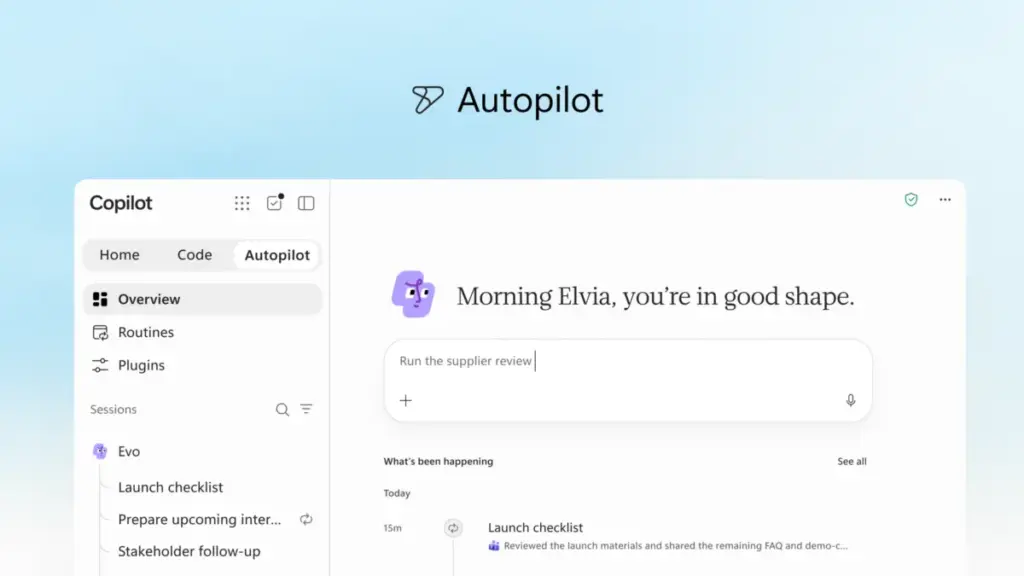
For more intensive, "agentic" work—such as the long-running processes handled by Autopilot or Cowork—Microsoft is moving toward Usage-Based Billing (UBB). This model gives organizations granular control over their spend, allowing them to match the cost of advanced frontier models, like Astra and Fable, to the specific business value they generate.
The new FinOps for AI tools provide administrators and business leaders with the visibility needed to manage these costs. Admins can set spending policies, manage credit requests, and determine which model families are available to specific user groups. Meanwhile, end-users can track their own AI usage and remaining balances directly within the Copilot interface, fostering a culture of responsible AI consumption within organizational guardrails.
Personalization and the Future of Proactive Assistance
Looking ahead, Microsoft provided a glimpse into upcoming features aimed at making Copilot even more personalized. "Today" is a forthcoming command center that will act as a proactive daily brief. It is designed to surface what a user missed, what requires immediate attention, and what tasks can be deferred. Beyond just listing tasks, "Today" will prepare the work in advance—having drafts ready for review or schedule changes proposed before the user even opens their inbox.
Additionally, the company is testing "@Copilot" in Microsoft Teams. This feature allows a team to invoke the AI within a group chat or channel, where it will have the shared context of the entire conversation history. It can explain the reasoning behind past decisions or prepare cross-functional reviews that identify owners and dependencies, keeping entire projects aligned without requiring manual summaries.
The new Copilot experience is currently rolling out through Microsoft’s Frontier program, with broader availability expected in the coming months. As these tools move from private preview to general release, the company continues to position AI not just as a tool for individuals, but as a fundamental shift in how organizations orchestrate labor, data, and ambition. Further details on these innovations and their impact on the future of work are expected to be a central theme at the upcoming Microsoft Ignite conference in November.
 Productivity Software & Office Suites
Microsoft Reimagines Copilot as a Centralized Engine for the Future of AI-Driven Work
In a major strategic shift aimed at redefining the intersection of human...
 Productivity Software & Office Suites
Microsoft Unveils Specialized AI Capabilities for Finance Professionals in Excel to Address Sector-Specific Complexity
The trajectory of transformative technology has followed a consistent, predictable rhythm for...
 Productivity Software & Office Suites
Microsoft Unveils ‘Autopilots’ and Scout: A New Frontier for Autonomous AI Agents in the Enterprise
The nature of professional productivity is undergoing a fundamental shift, moving away...







