
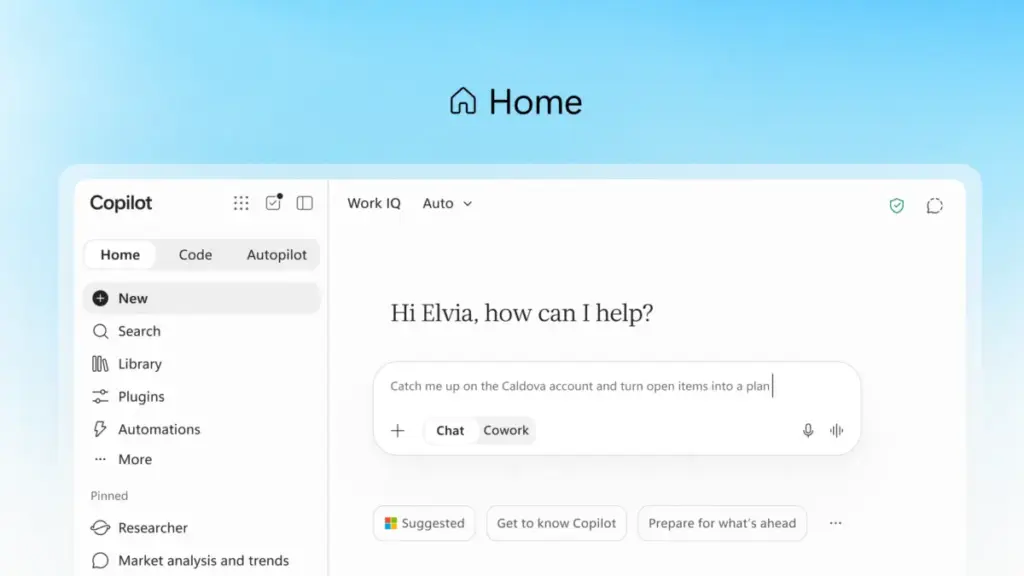
In a significant move to redefine the landscape of modern work, Microsoft has announced a comprehensive reimagining of its Copilot platform. The tech giant is shifting its AI strategy from a series of disparate assistants toward a unified, next-generation experience designed to integrate seamlessly into the "flow of human ambition." By introducing a redesigned Copilot app featuring new "Home," "Code," and "Autopilot" capabilities, Microsoft aims to provide a singular environment where individuals and organizations can build, customize, and scale artificial intelligence across every facet of their operations.
The announcement marks a pivotal moment in the evolution of generative AI within the enterprise. Rather than treating AI as an external tool that users must visit, Microsoft is positioning the new Copilot as the connective tissue between the software people rely on daily and the advanced capabilities required to manage increasingly complex digital workloads. The goal, according to company leadership, is to empower every worker to accomplish more by automating routine tasks and providing deeper, data-driven insights.
A New Experience for Every Mode of Work
At the center of this transformation is the new Copilot Home, which serves as a centralized starting point for the user’s workday. This interface is designed to bridge the gap between two distinct ways of working: Chat and Cowork. While Chat remains the go-to for instant, conversational interactions—such as asking quick questions, drafting emails, or summarizing documents—Cowork represents a shift toward delegation.
Through Cowork, users can define complex, end-to-end tasks that the AI executes independently. This includes the creation of Request for Proposal (RFP) responses, the development of comprehensive launch kits, or the assembly of financial close packages. By moving work into a delegated model, Microsoft hopes to free employees from the iterative "grind" of administrative assembly, allowing them to focus on high-level strategy and decision-making.
A critical component of this new Home experience is the deep integration of "Office in Copilot." Microsoft is bringing the full functionality of Word, Excel, and PowerPoint directly into the Copilot environment. This integration addresses a common friction point in AI workflows: the need to copy and paste content between an AI chat interface and a productivity app. Now, users can draft a brief or model a budget within Copilot, and the system will create or update a live, editable document that remains in sync across the entire Microsoft 365 suite. This ensures that formatting remains intact and version control is maintained, even as multiple team members collaborate on the file in real-time.
Furthermore, Microsoft has enhanced the specific "skills" available within these apps. For instance, Excel now features specialized financial skills and the ability for Copilot to recommend the most effective charts for data visualization. In PowerPoint, the AI can automatically ensure that decks remain on-brand while allowing for fine-tuned edits to images and slides. These role-specific workflows are intended to help organizations scale best practices across their entire workforce.

Democratizing Solution Building with Code
Perhaps the most ambitious addition to the platform is "Code," a feature that moves solution-building beyond the exclusive domain of professional software developers. Microsoft posits that the traditional unit of knowledge work—the file—is being joined by a fourth category: small, purpose-built AI solutions.
Powered by the same underlying technology as GitHub Copilot, the Code feature allows any user to describe an app, automation, or dashboard in natural language. Copilot then selects the appropriate technical approach and builds the solution in a secure, sandboxed environment. These can range from simple desktop widgets for quick data reference to complex, cloud-hosted internal apps designed for team-wide use.
 Productivity Software & Office Suites
Microsoft Reimagines Copilot as a Central Hub for AI-Driven Work and Autonomous Agents
In a significant shift for the future of digital productivity, Microsoft has...
 Productivity Software & Office Suites
Microsoft Reports 30 Million Paid Copilot Seats as Enterprise AI Shifts from Assistance to Autonomy
In a recent earnings call that signaled a pivotal moment for the...
 Productivity Software & Office Suites
Microsoft Reimagines Copilot: New "Autopilot" and "Code" Features Lead a Major Shift Toward Agentic Work
In a significant pivot toward the next era of enterprise productivity, Microsoft...







