
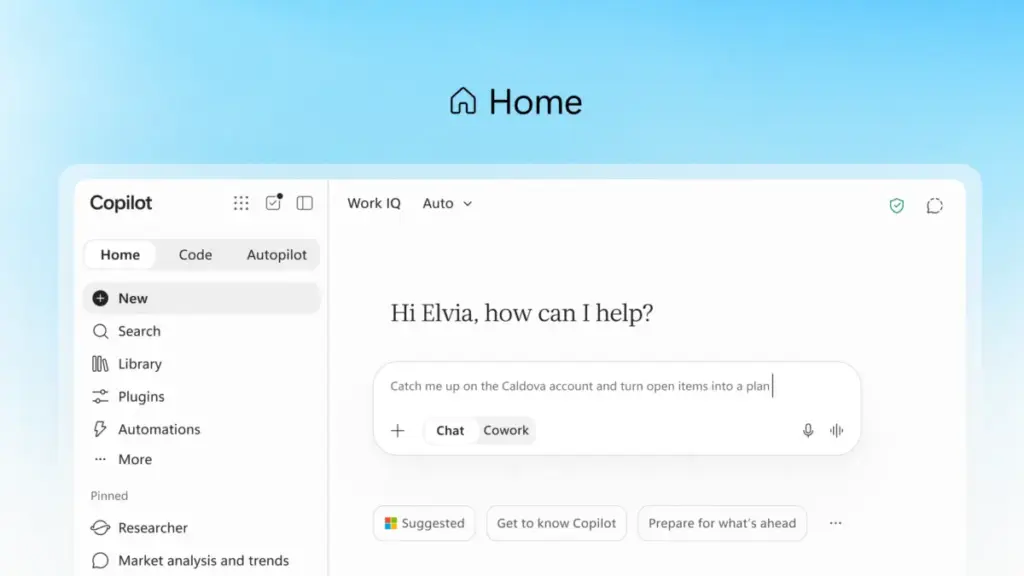
In a significant move to redefine the landscape of modern work, Microsoft has announced a comprehensive reimagining of its Copilot platform. The tech giant is shifting its AI strategy from a series of disparate assistants toward a unified, next-generation experience designed to integrate seamlessly into the "flow of human ambition." By introducing a redesigned Copilot app featuring new "Home," "Code," and "Autopilot" capabilities, Microsoft aims to provide a singular environment where individuals and organizations can build, customize, and scale artificial intelligence across every facet of their operations.
The announcement marks a pivotal moment in the evolution of generative AI within the enterprise. Rather than treating AI as an external tool that users must visit, Microsoft is positioning the new Copilot as the connective tissue between the software people rely on daily and the advanced capabilities required to manage increasingly complex digital workloads. The goal, according to company leadership, is to empower every worker to accomplish more by automating routine tasks and providing deeper, data-driven insights.
A New Experience for Every Mode of Work
At the center of this transformation is the new Copilot Home, which serves as a centralized starting point for the user’s workday. This interface is designed to bridge the gap between two distinct ways of working: Chat and Cowork. While Chat remains the go-to for instant, conversational interactions—such as asking quick questions, drafting emails, or summarizing documents—Cowork represents a shift toward delegation.
Through Cowork, users can define complex, end-to-end tasks that the AI executes independently. This includes the creation of Request for Proposal (RFP) responses, the development of comprehensive launch kits, or the assembly of financial close packages. By moving work into a delegated model, Microsoft hopes to free employees from the iterative "grind" of administrative assembly, allowing them to focus on high-level strategy and decision-making.
A critical component of this new Home experience is the deep integration of "Office in Copilot." Microsoft is bringing the full functionality of Word, Excel, and PowerPoint directly into the Copilot environment. This integration addresses a common friction point in AI workflows: the need to copy and paste content between an AI chat interface and a productivity app. Now, users can draft a brief or model a budget within Copilot, and the system will create or update a live, editable document that remains in sync across the entire Microsoft 365 suite. This ensures that formatting remains intact and version control is maintained, even as multiple team members collaborate on the file in real-time.
Furthermore, Microsoft has enhanced the specific "skills" available within these apps. For instance, Excel now features specialized financial skills and the ability for Copilot to recommend the most effective charts for data visualization. In PowerPoint, the AI can automatically ensure that decks remain on-brand while allowing for fine-tuned edits to images and slides. These role-specific workflows are intended to help organizations scale best practices across their entire workforce.

Democratizing Solution Building with Code
Perhaps the most ambitious addition to the platform is "Code," a feature that moves solution-building beyond the exclusive domain of professional software developers. Microsoft posits that the traditional unit of knowledge work—the file—is being joined by a fourth category: small, purpose-built AI solutions.
Powered by the same underlying technology as GitHub Copilot, the Code feature allows any user to describe an app, automation, or dashboard in natural language. Copilot then selects the appropriate technical approach and builds the solution in a secure, sandboxed environment. These can range from simple desktop widgets for quick data reference to complex, cloud-hosted internal apps designed for team-wide use.
To support this shift toward "citizen development," Microsoft is introducing the Copilot Managed Runtime. This hosting infrastructure allows custom-built code to run safely within an organization’s existing Microsoft 365 environment. It provides a governed space where IT departments can maintain oversight while allowing employees to connect their custom apps to live business data. By opening this runtime to third-party and professional developers as well, Microsoft is creating a broad ecosystem where bespoke AI agents and tools can be deployed with minimal friction.
The Rise of the Proactive Digital Teammate
While much of the current AI discourse focuses on reactive tools, Microsoft’s new "Autopilot" (previously known by the internal codename "Scout") introduces a proactive element to the workplace. Autopilot is described as a persistent digital teammate that continues to work even when the user is offline.
Unlike a standard chatbot that requires a prompt to initiate action, Autopilot can be assigned a specific name, role, and long-term goal. It is designed to monitor communication channels, follow up on email threads, and manage recurring processes without constant human intervention. For example, a user could task Autopilot with managing a supplier review process. The agent would then build a schedule, reach out to stakeholders for updates, and organize the necessary meetings and follow-ups.
Autopilot is built on "Microsoft IQ," a unified intelligence platform that allows the agent to understand the specific context and hierarchy of an organization. Because it is cloud-hosted and possesses its own identity and memory within the company’s tenant, it can be "@mentioned" in Teams or Outlook just like a human colleague. This allows for a level of collaboration where the AI handles the logistical "heavy lifting" of a project while keeping the human user informed and in control.
Expanding Business Context and Intelligence
A primary challenge for enterprise AI has been "grounding"—ensuring that the AI’s outputs are based on the company’s actual data rather than general internet knowledge. Microsoft is addressing this by expanding the business context available to Copilot through "Fabric IQ."

This integration brings context from over 20 million semantic models in Power BI directly into the Copilot environment. Furthermore, Microsoft is rolling out a public preview that grounds Copilot in data and workflows from Dynamics 365 and the Power Platform. This means that a salesperson drafting a proposal can have Copilot automatically pull in deal histories, support tickets, and customer interactions without ever leaving the document.
To manage the various ways these data sources interact, Microsoft is launching a new unified plugin registry. This catalog brings together first-party, partner, and custom-built plugins, allowing IT administrators to approve and manage extensions centrally. For developers, this provides a "publish once" model that extends their tools across all Copilot-supported experiences, ensuring a consistent and secure expansion of AI capabilities.
Navigating the Economics of AI: FinOps and Spend Management
As AI adoption scales, organizations are increasingly concerned with the associated costs. Microsoft is responding to these concerns by evolving its pricing models and introducing "FinOps for AI" capabilities.
The company is moving toward a bifurcated spending model. For everyday tasks like drafting and summarizing, users typically rely on a User Subscription License (USL), which offers a fixed cost for standard Copilot features. Within this model, a feature called "Auto" dynamically weighs accuracy, speed, and cost for each request, routing the task to the most efficient model available.
However, for more intensive "agentic" work—such as the long-running tasks performed by Autopilot or complex solution building in Code—Microsoft is utilizing Usage-Based Billing (UBB). This allows organizations to match their costs directly to the value generated by advanced frontier models like Astra and Fable.
To help businesses manage this complexity, new cost-management tools are being integrated into "Agent 365." Admins can now set spending policies, manage API access, and determine which model families are available to specific user groups. Business leaders can also analyze which tasks are generating the highest return on investment, allowing them to optimize their AI spend. For the end user, transparency is provided through direct views of credit usage and remaining balances within the Copilot app, encouraging responsible AI consumption within organizational guardrails.
A Roadmap for the Future of Collaboration
The current rollout is described as only the beginning of a broader roadmap. Microsoft also provided a "sneak peek" at upcoming features intended to make Copilot even more personalized.

In October, a new feature called "Today" will enter private preview. Described as a proactive command center, Today will aggregate information from mail, calendars, and Teams to show users what requires immediate attention. Rather than just listing tasks, Today will proactively prepare drafts, propose schedule changes, and surface forgotten follow-ups with the necessary context already attached.
Additionally, Microsoft is enhancing group collaboration with the introduction of "@Copilot in Teams." This feature allows an entire team to invoke Copilot within a shared channel or group chat. The AI will have access to the shared context of that specific group, allowing it to explain past decisions or prepare cross-functional reviews that identify dependencies and open questions. By keeping everyone aligned on the same data, Microsoft hopes to eliminate the need for repetitive status meetings and manual project tracking.
Implementation and Availability
The new Copilot experience is beginning its rollout through Microsoft’s Frontier program, with new capabilities expected to arrive continuously over the coming months. The "Code" feature is slated for preview for Microsoft 365 Premium and Pro subscribers later this year, while Autopilot is expanding to private preview at the end of this month.
Microsoft has invited the global tech community to learn more about these innovations at the upcoming Microsoft Ignite conference, scheduled for November 17–20 in San Francisco and online. As organizations grapple with the complexities of integrating AI into their core business processes, Microsoft’s reimagined Copilot represents a bet that a unified, proactive, and governed platform is the key to unlocking the next era of productivity.
 Productivity Software & Office Suites
Microsoft to Headline ESPC 2026 in Amsterdam: A Deep Dive into the Future of AI-Powered Work and Agentic Ecosystems
The landscape of enterprise technology is currently undergoing one of its most...
 Productivity Software & Office Suites
Microsoft Announces Global Launch of Copilot Cowork, Introducing Agentic AI to the Modern Enterprise
In a move that signals a significant shift in the landscape of...
 Productivity Software & Office Suites
Microsoft Unveils ‘Autopilots’ and Microsoft Scout: The Next Evolution of Autonomous AI Agents for the Enterprise
The landscape of digital productivity is undergoing a fundamental shift, moving away...







