
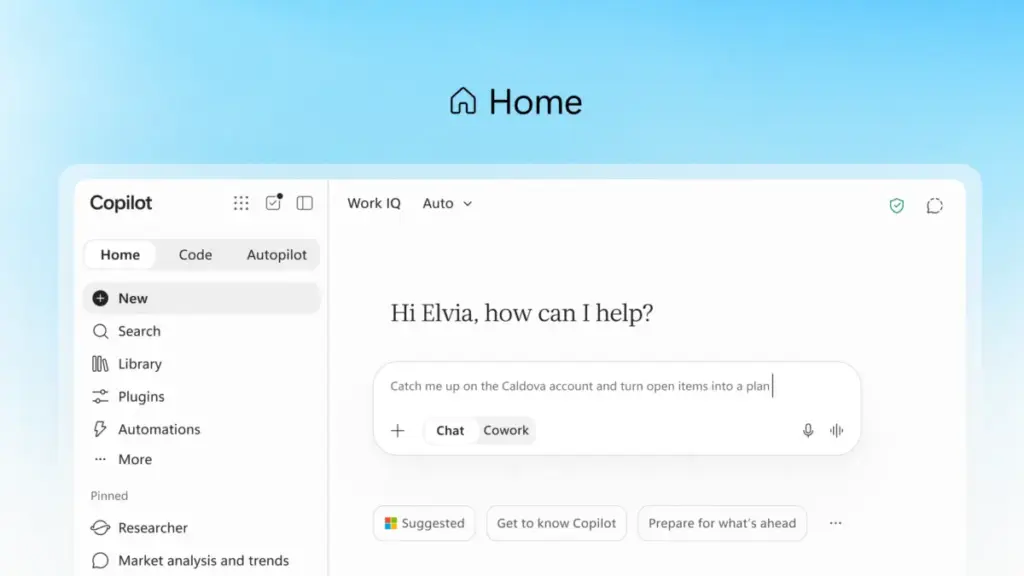
To support this shift toward "citizen development," Microsoft is introducing the Copilot Managed Runtime. This hosting infrastructure allows custom-built code to run safely within an organization’s existing Microsoft 365 environment. It provides a governed space where IT departments can maintain oversight while allowing employees to connect their custom apps to live business data. By opening this runtime to third-party and professional developers as well, Microsoft is creating a broad ecosystem where bespoke AI agents and tools can be deployed with minimal friction.
The Rise of the Proactive Digital Teammate
While much of the current AI discourse focuses on reactive tools, Microsoft’s new "Autopilot" (previously known by the internal codename "Scout") introduces a proactive element to the workplace. Autopilot is described as a persistent digital teammate that continues to work even when the user is offline.
Unlike a standard chatbot that requires a prompt to initiate action, Autopilot can be assigned a specific name, role, and long-term goal. It is designed to monitor communication channels, follow up on email threads, and manage recurring processes without constant human intervention. For example, a user could task Autopilot with managing a supplier review process. The agent would then build a schedule, reach out to stakeholders for updates, and organize the necessary meetings and follow-ups.
Autopilot is built on "Microsoft IQ," a unified intelligence platform that allows the agent to understand the specific context and hierarchy of an organization. Because it is cloud-hosted and possesses its own identity and memory within the company’s tenant, it can be "@mentioned" in Teams or Outlook just like a human colleague. This allows for a level of collaboration where the AI handles the logistical "heavy lifting" of a project while keeping the human user informed and in control.
Expanding Business Context and Intelligence
A primary challenge for enterprise AI has been "grounding"—ensuring that the AI’s outputs are based on the company’s actual data rather than general internet knowledge. Microsoft is addressing this by expanding the business context available to Copilot through "Fabric IQ."

This integration brings context from over 20 million semantic models in Power BI directly into the Copilot environment. Furthermore, Microsoft is rolling out a public preview that grounds Copilot in data and workflows from Dynamics 365 and the Power Platform. This means that a salesperson drafting a proposal can have Copilot automatically pull in deal histories, support tickets, and customer interactions without ever leaving the document.
To manage the various ways these data sources interact, Microsoft is launching a new unified plugin registry. This catalog brings together first-party, partner, and custom-built plugins, allowing IT administrators to approve and manage extensions centrally. For developers, this provides a "publish once" model that extends their tools across all Copilot-supported experiences, ensuring a consistent and secure expansion of AI capabilities.
Navigating the Economics of AI: FinOps and Spend Management
As AI adoption scales, organizations are increasingly concerned with the associated costs. Microsoft is responding to these concerns by evolving its pricing models and introducing "FinOps for AI" capabilities.
 Productivity Software & Office Suites
Microsoft Announces New AI-Integrated Office Suites to Streamline Small Business Operations
In the demanding ecosystem of small business management, success is often measured...
 Productivity Software & Office Suites
Microsoft Reimagines Copilot as a Unified AI Platform for the Next Generation of Work
In a significant shift that signals the next phase of the artificial...
 Productivity Software & Office Suites
Microsoft Unveils Advanced AI ‘Skills’ and Data Connectors to Transform Excel for Finance Professionals
The evolution of modern computing has historically followed a predictable trajectory, moving...







