

This "clean sheet" approach is particularly relevant as the industry debates the merits of UALink over Ethernet (UALoE) and the ESUN memory protocols. SkyHammer is fundamentally an Ethernet switch ASIC at its core, running UALoE rather than a native, non-Ethernet version of UALink. While some had hoped for a dedicated, high-radix switch that could run UALink natively, the decision to stick with Ethernet reflects the broader market trend. Many industry veterans believe that Ethernet will eventually displace InfiniBand as the dominant fabric for AI, provided it can close the gap on port-to-port hop latency.
In a strategic move that highlights the complexity of the AI ecosystem, Upscale AI has actually partnered with Nvidia for its scale-out requirements. The company will acquire Nvidia’s Spectrum-X ASICs to build its own scale-out switches. These will run Upscale AI’s "SkyOS" network operating system, an AI-optimized version of the SONiC (Software for Open Networking in the Cloud) platform originally created by Microsoft. SONiC has become a de facto standard for hyperscalers, and by porting SkyOS to Spectrum-X, Upscale AI ensures that its software stack can manage both scale-up and scale-out networks through a single, unified telemetry and orchestration tool called SkyCMD.
This software-led approach is intended to give customers the freedom to mix and match CPUs, GPUs, and XPUs from various vendors, front-ended by any NIC or DPU. The challenge, however, remains Nvidia’s refusal to support SkyHammer as a legitimate alternative to NVSwitch for its own GPUs. As it stands, there is no official path for users to perform scale-up networking with Nvidia hardware using Upscale AI’s fabric.
This standoff creates a unique opportunity for other silicon providers. AMD, for instance, is increasingly reliant on third-party scale-up options to support its UALink and ESUN initiatives. Some industry observers suggest that AMD might eventually seek to acquire a company like Upscale AI to secure its own scale-up networking technology and capture more of the value chain.
As the AI market continues to expand, the battle over the "glue" that binds these massive clusters together will only intensify. Nvidia may eventually be forced to choose between maintaining its proprietary walls or adapting its NVLink protocol to run on third-party hardware like SkyHammer to remain the dominant supplier in an increasingly standardized world. For now, the industry watches as Upscale AI attempts to prove that a predictable, lossless, and open Ethernet fabric can indeed compete with the most expensive and exclusive interconnects on the market.
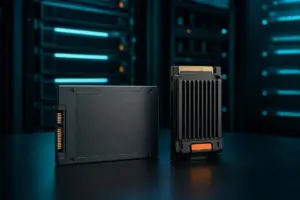 Enterprise Tech & Infrastructure
Understanding the Architecture of Modern Storage: Decoding the Relationship Between Flash Technology and Solid-State Drives
In the rapidly evolving landscape of data storage, the terminology used to...
 Enterprise Tech & Infrastructure
Navigating the Financial Realities of Enterprise Cloud Storage: A Comprehensive Analysis of Amazon S3 Cost Management
In the rapidly evolving landscape of enterprise cloud infrastructure, the management of...
 Enterprise Tech & Infrastructure
Bridging the Gap in Data Center Convergence: The Evolving Role of Fibre Channel over Ethernet
As data centers face unprecedented pressure to handle massive workloads driven by...







