
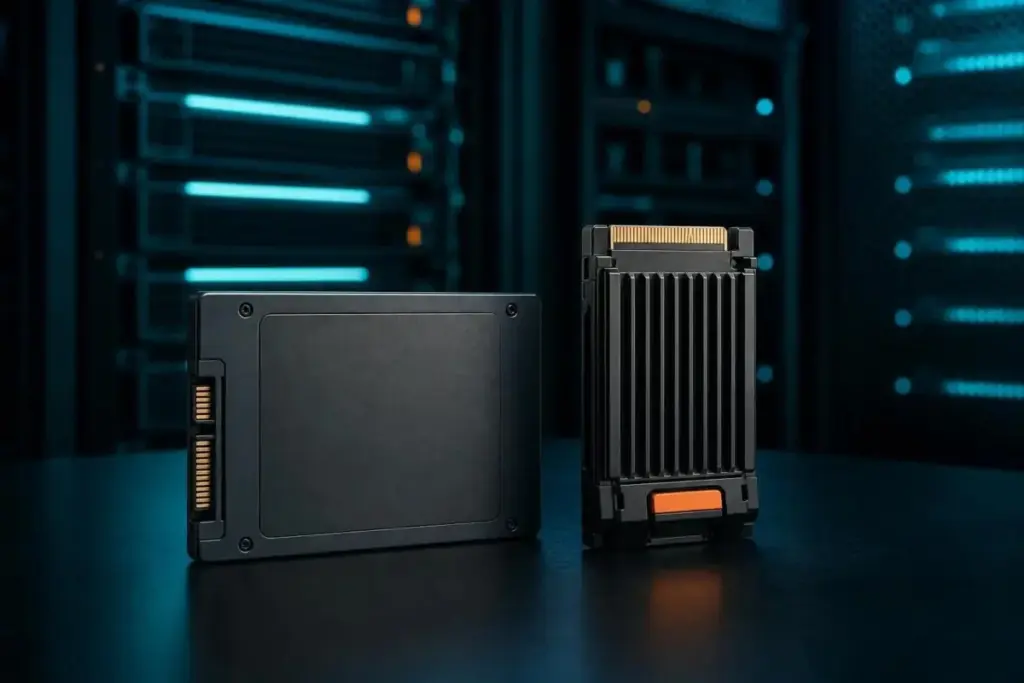
In the rapidly evolving landscape of data storage, the terminology used to describe modern hardware often leads to a fundamental misunderstanding among enterprise buyers and consumer enthusiasts alike. The terms "flash" and "SSD" are frequently used interchangeably in marketing materials and technical discussions, yet they represent two distinct levels of technology. As organizations look to optimize their data centers and individual users seek to upgrade their hardware, understanding that flash and SSDs are not competing options—but rather a component and its finished product—is essential for making informed purchasing decisions.
Flash storage is the foundational memory technology: a collection of electronic chips designed to store data without the need for moving parts. In contrast, a Solid-State Drive (SSD) is a sophisticated, integrated device built around that flash memory. An SSD incorporates several critical layers, including a specialized controller, complex firmware, and a standardized interface, to make raw flash chips usable for a computer system. The real challenge for modern buyers is not choosing between flash and an SSD, but rather navigating the nuances of NAND types, interface protocols, and endurance ratings that define the performance and longevity of the drive.
Flash Is the Chip, SSD Is the Product Built Around It
To understand the difference between these two concepts, it is helpful to look at the definitions provided by industry leaders. According to IBM, flash storage refers specifically to the underlying memory technology itself. These are electronic memory chips that utilize non-volatile silicon-based storage to retain data even when the power is disconnected. This non-volatile nature is achieved by storing data as electrical charges within memory cells. Because flash lacks the mechanical arms and spinning platters of traditional Hard Disk Drives (HDDs), it is significantly more resilient to physical shock and offers much lower latency.
The versatility of flash memory allows it to exist in many forms beyond the standard computer drive. As Pure Storage points out, flash technology is the engine behind USB thumb drives, SD cards used in professional cameras, and the internal storage of smartphones. However, while a USB stick utilizes flash, it is not categorized as an SSD. The distinction lies in the complexity of the internal architecture. What transforms raw flash chips into an SSD is the addition of a controller and firmware that manage data placement, along with a high-speed interface that allows the device to communicate effectively with a server or workstation. This management layer is where the most significant performance differences between various drives are found.
NAND vs. NOR: The Architectural Divide
Flash memory is generally divided into two primary families: NAND and NOR. These names refer to the type of logic gate used in the memory cells, and each serves a very different purpose in the ecosystem of electronics. IBM explains that NAND flash is the dominant force in the storage market because it offers higher storage density, smaller physical cell sizes, and significantly faster write and erase speeds. These characteristics make it ideal for high-capacity storage devices like SSDs.
NOR flash, on the other hand, excels in read speeds and provides random-access capabilities, allowing a system to jump directly to specific bits of data. However, NOR comes at a much higher cost per bit and lacks the density required for mass storage. Consequently, NOR flash is primarily reserved for storing firmware, BIOS code, and embedded applications where small amounts of data must be read quickly and reliably, but rarely changed.
Virtually every modern SSD on the market is built using NAND technology. As detailed in technical explainers from Computer Compatibility, NAND cells function as floating-gate transistors that trap electrons to represent data. Within the realm of NAND, the most critical variable for a buyer is the cell type, which determines how many bits of data are stored in each individual cell. This density directly impacts the drive’s speed, durability, and price.
Single-Level Cell (SLC) NAND stores only one bit per cell. It is the fastest and most durable version of the technology, capable of enduring the highest number of write cycles. However, because it is the least dense, it is also the most expensive. SLC is rarely found in consumer products, appearing instead in enterprise environments or military-grade hardware where mission-critical reliability is paramount.
 Enterprise Tech & Infrastructure
Understanding the Architecture of Modern Storage: Why the Choice Between Flash and SSD Is a Matter of Components, Not Categories
In the rapidly evolving landscape of enterprise data management, the terminology used...
 Enterprise Tech & Infrastructure
Beyond the Per-Gigabyte Rate: Navigating the Hidden Complexities of Amazon S3 Cost Management
In the landscape of enterprise cloud infrastructure, Amazon S3 has long been...
 Enterprise Tech & Infrastructure
Navigating the Hidden Complexities of Amazon S3 Cost Management
For many enterprise IT departments, the monthly Amazon Web Services (AWS) bill...







