
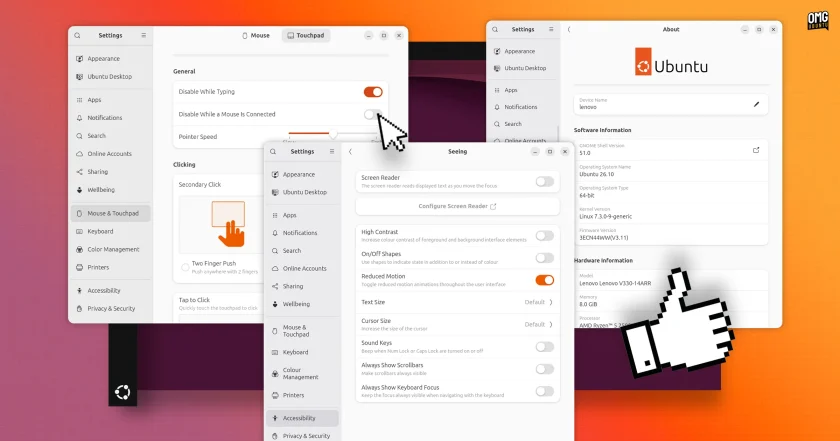
- Mouse & Touchpad: Users working with mobile setups can enable a toggle that automatically disables the internal laptop touchpad whenever a physical mouse is connected.
- Displays: Touchscreen users gain an explicit toggle to manage display auto-rotation. Furthermore, multi-monitor configuration interfaces now snap to center-aligned layouts automatically, preventing misaligned display boundaries.
- Display Memory: GNOME Shell now stores precise per-monitor display brightness levels and HDR color configuration profiles indexed by monitor EDID data. Unlike older iterations that relied on kernel-level memory that could be skewed by interim power-saving dimming sequences, the display server properly restores exact hardware brightness levels across subsequent system reboots.
- Network Security: The Network settings pane adds options for specific DNS domain search paths. Meanwhile, configuration support for legacy WEP wireless encryption has been removed entirely across the operating system due to fundamental security deficiencies.
- Accessibility: The "Reduce Motion" setting has been overhauled to suppress desktop transition animations more broadly, though primary application overview zoom sequences and the default application drawer currently remain active.
Modernizing Core Commands and System Architecture
Ubuntu 26.10 represents an engineering milestone in Canonical’s transition toward memory-safe system foundations. The distribution’s core command-line toolchain has completed its migration to Rust-based utilities, with core tools including cp, mv, and rm now fully provided by the uutils implementation. Rust-based OpenPGP functionality via Sequoia is also installed across system images ahead of planned default status in Ubuntu 27.04.
Underneath the user interface, Ubuntu 26.10 adopts dbus-broker as the standard system and session message bus, cleanly deprecating the 22-year-old dbus-daemon service. While visually transparent to users, the modern message broker improves inter-process communication performance and provides better architectural security across desktop services.
System responsiveness during high memory constraints has also received attention. Tuning across the systemd-oomd memory monitor ensures that when volatile RAM is depleted, runaway user applications are isolated and terminated prior to core graphical shell services, drastically mitigating the likelihood that high memory loads drop users back to the display manager login screen.

Terminal Diagnostics with APT 3.3.3
The core command-line packaging tool updates to APT version 3.3.3, bringing interactive, context-sensitive assistance to command-line operators. Previously, appending the --help flag to individual subcommands frequently yielded the broad, top-level help text rather than guidance pertinent to the action attempted. Under APT 3.3.3, subcommands like apt install --help properly output operational parameters, flags, and syntax exclusively relevant to that specific task, eliminating the need to consult external documentation or system manual pages for standard operations.
Expanded TPM Disk Encryption and Hardware Tracking
Disk encryption implementations in Ubuntu 26.10 broaden support for systems lacking hardware root of trust. Users can now apply Trusted Platform Module (TPM)-backed full-disk encryption across wider hardware classes by supplying an initial passkey or PIN during installation. Systems built after 2021 that fully implement hardware root of trust standards continue to benefit from transparent, automated hardware-authenticated unlocks without mandatory PIN entry.
In tandem, the Resources system monitor, introduced during the prior LTS cycle, gains native telemetry tracking for Neural Processing Units (NPUs). System resource displays can actively plot hardware utilization, operational efficiency, and power consumption across AMD Ryzen 7040, 8040, and Ryzen AI 300 and 400 series chips. Visual metrics within the interface have been elevated above sidebar graphs for better legibility, the sidebar can now be collapsed or restored via the F9 key, and tracking hooks have been refined to capture performance footprints across Steam gaming libraries and isolated Snap containers.
Linux 7.3 Kernel and Graphics Stack
At its foundational level, Ubuntu 26.10 ships with the Linux 7.3 kernel, packaged in its late release candidate state due to development cycles aligning just ahead of upstream kernel completion in late October; finalized kernel builds will roll out to 26.10 installations as an in-place software update.
Linux 7.3 incorporates broad architectural additions, including preliminary platform enablement for Snapdragon X2 Elite architectures like the Asus Zenbook A14, accompanied by peripheral expansions such as webcam support for existing X Elite laptops. Storage layers benefit from an overhauled EXT4 multi-block allocator optimizing large-file pre-allocations, alongside zero-copy throughput capabilities for FUSE configurations leveraging io_uring. Graphics management gains memory fixes mitigating micro-stutters, alongside tailored VRAM management algorithms that yield performance gains in gaming workloads on GPUs equipped with under 8GB of video memory.
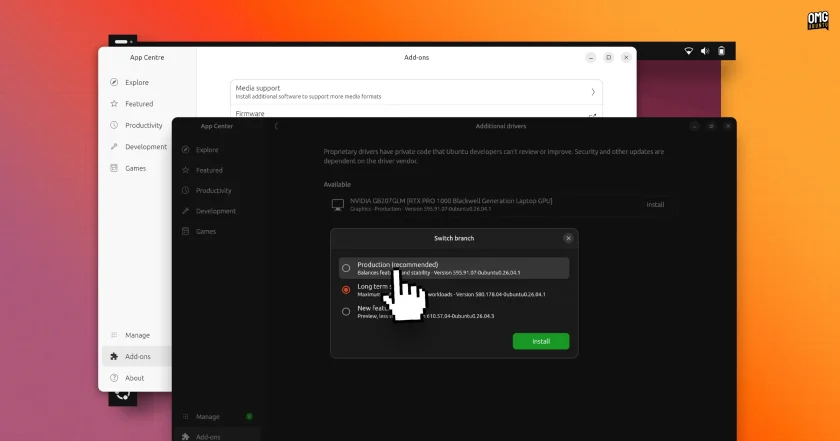
Graphical pipelines are reinforced by Mesa 26.2, which brings mesh shading pipelines to the open-source NVK Vulkan driver for NVIDIA hardware, alongside low-latency Vulkan Video encoding and decoding acceleration on AMD GPUs. Proprietary graphics stacks transition to the NVIDIA 615 driver branch. The updated package exclusively distributes open kernel modules compatible with the Turing architecture and newer, requiring legacy hardware configurations to remain on the NVIDIA 580 branch.
For developers, Ubuntu 26.10 updates its foundational software toolchains. Environments available or pre-installed across the software repositories include Python 3.14.7, Rust 1.97, LLVM 22.1.8, .NET 10, OpenJDK 25, and access to upcoming OpenJDK 27 packages.
Release Lifespan and Upgrade Paths
Ubuntu 26.10 installation media for 64-bit AMD and Intel hardware, alongside developer builds for Raspberry Pi, WSL environments, RISC-V developer platforms, and x86-64-v3 hardware, are available via Ubuntu’s public release distribution mirrors.
As an interim release, Ubuntu 26.10 will receive security patches, package updates, and system maintenance for nine months, concluding support in July 2027. Workstations actively operating Ubuntu 26.04 LTS can perform direct in-place operating system upgrades by intentionally configuring system update managers to track non-LTS releases. Older standalone iterations, including Ubuntu 24.04 LTS or 25.10, cannot jump directly to 26.10 and require successive release-to-release upgrades or standard clean installations using new media.
 Linux & Open Source Solutions
The Document Foundation Unveils New Visual Identity to Establish Distinct Institutional Profile Apart from LibreOffice
The Document Foundation, the charitable non-profit entity responsible for overseeing the development...
 Linux & Open Source Solutions
Canonical Releases Official Ubuntu Desktop Images for RISC-V Hardware Ahead of Ubuntu 26.10
Installing Ubuntu on RISC-V hardware is poised to become significantly more straightforward...
 Linux & Open Source Solutions
Hylki Brings Modern Rust Engineering and Deep Customization to the GNOME Desktop
For years, the Linux desktop has maintained a complicated relationship with the...







