
The prevailing narrative surrounding the generative artificial intelligence revolution often focuses on the ethereal—the complexity of neural networks, the trillions of parameters in frontier models, and the seemingly infinite billions of dollars being poured into Silicon Valley startups. However, a starker reality is beginning to settle over the industry: the growth of GenAI is not a purely digital phenomenon, nor is it one that can be accelerated by capital alone. No matter how much money is thrown at the problem, the expansion of the AI sector is physically tethered to the rate at which datacenters can be designed, built, and successfully connected to the electrical grid.
This physical bottleneck is becoming the defining characteristic of the current era. While political, social, and economic pressures are mounting to speed up the deployment of AI, these forces have little power to accelerate the manufacturing of massive transformers, the installation of high-voltage power lines, or the pouring of concrete. The industry was largely caught off guard by the sheer velocity of the AI boom, and the specialized supply chains—ranging from semiconductor manufacturing equipment to the heavy electrical gear required for power distribution—were simply not prepared to ramp up production at the scale the market now demands.
The human element remains the most significant variable in this equation. Despite the automation and intelligence promised by the software being developed, it still requires human labor to construct the physical shells that house these machines. In an era where remote work has become a standard for many—a shift that some observers note has been a personal reality since the mid-1990s—the demand for physical labor on construction sites has never been more critical. Ironically, the current economic climate, characterized by high interest rates for residential mortgages, has provided a convenient side effect for the tech industry. As the construction of homes and traditional office spaces slows down due to borrowing costs, a larger portion of the labor pool is being redirected toward massive datacenter projects.

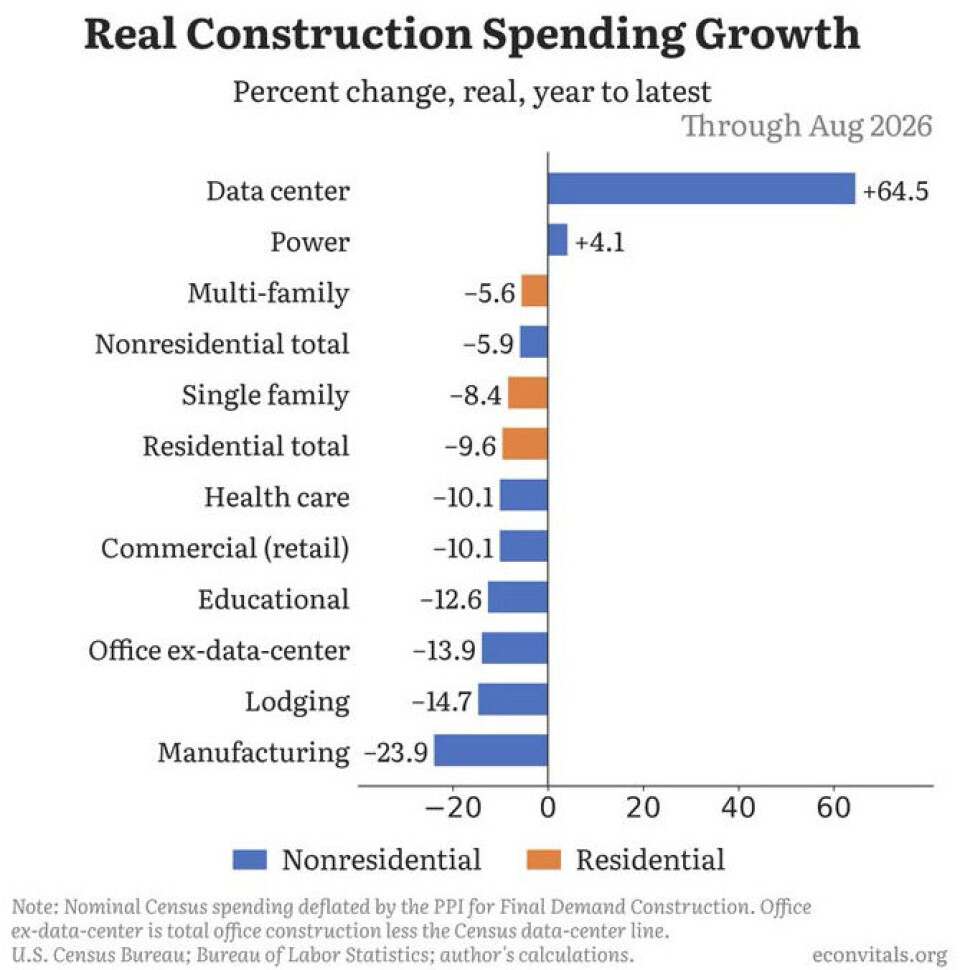
Recent economic data highlights the profound impact this shift is having on the broader American economy. Jason Furman, a professor of economics at Harvard University and a former high-ranking economic advisor, recently highlighted data through August 2026 that illustrates the divergence in the construction sector. According to figures from the U.S. Census Bureau and the Bureau of Labor Statistics, datacenter and power utility construction are currently serving as a vital stabilizer for the United States economy. As residential and commercial office construction face significant declines, the aggressive build-out of infrastructure for the digital age is counter-balancing what might otherwise be a more pronounced economic contraction.
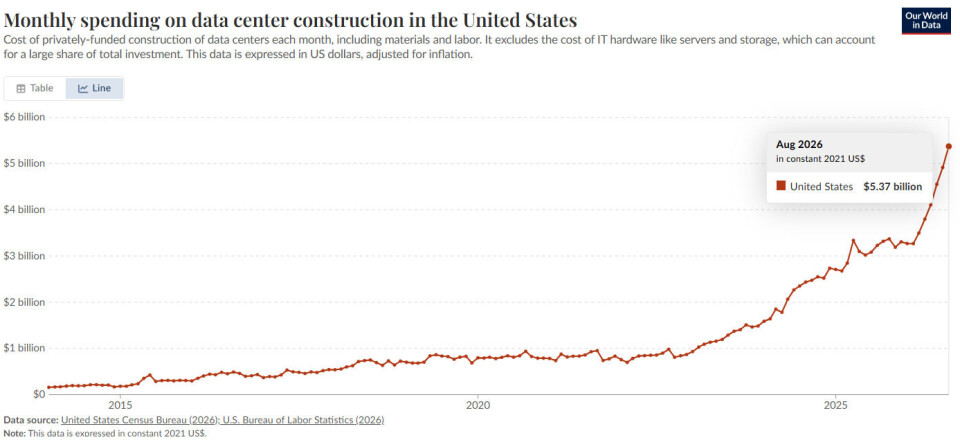
It is important to distinguish what these construction figures represent. The data accounts for the cost of raw materials and the labor required for the physical project, as well as the power distribution and energy backup equipment integrated into the facilities. Crucially, it does not include the cost of the actual IT hardware—the GPUs, CPUs, storage arrays, and networking switches—that will eventually populate these halls. When one considers that the hardware often costs more than the building itself, the total capital expenditure being funneled into this sector becomes even more staggering.
Looking at the historical trajectory provided by the U.S. Census Bureau and analyzed by researchers at Oxford University’s Our World in Data project, the inflection point is clear. When adjusted for inflation to 2021 dollars, spending on datacenter construction remained relatively stable for nearly a decade. However, that changed abruptly in November 2022. The launch of high-profile generative AI models acted as a starting gun, and since that moment, the market has moved into a period of vertical acceleration. This trend is almost entirely driven by private sector investment; while federal, state, and local governments do maintain their own datacenters, their spending is a mere fraction of the capital being deployed by hyperscalers, cloud service providers, and specialized AI model developers.
To understand where this trend is headed, a detailed forecast from analysts at Jeffries, produced in collaboration with market research firm Aterio, provides a sobering look at the limitations of the "bull case" for AI. While the industry is flush with ambitious announcements and massive "planned" projects, the reality of execution is far more complicated.
According to Jonathan Petersen, managing director at Jeffries, the AI industry is currently grappling with a fundamental "datacenter problem." The demand for inference and the training of next-generation frontier models is simply outstripping the ability of developers to bring physical capacity online. Jeffries’ dataset tracks approximately 65 gigawatts (GW) of IT capacity currently under construction in North America—a figure that represents roughly 140 percent of the total currently installed capacity. Even more ambitious is the pipeline of future announced projects, which totals 361 GW, or about 760 percent of the current footprint.
However, Petersen and his team are appropriately skeptical about how much of this pipeline will actually reach completion. The transition from a project "announcement" to an "online" facility is fraught with delays and cancellations. Jeffries expects approximately 12.9 GW of new capacity to come online in 2026, rising to 18 GW in 2027. These figures, while massive, represent a significant haircut compared to the aspirations of the world’s largest technology companies.
The gap between what hyperscalers want to build and what they are likely to achieve is widening. For 2026, the industry has largely locked in its plans, with hyperscalers aiming for 6.21 GW of capacity. But as we look further into the future, the projections diverge sharply. By 2028, hyperscalers have expressed a desire to build out 10.13 GW of capacity, yet Jeffries anticipates only about 6.54 GW will actually be completed. By 2029, the disparity becomes even more pronounced: against an aspirational goal of nearly 18 GW, analysts expect only 5.86 GW to reach the finish line. By the turn of the decade in 2030, the expected build-out drops to 4.46 GW, even as planned projects remain significantly higher.
This skepticism is rooted in a holistic view of the supply chain. Petersen notes that many industry observers focus too narrowly on a single gating factor, such as the availability of chips or the number of grid interconnect requests. In reality, a datacenter project requires the perfect alignment of multiple inputs: available land, specialized labor, the manufacturing of massive electrical and cooling systems, and a cooperative political and regulatory environment.
The nature of these bottlenecks is expected to shift over time. In the immediate term, through 2026, the primary damper on datacenter spending and completion is the labor shortage. There are simply not enough qualified electricians, engineers, and construction specialists to meet the demand. As we move into the 2027–2029 window, the constraint is expected to migrate toward specialized equipment—specifically the sophisticated liquid cooling systems required to manage the immense heat generated by high-density AI clusters. By 2030, the ultimate limit will likely be the power itself. The electrical grid in North America is facing unprecedented strain, and the time required to build new power plants or upgrade transmission lines is measured in decades, not years.
Furthermore, the "bear case" for this expansion is increasingly driven by social and political friction. Local communities are becoming more vocal in their skepticism of the benefits datacenters bring. While these facilities represent massive capital investments, they often create relatively few long-term jobs once construction is finished. At the same time, they consume vast amounts of local water and electricity, leading to rising pressure for datacenter operators to pay a larger share of infrastructure costs.
The "bull case," by contrast, assumes that supply chain issues for construction materials might ease slightly, but even the most optimistic scenarios account for significant delays. The industry is essentially running a race against physical reality. While the software side of the GenAI boom can iterate in weeks, the infrastructure side is bound by the laws of physics and the speed of heavy industry.
In summary, the next several years will see a massive, historic expansion of the digital footprint in North America, but it will likely fall short of the lofty goals set by the industry’s leaders. The constraints of labor, cooling technology, and power generation are not mere hurdles to be cleared with more funding; they are structural limits that will dictate the ultimate pace of the AI revolution. As the construction data shows, the "cloud" is very much a physical entity, and for the foreseeable future, its growth will be defined by the hard limits of the ground it is built upon.
 Enterprise Tech & Infrastructure
IonQ Breakthrough Demonstrates Real-Time Quantum Error Correction Using Standard CPU Architecture
The global pursuit of fault-tolerant, scalable quantum computing has long been defined...
 Enterprise Tech & Infrastructure
Understanding the Architecture of Modern Storage: Decoding the Relationship Between Flash Technology and Solid-State Drives
In the rapidly evolving landscape of data storage, the terminology used to...
 Enterprise Tech & Infrastructure
Navigating the Abstraction Layer: Strategic Best Practices for Software-Defined Storage Deployment
As the modern enterprise grapples with an unprecedented explosion of data, the...







