
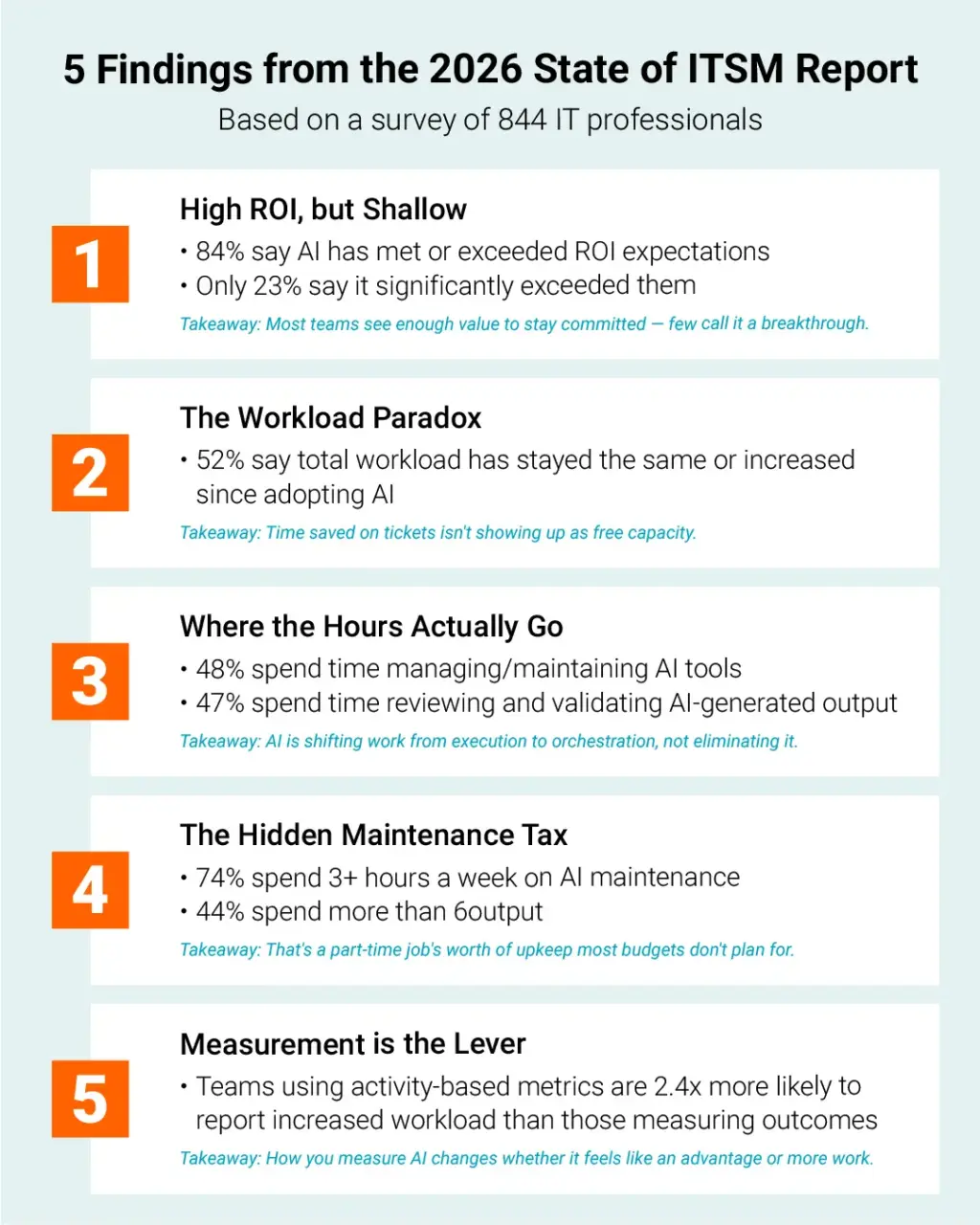
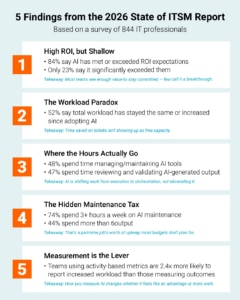
Despite these clear wins, the 2026 survey found that 52% of respondents saw their overall workload increase after adopting AI. An additional 19% reported that their workload remained the same. This means that for 71% of the IT workforce, the introduction of AI has not resulted in a lighter schedule.
This paradox can be explained by how "reclaimed time" is utilized. In many high-performing organizations, the hours saved by AI are immediately reinvested into higher-value activities. Instead of reducing headcount or creating idle capacity, service desks are using that time to process a higher volume of requests, improve the quality of their documentation, engage in proactive system maintenance, and contribute to long-term strategic projects. While this represents a significant gain in organizational capability, it also means that the pressure on the individual IT professional remains high. The report cautions leadership against promising that AI will lead to immediate staff reductions, suggesting instead that the technology should be framed as a tool for increasing the quality and scope of service.
AI Introduces New Requirements for Human Oversight
As AI takes over the execution of routine tasks, it creates a secondary category of work: quality control and operational oversight. The report highlights that IT teams are not simply delegating work to machines and walking away; rather, they are transitioning into roles as supervisors of the technology.
According to the survey, 48% of respondents now spend a portion of their week managing or maintaining AI tools. Furthermore, 47% are dedicated to reviewing and validating the output generated by AI. This oversight is critical in a service desk environment, where an incorrect AI-generated response or a flawed ticket summary can lead to cascading errors. If an AI miscategorizes a high-priority server issue as a low-priority software update, the resulting delay in resolution can have significant business consequences.
The findings suggest that the goal of modern ITSM is not to eliminate human judgment but to apply it where it provides the most value. Organizations are increasingly designing "human-in-the-loop" workflows, where AI handles the initial heavy lifting—such as gathering data and drafting a response—but a human agent provides the final approval. This ensures that the speed of AI is balanced by the accountability and nuanced understanding of a professional. For service desk managers, this means defining clear boundaries for when AI can operate autonomously and when it requires a manual audit.
The Reality of the AI Maintenance Tax
One of the less-discussed aspects of the AI revolution is the ongoing cost of keeping these systems functional and accurate. The SolarWinds report introduces the concept of an "AI maintenance tax," revealing that 83% of IT professionals spend at least three hours every week on AI maintenance. More tellingly, 44% of respondents spend six hours or more on these activities.
This maintenance work is diverse and demanding. It includes "prompt tuning" to ensure the AI provides relevant answers, reviewing outputs for accuracy, and coordinating with vendors to stay current with software updates. It also involves the "hygiene" of the data that feeds the AI; if knowledge base articles are out of date, the AI will provide stale information. Therefore, teams must spend time updating knowledge sources and addressing data gaps that the AI has exposed.
 Helpdesk & IT Service Management (ITSM)
Bridging the Observability Gap: How Integrated Distributed Tracing Isolates Database Latency in Modern API Stacks
In the high-stakes environment of modern software reliability, not every performance crisis...
 Helpdesk & IT Service Management (ITSM)
Decoding SAP HANA Architecture: How In-Memory Processing Redefines Enterprise Data Management
In the rapidly evolving landscape of enterprise technology, the ability to process...
 Helpdesk & IT Service Management (ITSM)
SolarWinds Service Desk Unveils Major Updates to Workflow Automation, Microsoft Teams Integration, and Asset Management
In an era where IT Service Management (ITSM) is increasingly defined by...







