

In an era where IT Service Management (ITSM) is increasingly defined by the speed of collaboration and the seamlessness of automated workflows, SolarWinds has announced a significant series of updates to its Service Desk platform. The latest release, detailed in a comprehensive briefing from the SolarWinds product team, introduces a suite of enhancements designed to provide administrators with greater flexibility, deeper integration with essential collaboration tools, and more granular control over asset lifecycles. These updates reflect a broader strategic focus on reducing the complexity of day-to-day IT operations while empowering teams to customize their environments to meet specific organizational needs.
The updates, which range from General Availability features to early-access "Labs" capabilities, target several core pillars of the Service Desk experience: process integration, collaboration, asset tracking, and user interface customization. By addressing both high-level automation and the ergonomic details of the agent workspace, SolarWinds aims to streamline the bridge between technical tasks and business outcomes.
Choosing the Right Foundation for Each Process Integration
One of the most foundational changes in this release concerns how administrators build and manage Process Integrations. Recognizing that not all integrations are created equal, SolarWinds has overhauled the integration framework to offer a more tailored approach from the moment of inception. This update, now in General Availability across all plan types, moves away from a one-size-fits-all model toward a more intuitive, categorized system.

The updated index page for Process Integrations has been redesigned with modern data management in mind. Admins now have access to a more robust set of tools for navigating their integration library, including advanced search functionality, filtering, and pagination. The interface also supports column resizing and reordering, as well as mass actions, which significantly reduces the administrative overhead for organizations maintaining dozens of distinct connections. A new "Template" column has been introduced, providing immediate clarity on the origin and structure of each integration, which is particularly useful for teams with multiple contributors.
The most significant shift, however, lies in the creation workflow itself. The process now begins with a "Type" selection step, allowing teams to choose the most efficient path for their specific use case. For organizations that require total control over every aspect of a connection—such as custom headers, specific methods, and unique payloads—the "Custom API" type remains the standard. This ensures that legacy systems or highly specialized third-party tools can still be integrated without compromise.
Conversely, for more common applications, SolarWinds has introduced application-specific types. These offer a more guided, action-based setup that abstracts away much of the underlying complexity, allowing admins to focus on the business logic rather than the technical minutiae of API calls. To ensure a smooth transition, all existing stateless Process Integrations have been automatically assigned to the Custom API type, preserving current functionality while opening the door to future optimizations.
Bringing Microsoft Teams Actions Directly into Your Workflows
As remote and hybrid work models continue to dominate the corporate landscape, the divide between the service desk and collaboration platforms has become a primary source of friction. To bridge this gap, SolarWinds has introduced a built-in Microsoft Teams Process Integration, currently available in "Labs" for customers on Advanced and Premier plans. This feature is designed to bring the power of Teams directly into the ITSM workflow, enabling automated actions that were previously manual and time-consuming.
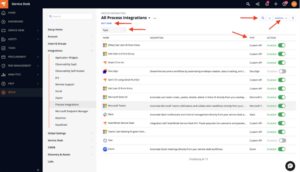
The integration focuses on the practical realities of incident response and team coordination. Through simplified, out-of-the-box actions, administrators can now automate the creation of Teams channels, add specific members to a team, and update channel details based on ticket triggers. This is particularly transformative for major incident management; rather than manually inviting stakeholders to a chat, the Service Desk can automatically spin up a dedicated "war room" channel the moment a high-priority incident is logged.
 Helpdesk & IT Service Management (ITSM)
International Law Enforcement Operation Dismantles KillSec Ransomware Group and Arrests Teenage Mastermind
In a sweeping international law enforcement operation coordinated across multiple borders, authorities...
 Helpdesk & IT Service Management (ITSM)
NetApp Insight 2024: Navigating the Shift Toward AI Inference and Sovereign Data Infrastructure
As the autumn conference season gathers momentum, the technology industry’s focus has...
 Helpdesk & IT Service Management (ITSM)
SolarWinds Announces Comprehensive September Webinar Series Addressing AI Integration, IT Observability, and Cloud Database Migration Challenges
The modern data landscape is currently undergoing a period of unprecedented transformation,...







