
The promise of artificial intelligence within the IT Service Management (ITSM) sector has long been framed as a revolutionary shift toward effortless efficiency. For years, industry narratives have suggested that AI would act as a release valve for overextended service desks, automating away the mundane and allowing human agents to focus on high-level strategy. However, the reality of this transition is proving to be far more complex. According to the recently released SolarWinds 2026 State of ITSM Report, while AI is undeniably accelerating certain aspects of service desk operations, it is simultaneously introducing a new layer of complexity that can actually increase the total workload for IT professionals.
The report, which draws on a comprehensive survey of 844 IT professionals across North America, Europe, the Middle East, Africa, and the Asia-Pacific region, offers a nuanced view of the current state of the industry. The central takeaway is clear: AI is not a "set it and forget it" solution. Its value is inextricably linked to how it is applied, maintained, and measured. While the technology can process data at speeds no human could match, it often exposes underlying weaknesses in data quality and reveals a lack of clarity in traditional performance metrics. For IT leaders, the challenge for the coming year is no longer just about adopting AI, but about managing the operational "tax" that comes with it.
Most Teams See ROI, But Few Experience a Strategic Breakthrough
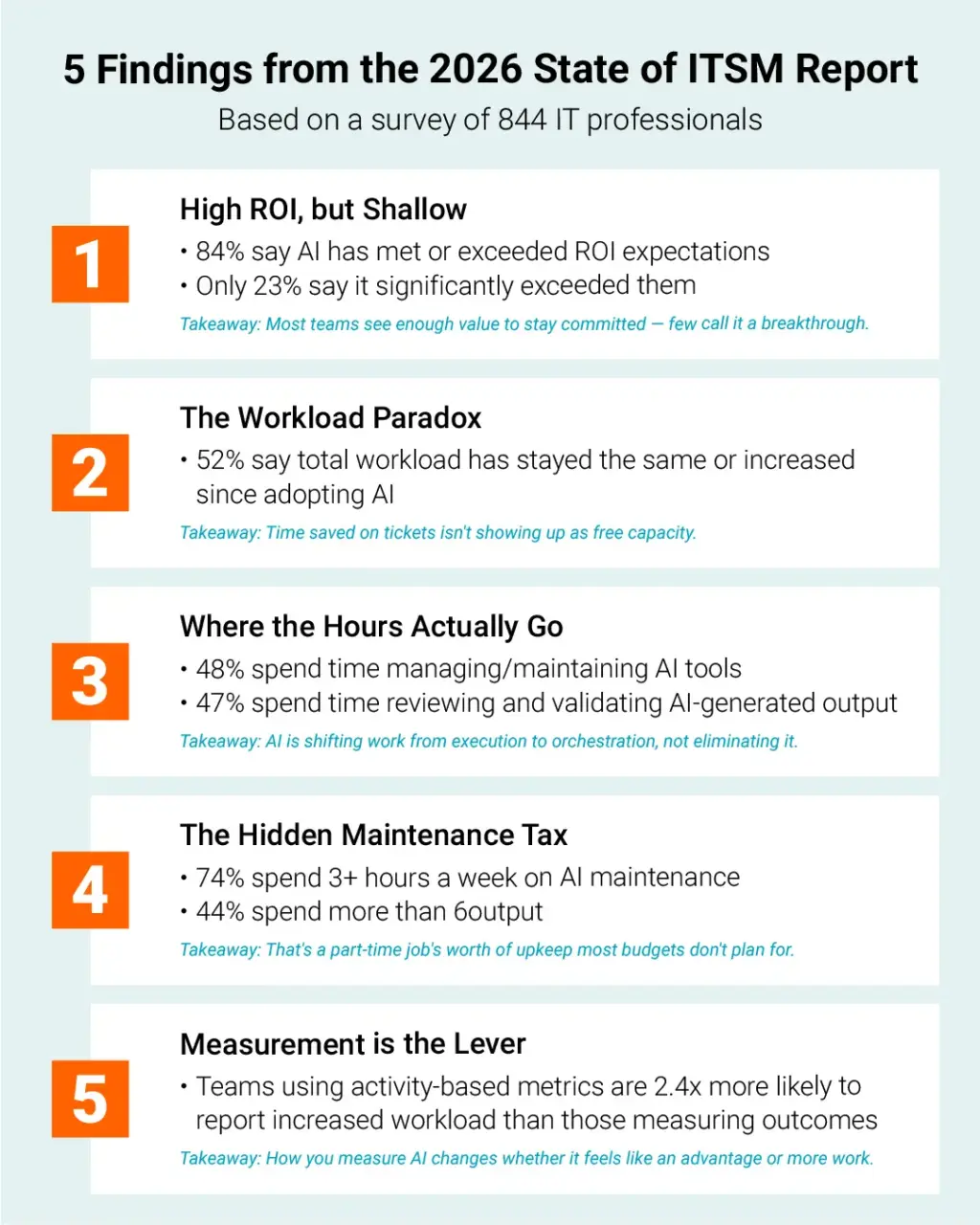
One of the most encouraging findings from the SolarWinds report is the high rate of return on investment (ROI) reported by IT departments. A significant 84% of respondents stated that AI has either met or exceeded their ROI expectations. This figure is particularly striking given the intense scrutiny and sometimes inflated expectations that have surrounded generative AI over the last several years. It suggests that IT teams have successfully moved past the experimentation phase and are finding practical, bottom-line benefits in deploying these tools.
However, a deeper look at the data reveals a gap between functional success and transformative change. Only 23% of those surveyed said that AI has significantly exceeded their expectations. This discrepancy indicates that while AI is performing well in specific, isolated tasks, it has not yet triggered a fundamental breakthrough in how service delivery is structured.
Currently, the gains are concentrated in practical, tactical areas. Respondents reported that AI is highly effective at drafting initial responses to user inquiries, summarizing long and complex ticket histories, and automatically categorizing incoming requests. It is also being used to surface relevant knowledge base articles for both agents and end-users. These are undoubtedly worthwhile improvements that reduce the friction of daily operations. Yet, the report suggests that these incremental wins do not automatically alter the fundamental economics of the service desk. To move from simple ROI to a true breakthrough, the report argues that organizations must stop treating AI adoption as a headline metric and start focusing on specific service outcomes, such as reduced escalation rates, improved SLA compliance, and higher overall employee satisfaction.
The Paradox of Time Savings and Rising Workloads
Perhaps the most surprising finding in the 2026 report is the contradiction between the time saved by AI and the total volume of work handled by IT staff. The survey data provides a clear breakdown of where AI is clawing back time for service desk agents. On average, respondents report that AI saves them 3.3 hours per week in detecting and flagging potential issues before they escalate. Another 3.0 hours are saved in responding to end-user requests, while the triaging and categorization of tickets accounts for 2.9 hours of savings.
The efficiency gains continue across the lifecycle of an incident. IT professionals report saving 2.9 hours a week on creating or uploading knowledge base articles, 2.8 hours on documenting and summarizing incidents, and 2.7 hours on the actual resolution and remediation of technical problems. When these figures are viewed in the context of earlier SolarWinds research, a pattern of steady improvement emerges. The 2024 State of ITSM Report noted that automation and self-service portals could reduce resolution times by several hours, and the 2025 analysis showed that GenAI-enabled features helped drop average incident resolution times from 27.42 hours to 22.55 hours—a nearly 18% improvement.
Despite these clear wins, the 2026 survey found that 52% of respondents saw their overall workload increase after adopting AI. An additional 19% reported that their workload remained the same. This means that for 71% of the IT workforce, the introduction of AI has not resulted in a lighter schedule.
This paradox can be explained by how "reclaimed time" is utilized. In many high-performing organizations, the hours saved by AI are immediately reinvested into higher-value activities. Instead of reducing headcount or creating idle capacity, service desks are using that time to process a higher volume of requests, improve the quality of their documentation, engage in proactive system maintenance, and contribute to long-term strategic projects. While this represents a significant gain in organizational capability, it also means that the pressure on the individual IT professional remains high. The report cautions leadership against promising that AI will lead to immediate staff reductions, suggesting instead that the technology should be framed as a tool for increasing the quality and scope of service.
AI Introduces New Requirements for Human Oversight
As AI takes over the execution of routine tasks, it creates a secondary category of work: quality control and operational oversight. The report highlights that IT teams are not simply delegating work to machines and walking away; rather, they are transitioning into roles as supervisors of the technology.
According to the survey, 48% of respondents now spend a portion of their week managing or maintaining AI tools. Furthermore, 47% are dedicated to reviewing and validating the output generated by AI. This oversight is critical in a service desk environment, where an incorrect AI-generated response or a flawed ticket summary can lead to cascading errors. If an AI miscategorizes a high-priority server issue as a low-priority software update, the resulting delay in resolution can have significant business consequences.
The findings suggest that the goal of modern ITSM is not to eliminate human judgment but to apply it where it provides the most value. Organizations are increasingly designing "human-in-the-loop" workflows, where AI handles the initial heavy lifting—such as gathering data and drafting a response—but a human agent provides the final approval. This ensures that the speed of AI is balanced by the accountability and nuanced understanding of a professional. For service desk managers, this means defining clear boundaries for when AI can operate autonomously and when it requires a manual audit.
The Reality of the AI Maintenance Tax
One of the less-discussed aspects of the AI revolution is the ongoing cost of keeping these systems functional and accurate. The SolarWinds report introduces the concept of an "AI maintenance tax," revealing that 83% of IT professionals spend at least three hours every week on AI maintenance. More tellingly, 44% of respondents spend six hours or more on these activities.
This maintenance work is diverse and demanding. It includes "prompt tuning" to ensure the AI provides relevant answers, reviewing outputs for accuracy, and coordinating with vendors to stay current with software updates. It also involves the "hygiene" of the data that feeds the AI; if knowledge base articles are out of date, the AI will provide stale information. Therefore, teams must spend time updating knowledge sources and addressing data gaps that the AI has exposed.
The report notes that while all ITSM tools require maintenance—such as updating automation rules or governing self-service portals—the operating models for AI are still in their infancy. Many organizations have not yet budgeted the time or the personnel required for this ongoing upkeep. To achieve sustainable value, the report suggests that AI maintenance must be a formal part of the IT roadmap. Assigning accountable owners to model tuning and data quality is essential to prevent the technology from becoming an operational drag rather than an accelerant.
Shifting Focus from Activity Metrics to Outcome Metrics
The way an organization measures its success with AI has a profound impact on how the technology is perceived by the staff. The survey found a striking correlation between measurement styles and perceived workload: organizations that use an activity-oriented approach are 2.4 times more likely to report an increased workload compared to those using an outcome-oriented approach.
Activity-oriented metrics focus on volume—counting how many summaries the AI generated, how many tickets it categorized, or how many times it was triggered. While these metrics show that the tool is being used, they do not necessarily prove it is providing value. A service desk could process more tickets than ever before, but if the end-users are still unhappy or the cost per ticket is rising, the AI implementation cannot be considered a success.
In contrast, outcome-oriented measures focus on the actual impact on the business. The report points to metrics such as employee productivity, the number of incidents prevented through proactive AI detection, and the Digital Employee Experience (DEX) score. By shifting the focus to these results, leadership can better understand whether AI is actually solving problems or just moving them around. For example, if AI is used for ticket triaging, the relevant metrics should be the rate of ticket reassignment and the total time to resolution, rather than just the number of tickets triaged.
Integrating AI into the Broader ITSM Discipline
The SolarWinds 2026 State of ITSM Report signals a shift toward a more mature, disciplined era of AI integration. The initial excitement of "AI for the sake of AI" is being replaced by a pragmatic understanding of the technology’s role within the broader IT ecosystem. The findings suggest that the question for IT leaders is no longer whether AI belongs in the service desk, but whether the service desk has the necessary infrastructure to support it.
This journey toward maturity has been documented over the last several years. The 2024 report established that a foundation of automation, self-service, and robust knowledge management was necessary for efficiency. The 2025 report demonstrated that generative AI could build upon that foundation to significantly reduce incident resolution times. Now, the 2026 data makes the next step clear: long-term success requires managing the work around the AI as intentionally as the AI itself.
As the industry moves forward, the most successful service desks will be those that view AI as a component of their overall operating model, requiring the same level of governance, maintenance, and strategic alignment as any other core service. By acknowledging the "maintenance tax," embracing human oversight, and focusing on meaningful business outcomes, IT organizations can finally begin to realize the full potential of the AI-powered service desk.
 Helpdesk & IT Service Management (ITSM)
Beyond the IT Help Desk: The Strategic Integration of Enterprise Service Management
As modern organizations grapple with increasing operational complexity, the traditional boundaries of...
 Helpdesk & IT Service Management (ITSM)
IPhone 18 Pro Review: A Refined Powerhouse Redefining the Professional Flagship
While the tech industry’s collective gaze has recently been fixed on the...
 Helpdesk & IT Service Management (ITSM)
SolarWinds Announces Comprehensive September Webinar Series Addressing AI Integration, IT Observability, and Cloud Database Migration Challenges
The modern data landscape is currently undergoing a period of unprecedented transformation,...







