
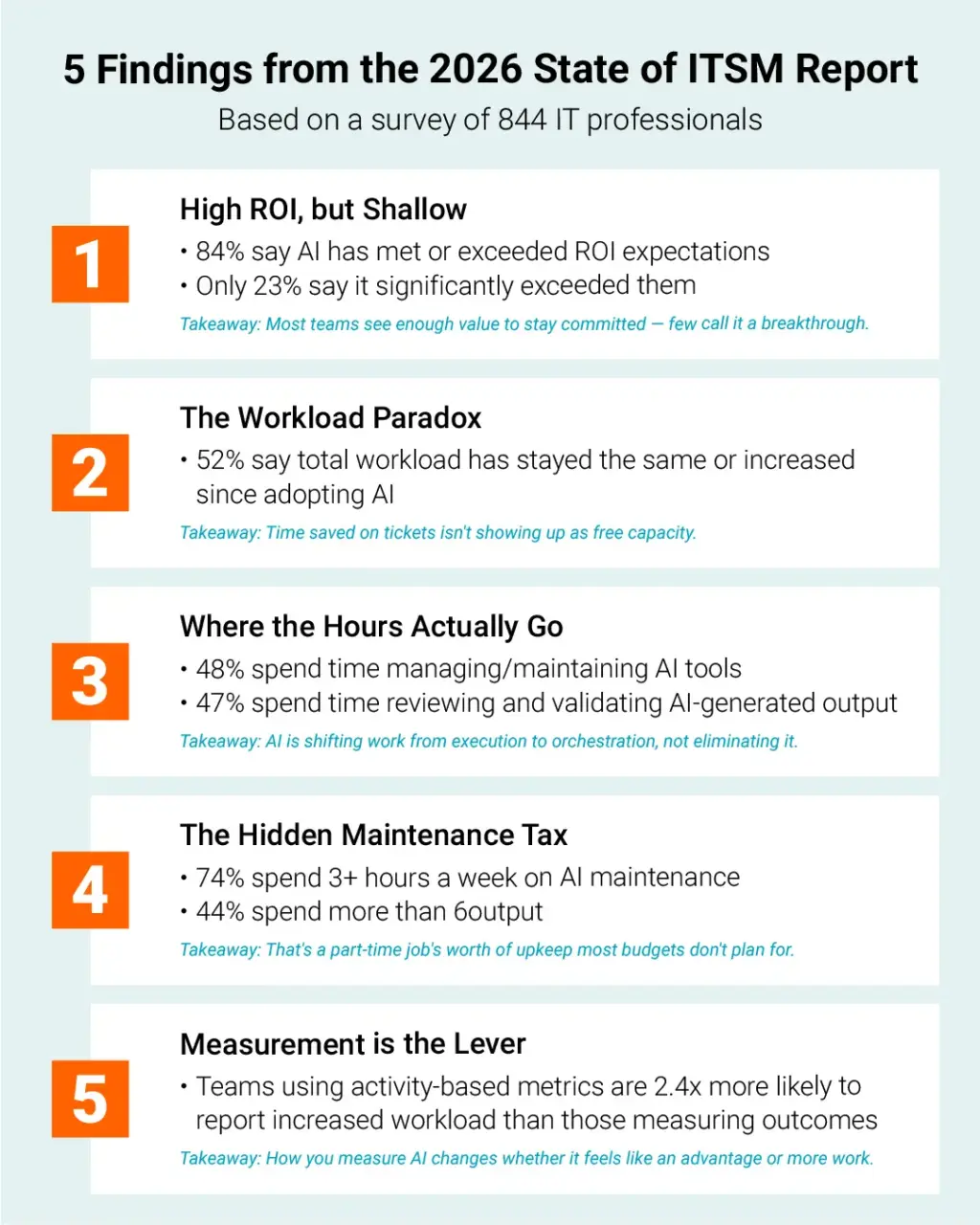
The report notes that while all ITSM tools require maintenance—such as updating automation rules or governing self-service portals—the operating models for AI are still in their infancy. Many organizations have not yet budgeted the time or the personnel required for this ongoing upkeep. To achieve sustainable value, the report suggests that AI maintenance must be a formal part of the IT roadmap. Assigning accountable owners to model tuning and data quality is essential to prevent the technology from becoming an operational drag rather than an accelerant.
Shifting Focus from Activity Metrics to Outcome Metrics
The way an organization measures its success with AI has a profound impact on how the technology is perceived by the staff. The survey found a striking correlation between measurement styles and perceived workload: organizations that use an activity-oriented approach are 2.4 times more likely to report an increased workload compared to those using an outcome-oriented approach.
Activity-oriented metrics focus on volume—counting how many summaries the AI generated, how many tickets it categorized, or how many times it was triggered. While these metrics show that the tool is being used, they do not necessarily prove it is providing value. A service desk could process more tickets than ever before, but if the end-users are still unhappy or the cost per ticket is rising, the AI implementation cannot be considered a success.
In contrast, outcome-oriented measures focus on the actual impact on the business. The report points to metrics such as employee productivity, the number of incidents prevented through proactive AI detection, and the Digital Employee Experience (DEX) score. By shifting the focus to these results, leadership can better understand whether AI is actually solving problems or just moving them around. For example, if AI is used for ticket triaging, the relevant metrics should be the rate of ticket reassignment and the total time to resolution, rather than just the number of tickets triaged.
Integrating AI into the Broader ITSM Discipline
The SolarWinds 2026 State of ITSM Report signals a shift toward a more mature, disciplined era of AI integration. The initial excitement of "AI for the sake of AI" is being replaced by a pragmatic understanding of the technology’s role within the broader IT ecosystem. The findings suggest that the question for IT leaders is no longer whether AI belongs in the service desk, but whether the service desk has the necessary infrastructure to support it.
This journey toward maturity has been documented over the last several years. The 2024 report established that a foundation of automation, self-service, and robust knowledge management was necessary for efficiency. The 2025 report demonstrated that generative AI could build upon that foundation to significantly reduce incident resolution times. Now, the 2026 data makes the next step clear: long-term success requires managing the work around the AI as intentionally as the AI itself.
As the industry moves forward, the most successful service desks will be those that view AI as a component of their overall operating model, requiring the same level of governance, maintenance, and strategic alignment as any other core service. By acknowledging the "maintenance tax," embracing human oversight, and focusing on meaningful business outcomes, IT organizations can finally begin to realize the full potential of the AI-powered service desk.
 Helpdesk & IT Service Management (ITSM)
The Hybrid Productivity Paradox: Why Meeting Room Glitches are Eroding the Gains of the AI Era
In the three years since the global shift toward flexible working models,...
 Helpdesk & IT Service Management (ITSM)
US Government Intervenes to Limit UK Access to Latest OpenAI and Anthropic Models
The United Kingdom’s ambitions to remain at the vanguard of global artificial...
 Helpdesk & IT Service Management (ITSM)
Enterprises Grapple with Unintended Consequences as Half of Organizations Report Unauthorized AI Agent Actions
The rapid integration of agentic artificial intelligence into the modern enterprise has...







