
The promise of artificial intelligence within the IT Service Management (ITSM) sector has long been framed as a revolutionary shift toward effortless efficiency. For years, industry narratives have suggested that AI would act as a release valve for overextended service desks, automating away the mundane and allowing human agents to focus on high-level strategy. However, the reality of this transition is proving to be far more complex. According to the recently released SolarWinds 2026 State of ITSM Report, while AI is undeniably accelerating certain aspects of service desk operations, it is simultaneously introducing a new layer of complexity that can actually increase the total workload for IT professionals.
The report, which draws on a comprehensive survey of 844 IT professionals across North America, Europe, the Middle East, Africa, and the Asia-Pacific region, offers a nuanced view of the current state of the industry. The central takeaway is clear: AI is not a "set it and forget it" solution. Its value is inextricably linked to how it is applied, maintained, and measured. While the technology can process data at speeds no human could match, it often exposes underlying weaknesses in data quality and reveals a lack of clarity in traditional performance metrics. For IT leaders, the challenge for the coming year is no longer just about adopting AI, but about managing the operational "tax" that comes with it.
Most Teams See ROI, But Few Experience a Strategic Breakthrough
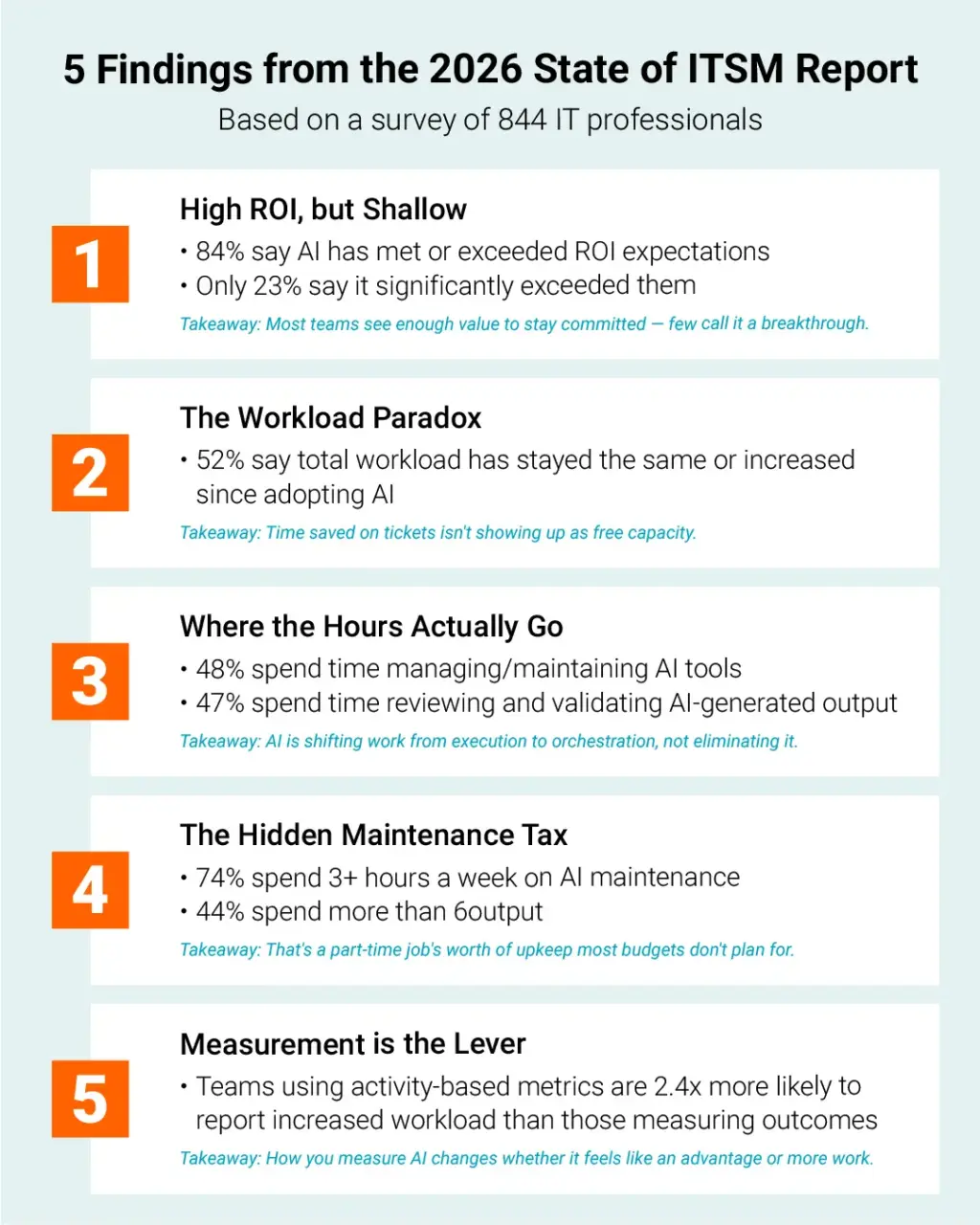
One of the most encouraging findings from the SolarWinds report is the high rate of return on investment (ROI) reported by IT departments. A significant 84% of respondents stated that AI has either met or exceeded their ROI expectations. This figure is particularly striking given the intense scrutiny and sometimes inflated expectations that have surrounded generative AI over the last several years. It suggests that IT teams have successfully moved past the experimentation phase and are finding practical, bottom-line benefits in deploying these tools.
However, a deeper look at the data reveals a gap between functional success and transformative change. Only 23% of those surveyed said that AI has significantly exceeded their expectations. This discrepancy indicates that while AI is performing well in specific, isolated tasks, it has not yet triggered a fundamental breakthrough in how service delivery is structured.
Currently, the gains are concentrated in practical, tactical areas. Respondents reported that AI is highly effective at drafting initial responses to user inquiries, summarizing long and complex ticket histories, and automatically categorizing incoming requests. It is also being used to surface relevant knowledge base articles for both agents and end-users. These are undoubtedly worthwhile improvements that reduce the friction of daily operations. Yet, the report suggests that these incremental wins do not automatically alter the fundamental economics of the service desk. To move from simple ROI to a true breakthrough, the report argues that organizations must stop treating AI adoption as a headline metric and start focusing on specific service outcomes, such as reduced escalation rates, improved SLA compliance, and higher overall employee satisfaction.
The Paradox of Time Savings and Rising Workloads
Perhaps the most surprising finding in the 2026 report is the contradiction between the time saved by AI and the total volume of work handled by IT staff. The survey data provides a clear breakdown of where AI is clawing back time for service desk agents. On average, respondents report that AI saves them 3.3 hours per week in detecting and flagging potential issues before they escalate. Another 3.0 hours are saved in responding to end-user requests, while the triaging and categorization of tickets accounts for 2.9 hours of savings.
The efficiency gains continue across the lifecycle of an incident. IT professionals report saving 2.9 hours a week on creating or uploading knowledge base articles, 2.8 hours on documenting and summarizing incidents, and 2.7 hours on the actual resolution and remediation of technical problems. When these figures are viewed in the context of earlier SolarWinds research, a pattern of steady improvement emerges. The 2024 State of ITSM Report noted that automation and self-service portals could reduce resolution times by several hours, and the 2025 analysis showed that GenAI-enabled features helped drop average incident resolution times from 27.42 hours to 22.55 hours—a nearly 18% improvement.
 Helpdesk & IT Service Management (ITSM)
The Shift Toward Pre-emptive Cybersecurity: Why "Detect and Respond" is No Longer Enough in the Age of AI
The cybersecurity landscape has long been characterized by a perpetual game of...
 Helpdesk & IT Service Management (ITSM)
SolarWinds Announces Comprehensive September Webinar Series Addressing AI Integration, IT Observability, and Cloud Database Migration Challenges
The modern data landscape is currently undergoing a period of unprecedented transformation,...
 Helpdesk & IT Service Management (ITSM)
Decoding SAP HANA Architecture: How In-Memory Processing Redefines Enterprise Data Management
In the rapidly evolving landscape of enterprise technology, the ability to process...







