
The Governance Gap: A Looming Crisis
The urgency of this issue is backed by recent industry data. A 2026 AI-ready governance report from OneTrust revealed a striking disparity in corporate readiness: while 87% of organizations are actively encouraging the use of AI agents to increase efficiency, only 47% have established clear governance and controls. This "act first, regulate later" mentality is creating significant risks.
The consequences of this gap are not merely theoretical. Gartner recently predicted that 40% of enterprises will eventually demote or decommission their autonomous AI agents by 2027. This isn’t because the AI failed to perform, but because governance gaps were only detected after high-profile incidents took place. In many cases, the lack of an audit trail or a "kill switch" for autonomous actions makes the risk of using AI agents higher than the potential productivity gains.
Patching these gaps is expected to become a massive business sector within IT management. As organizations realize they cannot simply "turn off" AI without falling behind, they will instead look for platforms that provide the necessary guardrails.
Who Watches the Watchmen?
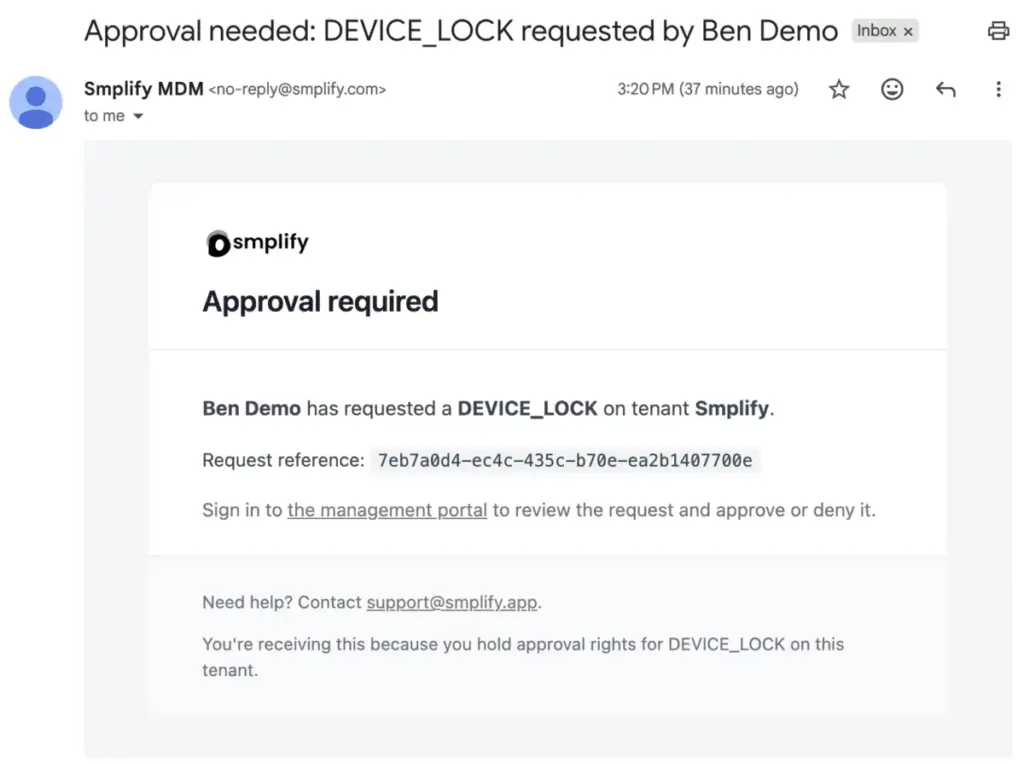
The fundamental question facing modern IT is one of accountability: Once agents can submit changes at lightning speed, who is responsible for approving them?
"The risk is an agent with the right key can wipe thousands of laptops before anyone notices," Greiner warned. This is not just a concern for startups like Smplify; it is a topic dominating the strategy of industry giants like Jamf and Fleet.
Jamf, a leader in the Apple management space, has already begun addressing this through its own AI Governance suite. Jamf CEO Beth Tschida has previously noted that blocking AI is a futile exercise. "AI is happening whether organizations know it or not," she told Computerworld earlier this year. "It’s far better to build visibility and governance around it."
While Jamf focuses on tool discovery and policy enforcement, Smplify’s approach is to embed these decisions directly into the management workflow itself. Greiner refers to this as the "last-mile control plane"—a final, automated checkpoint that sits between the AI’s decision and the actual execution on the device.
Assessing the Risks of Unmanaged AI
Beyond the immediate threat of a fleet-wide "wipe," unmanaged AI introduces more subtle risks, such as a lack of accountability and the potential for "hallucinations" in code. If an AI agent interprets a complex IT problem incorrectly and pushes a destructive script across the network, identifying the root cause after the fact can be an expensive and time-consuming nightmare.
Mike McNeil, CEO of Fleet, points out that the severity of the risk is tied to two factors: privilege and recovery. "I’d frame risk by two things: how much privilege the code runs with and how hard recovery is," McNeil said. When scripts are allowed to run at the "root" level, they gain full control over the machine. If an AI-driven script at the root level makes a fundamental change to the operating system, a simple "rollback" may not be possible.
 Small Business IT & Cloud Computing
FTC Launches Sweeping Investigation Into AI Industry Over Potential Consumer Deception and Security Risks
The Federal Trade Commission (FTC) has issued a stern warning to the...
 Small Business IT & Cloud Computing
Google Bolsters Android Security with New ‘Enhanced Protection’ for Messaging Scams
In the modern digital landscape, the most sophisticated firewall or biometric lock...
 Small Business IT & Cloud Computing
Apple Redefines the Professional Laptop with Touch-Integrated MacBook Pro and PROLED XDR Display
In a move that signals one of the most significant architectural and...







