The landscape of Apple device management is undergoing a profound transformation, driven by two converging forces: the steady rise of Mac adoption within the enterprise and the sudden, explosive integration of artificial intelligence into IT workflows. As the market for management solutions expands to accommodate a more diverse range of organizational needs, a new category of challenges is emerging. It is no longer enough to simply deploy software and manage security profiles; IT departments must now grapple with the "governance gap" created by autonomous AI agents capable of making changes at machine speed.
Smplify, a new entrant in the device management space, is positioning itself at the center of this transition. Having recently announced a $1 million pre-seed funding round, the company is introducing a "headless" management tool designed specifically for an era where automation is moving from suggestion to action. To understand how this shift is reshaping the industry, we spoke with Ben Greiner, co-founder and COO of Smplify, about the company’s vision for the future of IT administration and the critical need for a "last-mile control plane."
The Evolution of Device Management
For years, Apple device management followed a predictable trajectory. Solutions were built around the administrator—a human being who monitored dashboards, pushed updates, and manually intervened when things went wrong. However, as the enterprise market for Apple devices has grown—with Mac now capturing approximately 11% of the U.S. enterprise market share—the complexity of managing these fleets has outpaced traditional human-centric models.
Smplify’s approach reflects this shift. The company was co-founded by Greiner and Preetham Gurram, a figure well-known in device management circles for his extensive background at MobileIron, SOTI, Automox, Addigy, and Scalefusion. Crucially, Gurram also spent time at Apple, where he contributed to the development of the company’s core Mobile Device Management (MDM) platforms and the refinement of zero-touch enrollment at scale.
This pedigree has informed Smplify’s unique architecture. Unlike traditional MDM solutions that prioritize a proprietary user interface, Smplify is "headless." Everything the platform does is accessible through an API and a Command Line Interface (CLI). This allows IT teams to build management capabilities directly into the tools they already use, rather than forcing them to toggle between disparate dashboards. It is a philosophy built for a world where IT is increasingly treated as code.
The Rise of the Autonomous Agent
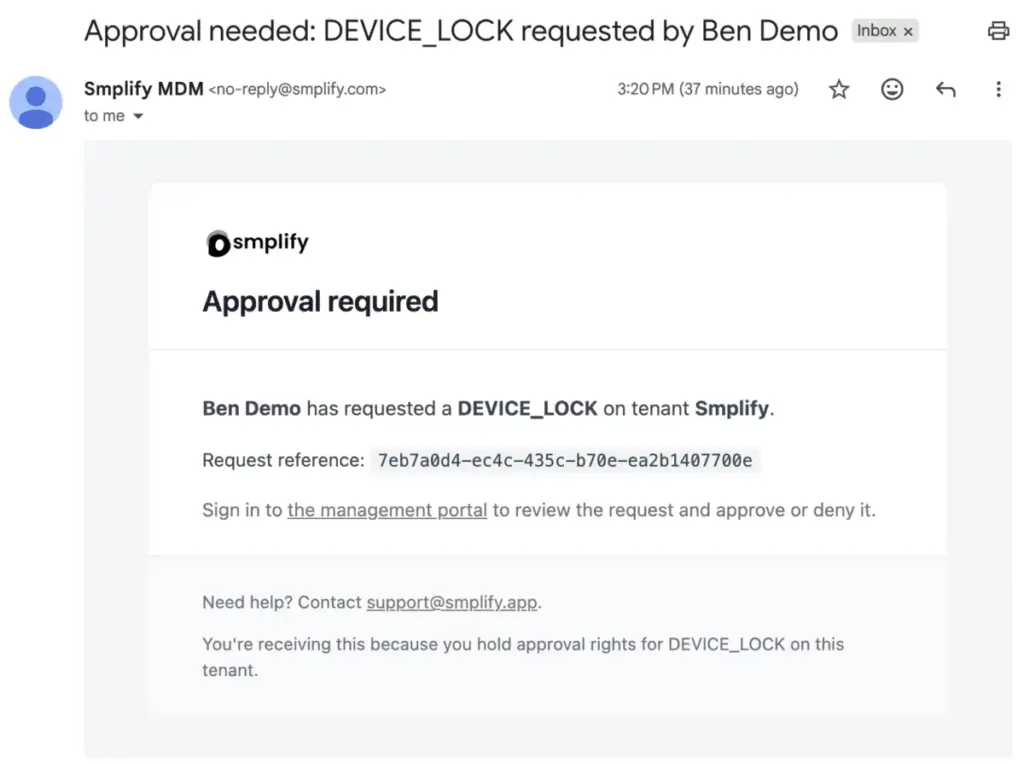
The core problem Smplify seeks to solve is the inherent speed of AI. "Device management still assumes a person is watching," Greiner noted during our discussion. "Admins already automate with scripts and pipelines, and now AI agents are showing up that can act on a fleet at machine speed."
In traditional IT environments, automation was "imperative"—the admin wrote a script, and the system executed it. Today, we are moving toward "agentic IT," where AI agents analyze data, identify problems, and determine the best course of action independently. The challenge is that these agents are beginning to take those actions directly, rather than merely suggesting them to a human supervisor.
This creates a dangerous oversight vacuum. If an AI agent detects a security vulnerability on five thousand laptops, it can theoretically push a configuration change or a script to fix that vulnerability in seconds. But what happens if the AI misinterprets the situation? What if the "fix" is actually a destructive action that renders the devices unusable?
"Enterprises that win won’t be the ones with the smartest agents," Greiner explained. "They’ll be the ones that can say exactly what each agent is allowed to do and prove what it did."
 Small Business IT & Cloud Computing
AI-Driven Cyberattacks Target Online Retailers at a Cost of Just $25 Per Breach
The landscape of cybersecurity is undergoing a fundamental shift as the barrier...
 Small Business IT & Cloud Computing
Security Researchers Detect Residential Proxy Activity Within White House Network Environment
In an era where the digital perimeter of government institutions is under...
 Small Business IT & Cloud Computing
Google Bolsters Android Security with New ‘Enhanced Protection’ for Messaging Scams
In the modern digital landscape, the most sophisticated firewall or biometric lock...