

The world of high-performance computing (HPC) has long been characterized by a relentless, rhythmic progression. For decades, the industry has operated on a predictable heartbeat, synchronized with the biannual release of the Top500 supercomputer rankings. Every June, the International Supercomputing (ISC) event in Europe serves as the stage for the first update, followed by the Super Computing (SC) conference in the United States every November. These lists have historically served as a scoreboard for the global arms race in compute power, reflecting the steady installation of new machines as national laboratories, research centers, and private enterprises navigate their respective budget and upgrade cycles.
However, the release of the November 2026 Top500 list has sent a ripple of concern through the community. Rather than the typical influx of cutting-edge hardware, the latest rankings show a dramatic stall in new installations. To be precise, the number of new machines that have undergone the rigorous High Performance LINPACK (HPL) benchmark test—the industry standard for gauging relative performance—has plummeted. The volume of new entries on the list is approximately half of what is normally expected during a typical SC cycle. This lack of "churn" represents a significant departure from historical trends and raises pressing questions about the current state and future direction of the HPC market.
A Market in Transition
The stagnation observed in the November 2026 list is not merely a statistical anomaly; it may signal a fundamental shift in how organizations approach massive scale computing. For years, the standard operating procedure for an HPC center involved acquiring a massive new system every four or five years, a process that required building or retrofitting specialized datacenters to handle systems that are becoming increasingly expensive and generating unprecedented levels of heat.
There is a growing sentiment among industry observers that priorities are shifting. Rather than committing to the massive capital expenditure and logistical headache of on-premise hardware, many organizations appear to be opting for the flexibility of renting capacity on the cloud. This transition allows researchers to access high-end compute engines without the long-term burden of facility management. However, while cloud adoption is a factor, it is likely not the only reason for the current lull.
Industry analysts suggest that the "stall" might be more of a tactical pause than a permanent decline. We are currently sitting in a peculiar window regarding hardware roadmaps. Many organizations may be holding back their benchmark submissions because they are in the middle of installing "iron" that isn’t quite ready for testing, or they are waiting for the imminent arrival of next-generation silicon scheduled for late 2026 or early 2027.
The Roadmap Bottleneck
The timing of product cycles from the major chipmakers is a primary suspect in the current installation vacuum. Nvidia is currently in the process of rolling out its highly anticipated "Rubin" GR200 GPUs and "Vera" CV100 CPUs. Simultaneously, AMD is preparing to launch its "Altair" MI400 GPUs and its "Venice" Epyc 9006 processors. For a Tier-1 supercomputing center, the prospect of installing a massive system today that might be overshadowed by these newer architectures in just six months is a difficult pill to swallow.
The situation is even more complex for those aligned with Intel’s ecosystem. While Intel currently lacks a top-tier HPC-focused GPU—focusing instead on inference-heavy workloads—its CPU roadmap has faced significant hurdles. The "Diamond Rapids" Xeon 7 CPU, featuring a massive 256 P-cores, is a highly anticipated piece of silicon for the HPC sector. However, rumors suggest this chip may be nearly a year late to market, with a potential debut in the second half of 2027.
Intel recently confirmed that the Diamond Rapids variant featuring 16 memory channels—a crucial feature for memory-bandwidth-hungry HPC applications—is currently sampling. However, the mainstream version with only eight memory channels has reportedly been cancelled. This leaves the existing "Granite Rapids" Xeon 6+ to bridge the gap until a future Xeon 8 refresh. For many customers, this uncertainty in the roadmap is a valid reason to delay major system deployments.
Furthermore, the industry is facing a bottleneck in networking. High-speed interconnects are the glue that holds supercomputers together, and the market is currently caught between generations. While 800 Gb/sec ports are the current standard, the world is waiting for the transition to 1.6 Tb/sec ports. Without the next leap in networking performance, the massive compute power of new GPUs cannot be fully realized, leading many architects to wait for the next generation of switches and adapters before committing to a fresh build.
Insights from the Top500 Caretakers
The organizers of the Top500 list—Erich Strohmaier of the Lawrence Berkeley National Lab, Jack Dongarra of the University of Tennessee and Oak Ridge National Lab, and Horst Simon of the ADIA Lab—have noted that this stall does not mean global performance has stopped growing. In their analysis, they suggest that a larger share of performance improvement is currently coming from incremental additions and upgrades to existing systems rather than the wholesale replacement of leading installations.
This "upgrading from within" strategy allows centers to extend the life of their existing infrastructure while still gaining performance. However, it does not result in a "new" entry on the Top500 list, which contributes to the perception of a market slowdown. The caretakers expect that this drop will eventually be balanced out. Forecasts suggest that the June 2027, November 2027, and June 2028 rankings will likely see an influx of roughly two dozen extra machines to compensate for the current deficit.
The Reality of the Rankings
It is important to remember that the Top500 is not an exhaustive census of every HPC system on the planet. It is a voluntary list composed of organizations that formally submit HPL benchmark results, often for the sake of prestige and "bragging rights." Many organizations, particularly those in the private sector or those operating classified national security systems, possess monstrous machines but never submit results.
The list is also skewed by the inclusion of clusters that do not perform traditional Modeling and Simulation (ModSim) as their primary function. Many cloud providers, telecommunications companies, and software firms submit results for large clusters used for AI training or general infrastructure-as-a-service (IaaS). This trend has led to a situation where the middle and end of the list are populated by machines that are not "true" HPC systems in the traditional sense.
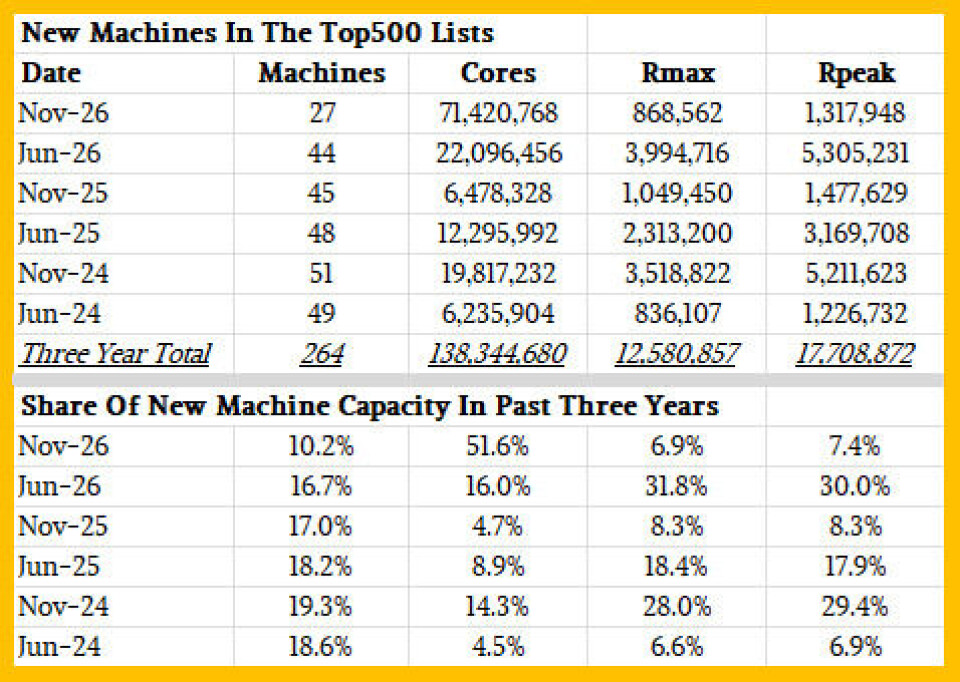
In the November 2026 list, only 27 new machines were added, the lowest level of churn in the 68-list history of the project dating back to 1993. This lack of movement means that older, less efficient machines are staying on the list longer than they perhaps should. Some analysts argue that a rolling list featuring only machines installed within the last four or five years would be a more accurate reflection of modern HPC trends, as it would prevent decades-old systems from occupying slots that could be held by newer, more relevant architectures.
Highlighting the New Arrivals
Despite the overall stall, the 27 new machines that did make the list offer some fascinating insights into current architectural choices. Interestingly, while the number of machines is small, the core counts are massive. Across these 27 new entries, there are a total of 71.4 million cores (a combined figure of CPU cores and GPU streaming multiprocessors).
A significant portion of this core count comes from a single, unusual entry: the eSurfing Cloud in Shanghai, operated by China Telecom. This IaaS offering is built on China’s 56-core Hygon C86 X86-based CPUs—which are derived from AMD’s older Zen1 architecture—and MetaX C588 GPUs. While this "machine" boasts a staggering 66.63 million cores, its actual performance is relatively modest. It delivered only 18.36 petaflops sustained on the HPL benchmark. To put this in perspective, this single cloud cluster represents over 93 percent of the total cores added to the November list but contributes less than 3 percent of the aggregate peak performance of the new machines.
At the top of the newcomer list is the "Hangang" system at the KISTI supercomputing center in South Korea. Built by Hewlett Packard Enterprise (HPE) using Cray EX254n server nodes, this system is powered by Nvidia Grace-Hopper superchips and utilizes HPE’s Slingshot 400 interconnect. With a peak performance of 588.3 petaflops, Hangang is the crown jewel of the new entries and represents the ongoing dominance of the Grace-Hopper and Grace-Blackwell architectures, which accounted for over half of the new capacity on the list.
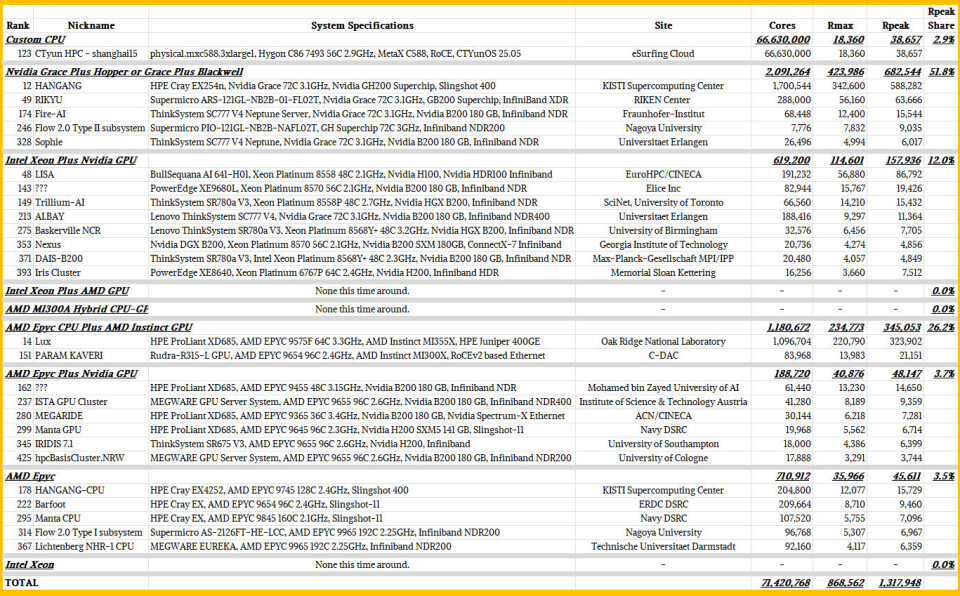
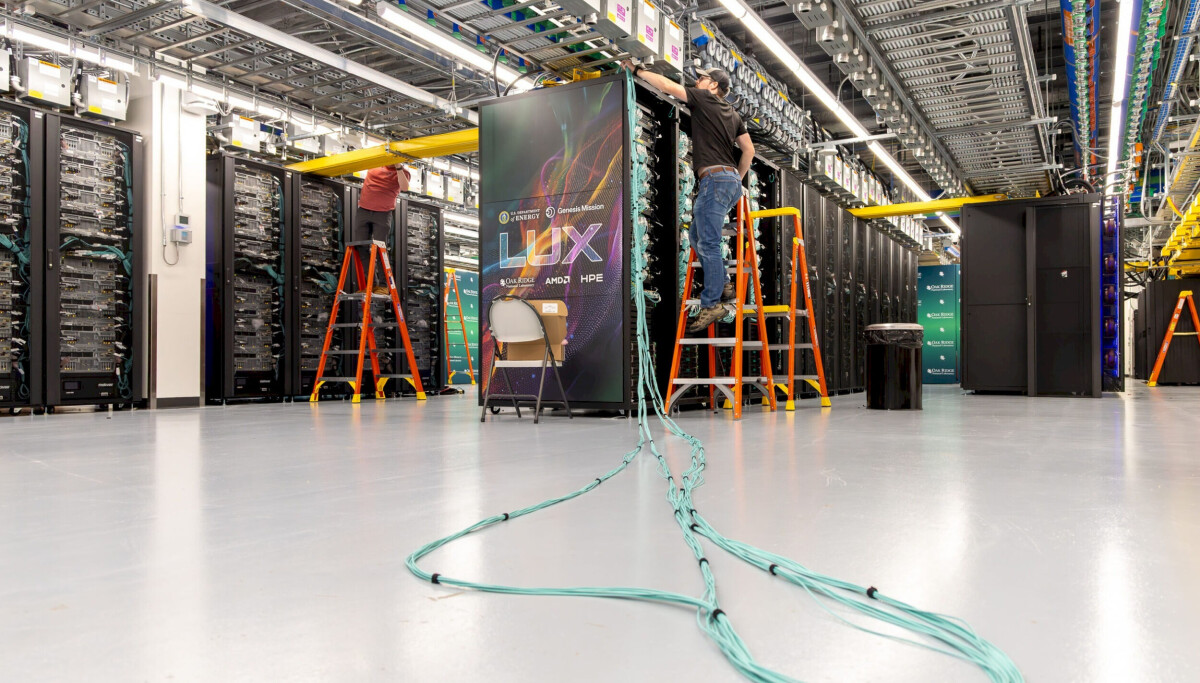
The second most powerful new entry is the "Lux" supercomputer at Oak Ridge National Laboratory (ORNL). Also built by HPE using ProLiant XD685 nodes, Lux takes a different architectural path, utilizing AMD "Turin" Epyc 9575F CPUs paired with "Antares" MI355X GPU accelerators. Rated at 323.9 petaflops, Lux serves as a significant win for AMD in the high-end research space.
The Era of Acceleration
The broader Top500 list continues to be defined by the rise of accelerated computing. Out of the 500 systems, 290 now utilize GPUs or other accelerators to boost their floating-point performance. While these accelerated systems make up 58 percent of the machines on the list, they account for a staggering 79.9 percent of the total peak exaflops.
In terms of raw horsepower, the accelerated machines provide an aggregate of 22.64 exaflops of FP64 performance, dwarfing the 5.7 exaflops provided by CPU-only systems. Nvidia remains the dominant force in terms of the number of machines, but AMD has carved out a significant niche in the very largest systems. Machines using AMD GPUs now account for 37.7 percent of the total FP64 floating-point operations on the list, compared to 52.9 percent for Nvidia-based machines.
A key battleground to watch over the next 18 months will be the competition between AMD’s MI430X and Nvidia’s future offerings. The MI430X is aimed explicitly at the HPC market with high native FP64 performance. This stands in contrast to Nvidia’s strategy of using emulated, software-based FP64 computing on top of matrix math engines. For traditional scientific researchers who require true FP64 precision for complex simulations, AMD’s architectural choices may prove increasingly attractive.
As the industry looks toward the June 2027 rankings, the question remains whether the current stall is a temporary breather or a sign of a more profound shift in the economics of supercomputing. With massive new chips from Nvidia, AMD, and Intel on the horizon, and the transition to 1.6 Tb/sec networking looming, the next few years will determine if the traditional on-premise supercomputer remains the king of the mountain, or if the cloud will finally claim the summit.
 Enterprise Tech & Infrastructure
Understanding the Architecture of Modern Storage: Why the ‘Flash vs. SSD’ Debate Misses the Point
In the rapidly evolving landscape of enterprise data management, the terminology used...
 Enterprise Tech & Infrastructure
Micron Technology and the Global Memory Boom: HBM’s Ascent to the Most Profitable Product in IT History
The history of the commercial information technology sector spans more than six...
 Enterprise Tech & Infrastructure
The Resurgence of the CPU in the Era of Agentic AI: Why the Industry is Rethinking the Rack
A peculiar transformation is taking place within the architecture of modern data...







