

Furthermore, the industry is facing a bottleneck in networking. High-speed interconnects are the glue that holds supercomputers together, and the market is currently caught between generations. While 800 Gb/sec ports are the current standard, the world is waiting for the transition to 1.6 Tb/sec ports. Without the next leap in networking performance, the massive compute power of new GPUs cannot be fully realized, leading many architects to wait for the next generation of switches and adapters before committing to a fresh build.
Insights from the Top500 Caretakers
The organizers of the Top500 list—Erich Strohmaier of the Lawrence Berkeley National Lab, Jack Dongarra of the University of Tennessee and Oak Ridge National Lab, and Horst Simon of the ADIA Lab—have noted that this stall does not mean global performance has stopped growing. In their analysis, they suggest that a larger share of performance improvement is currently coming from incremental additions and upgrades to existing systems rather than the wholesale replacement of leading installations.
This "upgrading from within" strategy allows centers to extend the life of their existing infrastructure while still gaining performance. However, it does not result in a "new" entry on the Top500 list, which contributes to the perception of a market slowdown. The caretakers expect that this drop will eventually be balanced out. Forecasts suggest that the June 2027, November 2027, and June 2028 rankings will likely see an influx of roughly two dozen extra machines to compensate for the current deficit.
The Reality of the Rankings
It is important to remember that the Top500 is not an exhaustive census of every HPC system on the planet. It is a voluntary list composed of organizations that formally submit HPL benchmark results, often for the sake of prestige and "bragging rights." Many organizations, particularly those in the private sector or those operating classified national security systems, possess monstrous machines but never submit results.
The list is also skewed by the inclusion of clusters that do not perform traditional Modeling and Simulation (ModSim) as their primary function. Many cloud providers, telecommunications companies, and software firms submit results for large clusters used for AI training or general infrastructure-as-a-service (IaaS). This trend has led to a situation where the middle and end of the list are populated by machines that are not "true" HPC systems in the traditional sense.
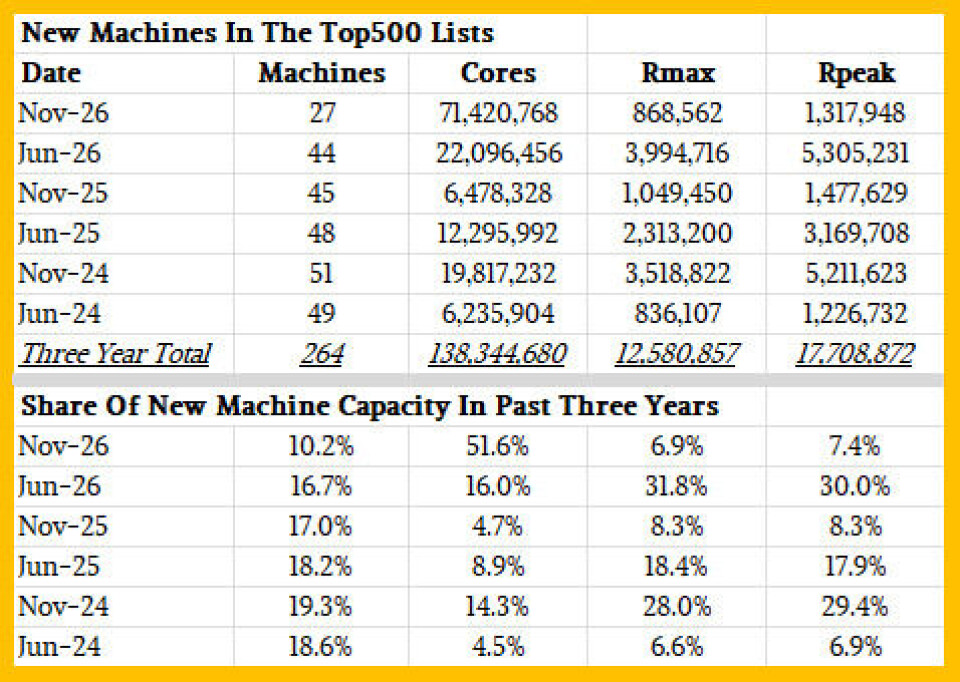
In the November 2026 list, only 27 new machines were added, the lowest level of churn in the 68-list history of the project dating back to 1993. This lack of movement means that older, less efficient machines are staying on the list longer than they perhaps should. Some analysts argue that a rolling list featuring only machines installed within the last four or five years would be a more accurate reflection of modern HPC trends, as it would prevent decades-old systems from occupying slots that could be held by newer, more relevant architectures.
Highlighting the New Arrivals
Despite the overall stall, the 27 new machines that did make the list offer some fascinating insights into current architectural choices. Interestingly, while the number of machines is small, the core counts are massive. Across these 27 new entries, there are a total of 71.4 million cores (a combined figure of CPU cores and GPU streaming multiprocessors).
 Enterprise Tech & Infrastructure
AMD’s Strategic Pivot: How the Venice Epyc CPUs Are Positioning for the Agentic AI Era
The debut of OpenAI’s ChatGPT in the closing months of 2022 did...
 Enterprise Tech & Infrastructure
Strategic Navigation of Amazon S3 Economics: Beyond the Per-Gigabyte Price Point
In the landscape of modern enterprise cloud architecture, Amazon S3 has long...
 Enterprise Tech & Infrastructure
Quantum Elements Bridges the Hardware-Software Gap in Quest for Fault-Tolerant Computing
The journey toward a practical, large-scale quantum computer has long been defined...







