A significant portion of this core count comes from a single, unusual entry: the eSurfing Cloud in Shanghai, operated by China Telecom. This IaaS offering is built on China’s 56-core Hygon C86 X86-based CPUs—which are derived from AMD’s older Zen1 architecture—and MetaX C588 GPUs. While this "machine" boasts a staggering 66.63 million cores, its actual performance is relatively modest. It delivered only 18.36 petaflops sustained on the HPL benchmark. To put this in perspective, this single cloud cluster represents over 93 percent of the total cores added to the November list but contributes less than 3 percent of the aggregate peak performance of the new machines.
At the top of the newcomer list is the "Hangang" system at the KISTI supercomputing center in South Korea. Built by Hewlett Packard Enterprise (HPE) using Cray EX254n server nodes, this system is powered by Nvidia Grace-Hopper superchips and utilizes HPE’s Slingshot 400 interconnect. With a peak performance of 588.3 petaflops, Hangang is the crown jewel of the new entries and represents the ongoing dominance of the Grace-Hopper and Grace-Blackwell architectures, which accounted for over half of the new capacity on the list.
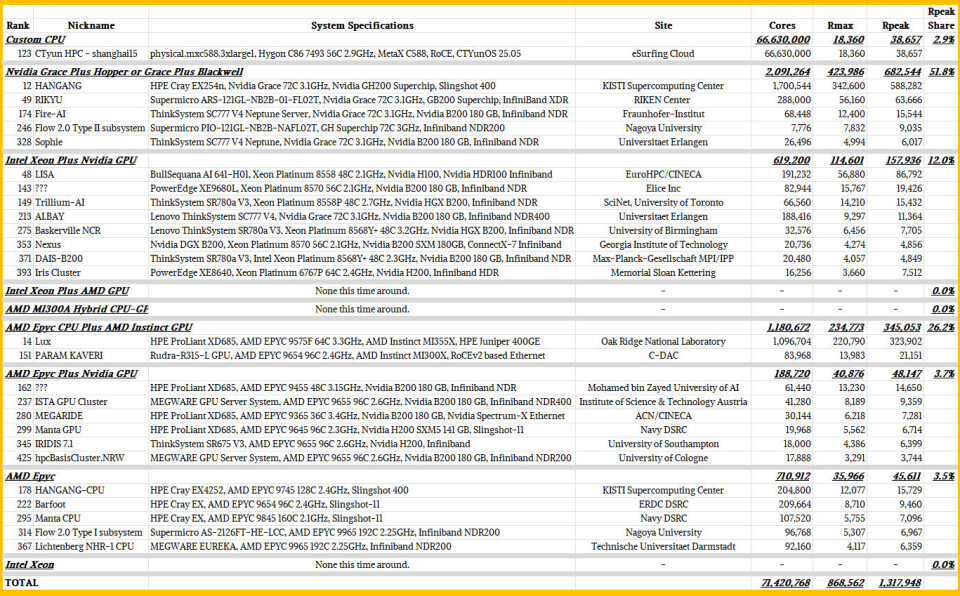
The second most powerful new entry is the "Lux" supercomputer at Oak Ridge National Laboratory (ORNL). Also built by HPE using ProLiant XD685 nodes, Lux takes a different architectural path, utilizing AMD "Turin" Epyc 9575F CPUs paired with "Antares" MI355X GPU accelerators. Rated at 323.9 petaflops, Lux serves as a significant win for AMD in the high-end research space.
The Era of Acceleration
The broader Top500 list continues to be defined by the rise of accelerated computing. Out of the 500 systems, 290 now utilize GPUs or other accelerators to boost their floating-point performance. While these accelerated systems make up 58 percent of the machines on the list, they account for a staggering 79.9 percent of the total peak exaflops.
In terms of raw horsepower, the accelerated machines provide an aggregate of 22.64 exaflops of FP64 performance, dwarfing the 5.7 exaflops provided by CPU-only systems. Nvidia remains the dominant force in terms of the number of machines, but AMD has carved out a significant niche in the very largest systems. Machines using AMD GPUs now account for 37.7 percent of the total FP64 floating-point operations on the list, compared to 52.9 percent for Nvidia-based machines.
A key battleground to watch over the next 18 months will be the competition between AMD’s MI430X and Nvidia’s future offerings. The MI430X is aimed explicitly at the HPC market with high native FP64 performance. This stands in contrast to Nvidia’s strategy of using emulated, software-based FP64 computing on top of matrix math engines. For traditional scientific researchers who require true FP64 precision for complex simulations, AMD’s architectural choices may prove increasingly attractive.
As the industry looks toward the June 2027 rankings, the question remains whether the current stall is a temporary breather or a sign of a more profound shift in the economics of supercomputing. With massive new chips from Nvidia, AMD, and Intel on the horizon, and the transition to 1.6 Tb/sec networking looming, the next few years will determine if the traditional on-premise supercomputer remains the king of the mountain, or if the cloud will finally claim the summit.
 Enterprise Tech & Infrastructure
Bridging the Gap: The Role of Fibre Channel over Ethernet in Modern Storage Networking
As data centers continue to evolve under the pressures of massive data...
 Enterprise Tech & Infrastructure
The Evolution of Enterprise Storage: Evaluating the Performance and Persistence of SSDs and HDDs
In the modern data center, the pursuit of speed has fundamentally reshaped...
 Enterprise Tech & Infrastructure
The Pillars of Data Infrastructure: A Comprehensive Evaluation of the Top Enterprise Hard Drives for 2023
In the modern landscape of digital infrastructure, the demand for robust, high-capacity...