
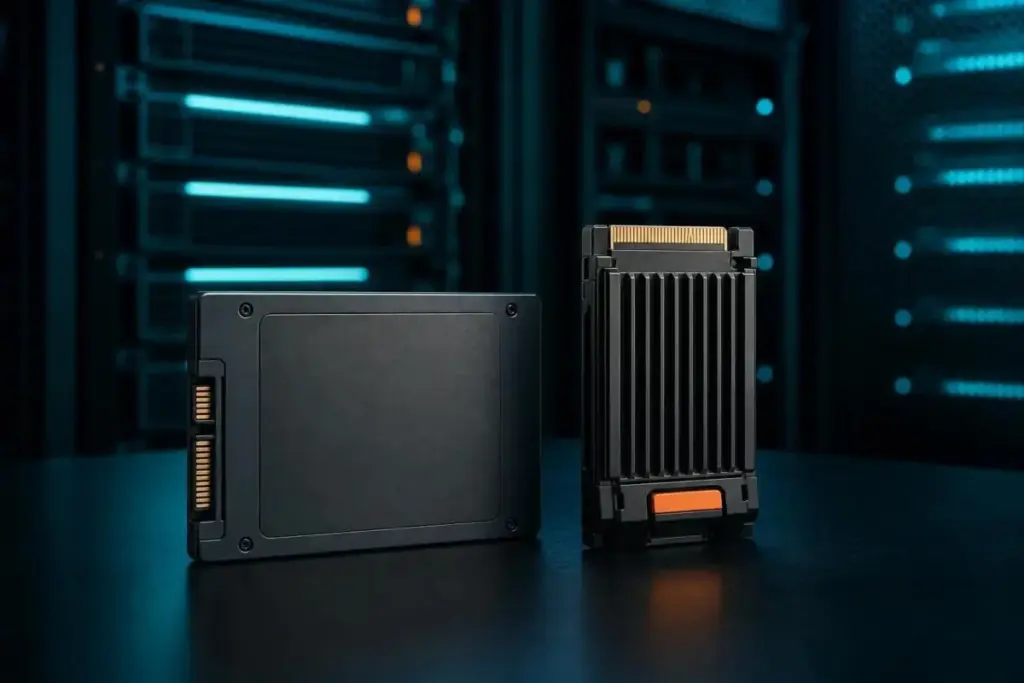
In the rapidly evolving landscape of enterprise data management, the terminology used to describe storage often becomes a source of confusion rather than clarity. For IT professionals and procurement officers, the terms "flash" and "SSD" are frequently used interchangeably, yet they represent two distinct levels of a single technology stack. To make informed purchasing decisions, one must look past the labels and understand that flash is the underlying memory technology—the electronic chips themselves—while a Solid State Drive (SSD) is the integrated device built around those chips.
As storage demands scale, the industry is moving away from the simplistic "flash versus SSD" comparison. Instead, the focus has shifted toward the specific architectural nuances that dictate performance, longevity, and cost. The real buying questions now center on NAND cell types, interface protocols, and endurance ratings. Understanding these components is essential for matching storage hardware to specific enterprise workloads, from high-frequency trading to long-term data archiving.
Flash Is the Chip, SSD Is the Product Built Around It
At its most fundamental level, flash storage refers to a specific type of non-volatile memory technology. According to industry insights from IBM, flash consists of electronic memory chips that store data without the need for moving parts. This stands in stark contrast to the mechanical nature of traditional Hard Disk Drives (HDDs). Because flash is non-volatile, it utilizes electrical charges stored on silicon to retain data even when the power is disconnected.
This inherent property of flash technology is why it is found in a vast array of devices beyond the data center. As Pure Storage notes, flash is the engine behind USB thumb drives, SD cards, smartphones, and digital cameras. However, none of these devices are considered SSDs. The distinction lies in the complexity of the implementation. An SSD is a sophisticated storage device designed to replace or augment HDDs in computing environments. It takes raw flash memory and adds a specialized controller, complex firmware, and a standardized interface.
The extra layer of intelligence provided by the controller and firmware is what separates an enterprise-grade SSD from a simple USB stick. While both use NAND flash to hold data, the SSD is engineered to handle the rigorous input/output (I/O) demands of a server or workstation, managing data placement and error correction in ways that raw flash chips cannot do on their own.
NAND vs. NOR and the Evolution of Cell Types
Flash technology is split into two primary families: NAND and NOR. The names refer to the type of logic gate used in the memory cells. IBM explains that NAND flash has become the dominant force in the storage market because it offers significantly higher storage density and faster write and erase speeds at a lower cost per bit. In contrast, NOR flash provides faster read speeds and random-access capabilities, but its lower density and higher cost have relegated it to specific roles, such as storing firmware or embedded code where execution-in-place is required.
Virtually every modern SSD is built on NAND technology. Within the world of NAND, the most critical variable for a buyer is the cell type, which determines how many bits of data are stored in each memory cell. This choice involves a direct trade-off between density, performance, and endurance.
 Enterprise Tech & Infrastructure
The Great Storage Divide: Navigating the Evolving Performance Landscape of SSDs and HDDs
In the modern enterprise data center, the choice between solid-state drives (SSDs)...
 Enterprise Tech & Infrastructure
Micron Technology and the Global Memory Boom: HBM’s Ascent to the Most Profitable Product in IT History
The history of the commercial information technology sector spans more than six...
 Enterprise Tech & Infrastructure
Upscale AI Unveils SkyHammer Architecture to Challenge Nvidia’s Scale-Up Networking Monopoly
In the history of the semiconductor industry, the desire for a "universal...







