
Single-Level Cell (SLC) NAND stores just one bit per cell. As noted by Computer Compatibility, SLC is the fastest and most durable option, capable of withstanding the highest number of program/erase cycles. However, it is also the most expensive and offers the lowest density, making it rare in consumer products. It is typically reserved for mission-critical enterprise or military-grade applications where reliability is paramount.
Triple-Level Cell (TLC), storing three bits per cell, currently represents the mainstream balance for the industry, providing a sweet spot between capacity and speed. Meanwhile, Quad-Level Cell (QLC) pushes density further by storing four bits per cell. While QLC significantly lowers the cost per gigabyte and enables high-capacity drives of 4TB and beyond, it does so at the expense of write speed and long-term endurance. This makes QLC an excellent choice for read-heavy workloads but less ideal for environments with constant, heavy write operations.
What an SSD Adds Beyond the NAND Chips
The transition from a collection of raw NAND chips to a functional SSD involves the addition of a "brain" in the form of a controller. This controller is responsible for managing the inherent limitations of flash memory. Unlike magnetic storage, NAND cells wear out over time as they are written to and erased. To combat this, the controller employs wear-leveling algorithms that ensure writes are spread evenly across all available cells, preventing any single block of memory from failing prematurely.
Another critical function is garbage collection. Because NAND cannot overwrite existing data without first erasing an entire block of cells, the controller must constantly move valid data to new locations and clear out "stale" blocks to keep the drive performing efficiently. This background maintenance is invisible to the user but essential for the drive’s operation.
To support these background tasks, manufacturers utilize over-provisioning. This involves reserving a portion of the drive’s total NAND capacity—often between 7% and 28%—that is not accessible to the user. SK Hynix notes that this hidden capacity provides the controller with the "breathing room" needed to perform wear-leveling and garbage collection without impacting the drive’s advertised performance. The exact amount of over-provisioning often distinguishes a client-grade drive from an enterprise-grade model, with the latter featuring more reserved space to handle sustained, heavy workloads.
Performance is further enhanced through the use of pseudo-SLC write caches. Many TLC and QLC drives operate a small portion of their memory in a single-bit mode to act as a high-speed buffer. While this allows for extremely fast initial write speeds, Computer Compatibility points out that once this cache is exhausted during a long transfer, write speeds can drop significantly as the drive begins writing directly to the slower native NAND.
Interface, Form Factor, and the Reality of Endurance
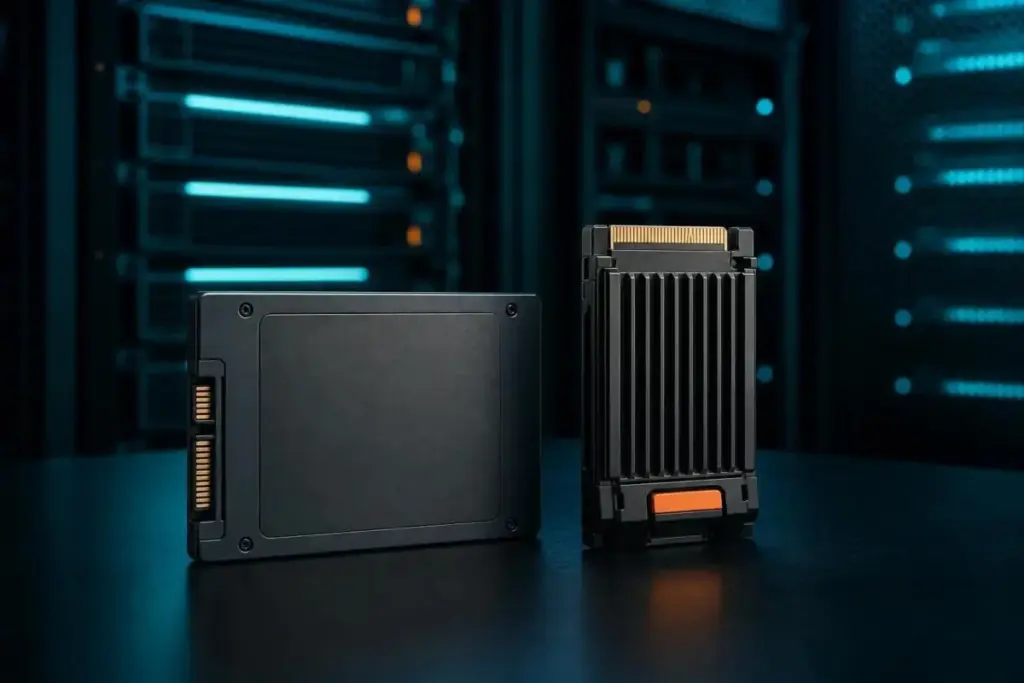
The physical and logical connection between the SSD and the rest of the system is the next major consideration. Legacy SATA SSDs are limited by the 6 Gb/s SATA bus, which caps sequential throughput at approximately 550 MB/s. To unlock the true potential of flash, the industry moved to NVMe (Non-Volatile Memory express). NVMe allows the drive to communicate directly with the CPU over PCIe lanes, bypassing the bottlenecks of older protocols. Modern NVMe Gen 4 drives can achieve speeds between 4,500 and 7,000 MB/s, a massive leap over SATA.
 Enterprise Tech & Infrastructure
Micron Technology and the Global Memory Boom: HBM’s Ascent to the Most Profitable Product in IT History
The history of the commercial information technology sector spans more than six...
 Enterprise Tech & Infrastructure
Navigating the Shift to Software-Defined Storage: Expert Strategies for Enterprise Success
The modern enterprise data center is undergoing a fundamental transformation, driven by...
 Enterprise Tech & Infrastructure
Securing the Data Core: Evaluating the Security Architectures of DAS and NAS in the Enterprise
In the modern enterprise landscape, data is frequently described as the new...






