

As IT environments become increasingly complex and distributed, the demand for more agile and integrated service management tools has never been higher. In a significant move to address these evolving needs, SolarWinds has announced a suite of major updates to its Service Desk platform. The September 15 release focuses on three primary pillars: increasing administrative flexibility through refined process integrations, deepening collaboration through a new Microsoft Teams integration, and enhancing the granularity of asset management and user interface customization.
These updates arrive at a time when IT Service Management (ITSM) is shifting away from rigid, siloed workflows toward a more interconnected ecosystem. By providing administrators with more control over how data flows between applications and how users interact with their daily task queues, SolarWinds is positioning its Service Desk as a more adaptable hub for modern enterprise operations.
Choose the Right Foundation for Each Process Integration
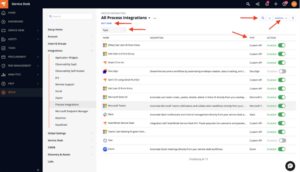
One of the most significant changes in this release is the overhaul of the Process Integrations framework. Now available under General Availability (GA), this update is designed to provide administrators with a more sophisticated toolkit for managing how Service Desk interacts with external third-party applications.

In previous iterations, managing multiple integrations could often lead to administrative bottlenecks. To solve this, SolarWinds has introduced a completely updated index page for Process Integrations. This new interface is built for scale, featuring robust search functionality, advanced filtering, and pagination. Recognizing that different IT teams have different visual preferences, the platform now supports column resizing and reordering, allowing admins to prioritize the most relevant information at a glance. Furthermore, the introduction of mass actions significantly reduces the manual effort required to manage large sets of integrations simultaneously.
Beyond the interface, the core logic of integration creation has been redesigned. The new workflow begins with a "Type" selection step, which serves as the foundation for the integration. This choice allows teams to bifurcate their approach based on the complexity of the task at hand. For highly specialized requirements, the "Custom API" type remains available, offering full control over HTTP methods, headers, and payloads. This is essential for teams working with proprietary internal tools or legacy systems that require precise configurations.
Alternatively, for common enterprise applications, a new application-specific type offers a guided, action-based setup. This "low-code" approach simplifies the connection process, reducing the likelihood of configuration errors and accelerating the time-to-value for new automations. To ensure a smooth transition, SolarWinds has confirmed that any existing stateless Process Integrations will be automatically assigned to the Custom API type, preserving current functionality while opening the door to future enhancements.
Bring Microsoft Teams Actions Directly Into Your Workflows
As hybrid work remains the standard for many organizations, the line between communication tools and service management platforms continues to blur. Addressing this trend, SolarWinds has introduced a built-in Microsoft Teams Process Integration, currently available for Advanced and Premier plan customers under the "Labs" designation.
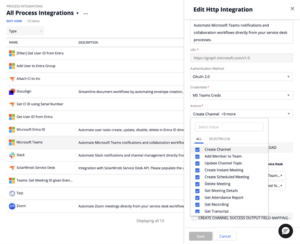
The Labs status indicates that while the feature is functional and ready for deployment, it is in an early-access phase where user feedback will directly influence its final iteration. This integration is not merely a notification bridge; it is a functional extension of the Service Desk workflow. It allows IT teams to trigger specific Microsoft Teams actions directly from within a Service Desk ticket or automated workflow.
The practical applications for this are broad. For instance, in the event of a major incident, an admin can configure the system to automatically create a dedicated Teams "war room" channel and add the relevant subject matter experts as members. This eliminates the manual overhead of setting up communication channels during high-pressure outages.
Furthermore, the integration supports meeting management. Admins can schedule meetings, retrieve specific meeting details, and—perhaps most impressively—sync attendance records, recordings, and transcripts back into the Service Desk ticket. This ensures that the context of a live troubleshooting session is preserved within the system of record, providing an invaluable resource for post-incident reviews and knowledge base creation. By pulling transcripts directly into tickets, SolarWinds is helping teams bridge the gap between spoken collaboration and documented history.
Make Asset Check-out and Check-in Easier to Manage
Effective hardware asset management remains a cornerstone of IT operations, particularly as organizations manage the lifecycle of laptops, mobile devices, and peripherals across various locations. The latest update to the Asset Check-out and Check-in feature, also currently in Labs, focuses on improving visibility and accountability.
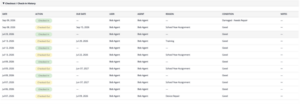
The core of this update is a new, highly granular filtering system. IT asset managers can now sort and search through checkout details based on a wide array of criteria, including the checkout date, the specific individual the asset is assigned to, the current status of the asset, its physical condition, and the expected return date. This level of detail is critical for maintaining an accurate inventory and ensuring that assets are not lost or forgotten in the field.
To further tighten the loop on asset recovery, SolarWinds has introduced a checkout history table and a customizable notification system. These notifications are designed to be proactive rather than reactive. Admins can define exactly when a user should receive a reminder that an asset is due for return. If an asset becomes overdue, the system can be configured to send recurring messages at specified intervals.
In a move to increase organizational accountability, these notifications can also be configured to include the user’s manager. For the IT team itself, the system now supports scheduled summary emails—delivered daily, weekly, or monthly—that highlight which assets are coming due and which are currently overdue. This automated oversight allows IT departments to manage by exception, focusing their energy on high-risk assets rather than manually auditing the entire inventory.
Build Index Views Around the Work That Matters Most
Information overload is a common challenge for service desk agents who must navigate dozens of tickets and records every day. To combat this, SolarWinds has introduced more flexibility in how index views are constructed, a feature now in General Availability for all plan types.
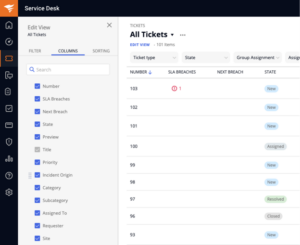
In the past, certain default columns were fixed in the user interface, often taking up valuable screen real estate with information that might not be relevant to every team’s specific workflow. With this update, users can now uncheck these previously mandatory fields. This "decluttering" of the index view allows more room for custom fields and system data that are vital to a team’s day-to-day operations.
The breadth of this update is extensive, applying to almost every major module within the Service Desk. This includes Incidents, Problems, Changes, and Releases, as well as the Service Catalog, CMDB, and various asset categories such as Computers, Printers, and Mobile Devices. It even extends to administrative areas like Contracts, Purchase Orders, and Vendor management.
Crucially, the primary field used to open a record remains fixed to ensure navigation remains intuitive, but all other columns are now at the user’s discretion. SolarWinds has also ensured that this update does not disrupt existing workflows; saved views will remain unchanged unless a user explicitly chooses to modify them. This allows teams to transition to the more streamlined interface at their own pace.
Continuous Improvement and Future Outlook
While the headline features of the September release focus on integration and customization, SolarWinds emphasized that this update also includes a variety of smaller, deliberate refinements. These incremental changes are aimed at smoothing out the "friction points" of daily use, ensuring that the platform remains responsive to the practical needs of IT professionals.
To help customers navigate these changes, SolarWinds has released comprehensive documentation and is hosting an upcoming webinar where product experts will provide deeper insights into the current updates and the future roadmap for the Service Desk. For organizations not yet using the platform, the company continues to offer a 30-day free trial of its Premier plan, allowing prospective users to test the new Microsoft Teams integration and advanced process foundations in a live environment.
As the "State of ITSM" continues to move toward more automated and collaborative models, these updates suggest that SolarWinds is committed to a strategy of openness and flexibility. By empowering admins to customize their views and build more intelligent connections between their tools, the Service Desk is evolving from a simple ticketing system into a sophisticated engine for enterprise-wide service delivery.
 Helpdesk & IT Service Management (ITSM)
Decoding SAP HANA Architecture: How In-Memory Processing Redefines Enterprise Data Management
In the rapidly evolving landscape of enterprise technology, the ability to process...
 Helpdesk & IT Service Management (ITSM)
Former Sophos Chief Security Officer Simon Reed Joins Overe to Strengthen MSP Cybersecurity Strategy
The cybersecurity landscape for managed service providers (MSPs) and small-to-medium enterprises (SMEs)...
 Helpdesk & IT Service Management (ITSM)
Asus Expands Snapdragon-Powered Lineup with Affordable Zenbook 14 for the Modern Professional
Asus has officially expanded its ultra-portable laptop portfolio with the introduction of...







