

Intel is not alone in this pursuit. The roster of companies building out full-stack capabilities includes industry titans and specialized pioneers alike, such as IBM, D-Wave, Rigetti, and IonQ. Among these, Quantinuum has emerged as a major force, particularly following its 2021 formation through the merger of Honeywell’s Quantum Solutions and the software-focused Cambridge Quantum Computing. By combining world-class trapped-ion hardware with advanced software applications like InQuanto and Quantum Origin, Quantinuum has positioned itself as a primary architect of the full-stack era.
The focus on software and developer tools is a critical indicator of the field’s maturity. Josh Savory, Senior Director of Offering Management for Quantinuum, emphasizes that the industry is becoming increasingly preoccupied with what it takes to make quantum computing genuinely useful for end-users. While qubit counts remain a common benchmark for progress, Savory argues that customers ultimately prioritize accurate results delivered at the speeds required by their specific applications. Achieving this requires a delicate balance of high-accuracy hardware, scalable error correction, and deep integration with classical computing workflows.
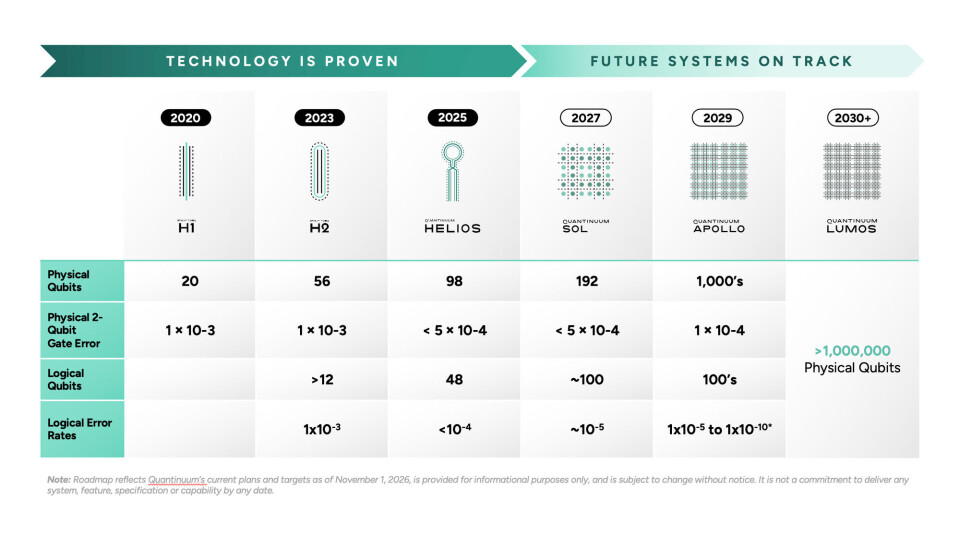
Quantinuum’s strategy revolves around the close co-design of hardware, error correction protocols, and compilers alongside developer tools. This integrated approach allows developers to capitalize on hardware improvements almost as soon as they are implemented. To provide a clear path forward for its partners, Quantinuum recently unveiled an updated roadmap for its Nexus platform, outlining a progression of capabilities leading up to "Apollo," the company’s first scheduled fault-tolerant system, expected in 2029.
The technical foundation for this roadmap was bolstered last year with the launch of "Helios," Quantinuum’s third-generation trapped-ion system. Featuring 98 qubits, Helios recently achieved a remarkable fidelity milestone, reaching 99.9995 percent accuracy. This level of precision—representing only five errors in a million operations—is a crucial threshold that company executives believe puts them within the necessary target range for the upcoming Apollo system. The Nexus platform currently utilizes these hardware capabilities to offer customized error suppression, prebuilt logical qubits, and specialized tools for quantum chemistry.
Looking ahead, the roadmap points toward the "Sol" system, scheduled for next year, which will further expand the capabilities of the Nexus platform. These advancements are designed to ensure that the work developers do today remains relevant as the hardware evolves. A key component of this effort is Guppy FT, a fault-tolerant programming framework that extends the Python-based Guppy language. By providing an open-source library of reusable building blocks and algorithmic primitives, Quantinuum allows developers to focus on the logic of their algorithms while specialists handle the complexities of protecting those algorithms from noise and errors.
 Enterprise Tech & Infrastructure
CoreWeave Leverages GPU Scarcity to Drive Record Revenues Despite Mounting Debt Service Costs
CoreWeave, the specialized cloud provider that has effectively crowned itself the king...
 Enterprise Tech & Infrastructure
Advanced Photonics Coalition Sets New Standards to Scale Optical Networking for the AI Era
The global infrastructure supporting the rapid expansion of artificial intelligence reached a...
 Enterprise Tech & Infrastructure
Optimizing the Modern Data Center: Essential Strategies for Implementing Software-Defined Storage
The modern enterprise landscape is defined by an insatiable appetite for data,...







